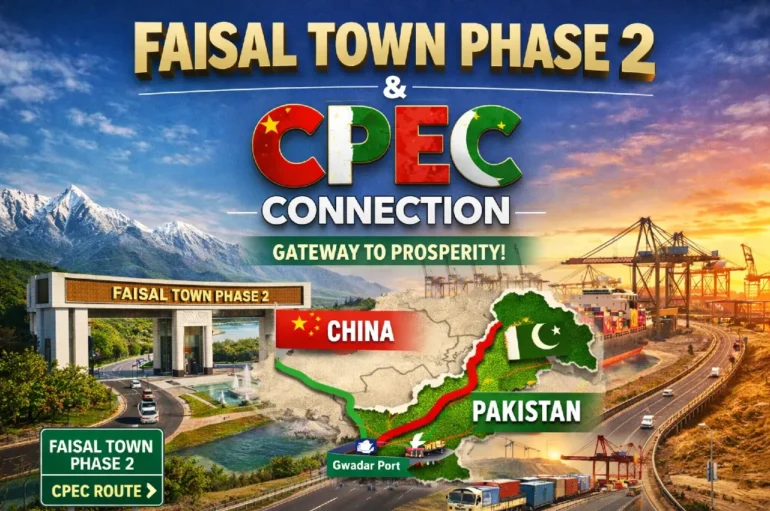
The Corridor That’s Changing Everything
When Pakistan joined China’s Belt and Road Initiative, most of the headlines focused on ports, pipelines, and power plants. But far from the front pages, a quieter transformation was underway — one that is fundamentally reshaping the real estate landscape along one of Pakistan’s most strategically vital routes: the Islamabad–Lahore Motorway (M-2) corridor.
The China-Pakistan Economic Corridor (CPEC) has triggered a wave of infrastructure development, industrial activity, and population movement that has sent property values climbing across dozens of towns and districts along this 375-kilometer stretch. From the outskirts of Islamabad to the outer rings of Lahore, a new real estate belt is quietly emerging — and those who recognized it early are already sitting on significant gains.
This article unpacks the mechanics of how CPEC is driving property appreciation along the motorway corridor, why Islamabad’s surrounding areas are among the biggest beneficiaries, and how projects like Faisal Town Phase 2 are positioning themselves at the very heart of this transformation.
Understanding CPEC’s Real Estate Effect
CPEC is not simply a road or pipeline project. It is a multi-decade, multi-billion-dollar economic restructuring of Pakistan’s geography. With over $62 billion committed across energy, infrastructure, and industrial zones, the corridor is rerouting trade flows, creating employment hubs, and — most importantly for property investors — generating demand for housing, commercial space, and logistics land at an unprecedented scale.
The Islamabad–Lahore Motorway corridor sits at the northern anchor of CPEC’s Eastern Alignment, the route linking Khunjerab in the north all the way down through Punjab toward Karachi. This positioning alone makes it one of the highest-value corridors for real estate in all of Pakistan.
Key CPEC-linked demand drivers include:
- Special Economic Zones (SEZs) near Islamabad and Rawalpindi are attracting industrial tenants, creating housing demand for workers, engineers, and management personnel.
- New expressways and interchanges are connecting previously inaccessible areas to the motorway, dramatically reducing commute times and unlocking land value overnight.
- Logistics and warehousing demand is pushing commercial real estate development along the corridor’s key nodes, as supply chains reorganize around CPEC infrastructure.
- International project workers — Chinese engineers, consultants, and their families — are creating short-to-medium-term rental demand in well-connected urban areas near Islamabad.
- Government infrastructure spending on roads, utilities, and digital connectivity is reducing the development cost premium for housing societies along the motorway belt.
📊 Key Stat: Areas within a 10–15 km radius of M-2 interchanges have recorded property appreciation of 35–60% between 2019 and 2024, outpacing many established urban sectors in both Islamabad and Lahore.
Why the Islamabad End of the Corridor Is Especially Hot
Of the two anchor cities, Islamabad’s surrounding belt has seen the more dramatic real estate activity — and there are several interconnected reasons for this.
First, Islamabad has a constrained land supply. The Capital Development Authority (CDA) tightly controls development within the Islamabad Capital Territory, which limits new housing supply inside the city. As a result, demand spills over into adjacent areas — Rawalpindi, Taxila, and above all, the districts immediately south and west of the capital along the M-2 approach.
Second, Islamabad’s expanding middle and upper-middle class — fueled in part by CPEC-linked government jobs, tech sector growth, and returning overseas Pakistanis — is generating strong demand for quality housing in well-planned communities. This demographic wants space, security, and connectivity, but cannot afford the steep premium of established sectors like F-7 or DHA Phase 1. The motorway corridor fills that gap almost perfectly.
Third, Ring Road projects and expressway extensions linking Islamabad’s outer zones to the motorway are making previously distant areas functionally close. A community that was 45 minutes from Islamabad’s Blue Area five years ago may now be 25 minutes away. In real estate terms, that is a transformational change — and the market has begun pricing it in.
🔍 Analyst Insight: Real estate analysts tracking the motorway corridor consistently identify the stretch between the M-2 Islamabad Toll Plaza and the Fateh Jang interchange as a primary zone of value appreciation — driven simultaneously by CPEC spillover and Islamabad’s growing structural housing deficit.
Faisal Town Phase 2: A Strategic Bet on the Corridor
Against this backdrop, Faisal Town Phase 2 has emerged as one of the most closely watched residential projects in the greater Islamabad real estate market. Located along the motorway corridor with direct connectivity to major road arteries, the project is explicitly designed to capture the value being generated by CPEC’s northern infrastructure push.
Faisal Town Phase 2 is developed by Faisal Town (Pvt.) Ltd., a name that carries significant credibility in Pakistani real estate following the success of the original Faisal Town project. The Phase 2 development builds on that legacy while targeting a broader investor and end-user base with a diverse range of plot sizes and a flexible financial structure designed for today’s market conditions.
Location Advantage in the CPEC Context
The project’s location along the Islamabad–Lahore Motorway corridor is its single most powerful value proposition. Buyers and investors benefit from:
- Direct M-2 Motorway access, putting Islamabad’s city center within a short and stress-free drive.
- Proximity to CPEC-linked industrial and commercial zones that are generating sustained employment and economic activity in the region.
- Connectivity to the New Islamabad International Airport, a major infrastructure node that has been independently reshaping property values across its entire catchment area.
- Access to the Rawalpindi Ring Road, which upon completion will further reduce commute times and significantly increase the area’s attractiveness for upper-middle-class housing demand.
- A rapidly developing social infrastructure of schools, hospitals, and commercial centers growing up around the motorway corridor as population density increases.
Project Features
Faisal Town Phase 2 is designed as a fully integrated housing community, not merely a plot scheme. The master plan incorporates residential plots of multiple sizes, dedicated commercial zones, parks and green belts, educational institutions, mosques, and healthcare facilities. Additional features include a modern gated community structure with boundary walls and 24/7 security, underground utilities covering electricity, gas, water, and sewage, and wide grid-planned roads enabling smooth internal and external circulation.
Faisal Town Phase 2 Payment Plan: Making the Corridor Accessible
One of the most strategically important aspects of Faisal Town Phase 2 is how its payment plan structure democratizes access to a market that has been rapidly appreciating. In an environment where corridor property values have climbed sharply, the ability to enter on installments — rather than requiring full upfront payment — is a critical differentiator.
TheFaisal Town Phase 2 payment plan is built around reducing the initial capital commitment while allowing buyers to lock in current prices ahead of further appreciation. The general structure is as follows:
| Plot Size | Total Price | Down Payment | Installment Period |
| 3.5 Marla | PKR 45–55 Lacs | PKR 10–12 Lacs | 24–36 months |
| 5 Marla | PKR 65–80 Lacs | PKR 14–18 Lacs | 24–36 months |
| 7 Marla | PKR 90–110 Lacs | PKR 20–25 Lacs | 36–48 months |
| 10 Marla | PKR 130–160 Lacs | PKR 28–35 Lacs | 36–48 months |
| 1 Kanal | PKR 220–270 Lacs | PKR 45–60 Lacs | 48–60 months |
⚠️ Figures are indicative based on market intelligence at time of writing. Verify current pricing directly with the official Faisal Town sales office or an authorized dealer.
Key Features of the Payment Plan
The Faisal Town Phase 2 payment plan is structured with several buyer-friendly features. Down payments ranging from 20–25% of total plot value keep the entry point accessible for a broad investor and end-user base. Extended installment periods of 24 to 60 months depending on plot size reduce monthly financial pressure significantly. The balloting-based allocation system ensures transparent plot assignment, with buyers receiving a ballot number upon submission of the booking amount. Development charges are clearly disclosed at the time of booking, avoiding the hidden-cost surprises that have historically frustrated buyers in other schemes. For the diaspora market, an overseas Pakistani-friendly buying process provides dedicated support for those looking to invest remotely.
Why the Payment Plan Matters for CPEC Investors
The significance of a well-structured Faisal Town Phase 2 payment plan extends well beyond simple affordability. In the context of CPEC-driven appreciation, entering the market on installments means buyers are effectively locking in today’s prices while paying over time — during which the property’s value is likely to continue appreciating.
For investors, this creates a compelling leverage dynamic. The return on the actual down payment capital deployed can be significantly higher than the headline appreciation rate on the total property value. A buyer who commits PKR 15 lacs as a down payment on a plot that appreciates by 25% over three years is not earning a 25% return on their money — they are earning a return calculated against their actual deployed capital, which in this structure can be substantially higher. It is one of the most powerful features of installment-based real estate investment when the underlying market is trending upward.
The Bigger Picture: Motorway Corridor as a Long-Term Thesis
Property investment is fundamentally a bet on the future use of land. Along the Islamabad–Lahore Motorway corridor, the case for long-term appreciation rests on structural drivers that show no signs of reversing:
- CPEC investment continues to mature, with SEZs along the corridor moving from planning into operational status over the coming decade, bringing sustained employment and economic activity.
- Islamabad’s population continues to grow, with limited expansion capacity within the CDA zone consistently pushing demand outward toward motorway-connected areas.
- Pakistan’s urbanization trend — one of the fastest in South Asia — is generating sustained demand for planned, serviced housing communities that informal settlements simply cannot meet.
- Progressive infrastructure improvements — Ring Road extensions, new motorway interchanges, improved utility networks — are continuously reducing the effective distance between corridor communities and Islamabad’s core employment zones.
- Overseas Pakistani investment in real estate continues to grow, with well-branded, installment-friendly projects like Faisal Town Phase 2 serving as preferred vehicles for diaspora capital seeking stable, appreciating assets back home.
None of these drivers are new phenomena. But CPEC has materially accelerated their combined effect, compressing what might have been a decade of organic growth into a far shorter window of concentrated appreciation.
Risks to Consider
No investment analysis is complete without a sober look at risk. The motorway corridor real estate market, for all its structural appeal, carries genuine risks that every buyer should understand before committing capital.
Regulatory risk is perhaps the most important. Many housing projects on the outskirts of Islamabad have faced issues with NOC approvals, CDA or RDA compliance, and the legal status of land acquisition. Buyers must conduct thorough due diligence on the legal standing of any project — including verifying NOC status with the relevant authority directly — before committing any funds.
Delivery risk is endemic to Pakistan’s housing market. The industry has a well-documented history of delays in possession handover, development works, and utilities installation. Buyers relying on rental income or a specific resale timeline should build in generous buffer assumptions.
Liquidity risk deserves attention as well. While the secondary market for plots in premium housing societies is active during bull markets, it can become illiquid quickly during downturns. Investors should ensure they are not overexposed relative to their near-term liquidity needs.
Currency and inflation risk particularly affects overseas buyers. PKR depreciation and domestic inflation affect the real value of returns when converted back to foreign currencies, and buyers should model multiple currency scenarios before committing.
Conclusion: A Window That Won’t Stay Open Forever
CPEC is not a short-term stimulus. It is a structural reconfiguration of Pakistan’s economic geography — and the Islamabad–Lahore Motorway corridor is one of its primary beneficiaries. For property investors and homebuyers who understand this, the current market moment represents a window of opportunity that history suggests will not remain open indefinitely.
Projects like Faisal Town Phase 2 are well-positioned to ride this wave, combining a strategically sound location on the motorway corridor with an accessible Faisal Town Phase 2 payment plan that allows buyers from a wide range of financial backgrounds to participate in the appreciation story before the next leg of growth closes the gap.
As always in real estate, timing and due diligence are everything. But for those who have been watching the corridor, the signals have been clear for some time — and they are only getting louder.