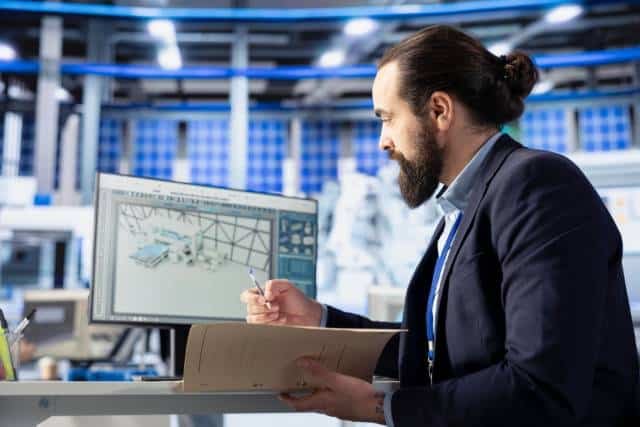
Aerospace Project Analysis
The aerospace industry stands at the forefront of technological evolution, constantly redefining the standards for safety, efficiency, and global competitiveness. As emerging technologies and shifting regulations accelerate change, both established organizations and newcomers alike are seeking cutting-edge methodologies to remain agile and effective. The ability to intelligently analyze and execute projects has never been more crucial. As a result, professionals in the field are increasingly turning to well-developed educational programs such as this comprehensive aerospace online course to stay up to date on industry advancements, best practices, and future-focused trends. Embracing a wave of disruptive innovation, the sector is witnessing significant shifts in how aerospace projects are designed, tested, and brought to fruition. Breakthroughs in agile project management, advanced simulation tools, additive manufacturing, artificial intelligence, the use of digital twins, and sustainability-focused design are collectively redefining industry benchmarks. This expanded exploration provides in-depth insights for engineers, project leaders, and stakeholders passionate about the next chapter of aerospace project analysis and innovation.
Agile Methodologies in Aerospace Design
Agile methodologies have revolutionized aerospace design by enabling teams to adapt to constant change and deliver functional results with greater flexibility and efficiency. This approach involves segmenting work into short, focused sprints, allowing engineering groups to conduct frequent reviews and align designs with evolving requirements and stakeholder feedback. The incremental development of projects promotes steady progress and meaningful critique, while cross-functional collaboration facilitates creative problem-solving and minimizes the risk of oversight. Continuous input from every cycle enables timely course corrections, saving time and resources. Agile practices also shape the culture of aerospace organizations, fostering transparency, adaptability, and shared ownership of outcomes, which in turn promote innovation and meeting deadlines.
Advanced Simulation Techniques
Simulation tools are essential for efficient analysis and design validation in aerospace projects. They enable engineers to simulate real-world scenarios with accuracy, eliminating the need for costly physical prototyping. Modern software accounts for various variables, creating detailed virtual prototypes that accurately predict real-world performance. Simulation also improves time efficiency by allowing rapid digital experimentation without material waste. It encourages design exploration by enabling designers to quickly evaluate alternative shapes, materials, or control structures. Collaborative simulation environments allow multidisciplinary teams to share results and integrate feedback across various fields, thereby reducing miscommunications and ensuring designs meet aerospace reliability and safety standards.
To fully validate system-level performance, teams should also model electrical interconnect behavior — including contact resistance and localized heating — since these factors can govern reliability in tight assemblies. Certain contact geometries exhibit lower resistance and improved heat dissipation under high loads, which simulation parameterization must capture to avoid conservative overdesign or unexpected field failures. For practical guidance on how contact design affects current capacity and thermal performance, engineers can review resources on connectors for military and aerospace applications that detail hyperboloid contact characteristics and testing approaches. Feeding such empirical data into virtual prototypes yields more accurate lifetime and performance predictions, supporting lighter, more resilient designs.
While advanced simulations offer significant predictive power, the ultimate validation of critical components often necessitates rigorous physical testing. For aerospace parts, particularly those within high-speed rotating machinery, understanding material behavior under repeated stress is paramount to preventing premature failure. This is where a specialized low cycle fatigue test becomes indispensable, providing crucial empirical data on a component’s durability and lifespan under cyclic loads. Such testing helps engineers assess how materials respond to the specific operational stresses they will encounter, ensuring designs meet the stringent reliability and safety standards required for aerospace applications. By integrating these real-world test results, designers can refine their virtual prototypes and make more informed decisions, leading to more robust and resilient designs.
Additive Manufacturing Integration
Additive manufacturing (AM), also known as 3D printing, has revolutionized aerospace engineering by enabling the creation of more complex, lightweight, and robust structures. This process eliminates historic constraints associated with subtractive manufacturing, allowing for design freedom, material efficiency, and rapid prototyping. It unlocks previously unachievable geometries, saves expensive aerospace-grade materials, and accelerates the transition from concept to physical prototype. Pioneers like Relativity Space are integrating metal AM with artificial intelligence and robotics to manufacture rocket engines and structural components at unprecedented speeds. This process reduces part counts, streamlines supply chains, and inspires new paradigms for aerospace innovation.
To ensure that these advanced components meet strict aerospace standards, careful measurement and inspection using tools such as Micrometers, calipers, and other precision instruments are essential throughout the production process. Engineers verify dimensions, tolerances, and critical features to maintain consistency between digital designs and physical parts. This meticulous attention to detail helps identify deviations early, reducing the risk of costly errors or rework. By integrating precise evaluation into additive manufacturing workflows, aerospace teams can deliver highly reliable, performance-ready components. Combining innovative 3D printing techniques with rigorous quality control allows engineers to push the limits of design while maintaining the highest standards of accuracy and safety.
Beyond these immediate checks, comprehensive quality assurance in aerospace manufacturing extends to stringent process controls and certifications. For instance, ensuring aerospace fastener quality control involves adherence to industry benchmarks like AS9100 and ITAR compliance, which dictate everything from supplier selection to final product delivery. This includes meticulous material documentation, providing a complete chain of custody for every component. Such rigorous oversight throughout the manufacturing process is crucial, distinguishing top-tier suppliers and guaranteeing the integrity and performance of every fastener in critical aerospace applications.
Artificial Intelligence Integration
Artificial intelligence (AI) is revolutionizing aerospace project analysis and innovation by utilizing vast datasets. AI models uncover subtle patterns and offer optimization suggestions, enhancing efficiency and reliability. AI-powered CAD software enables engineers to generate and evaluate potential solutions, leading to smarter, safer, and lighter aerospace products. It reduces development time and improves AI’s recommendations. As these tools mature, their role in problem-solving and driving disruptive innovation will expand, redefining the possibilities of aerospace engineering.
Digital Twins and Immersive Technologies
Digital twins, high-fidelity virtual models that mirror actual aircraft, systems, or assemblies, are becoming a popular practice in aerospace project analysis. These models are updated in real-time with data from the physical asset, allowing engineers to simulate in-service performance, anticipate failures, and optimize design choices before parts reach the assembly floor. They enable early issue identification, design optimization, predictive maintenance, and proactive scheduling of maintenance. Immersive technologies, such as virtual reality and augmented reality, are also enhancing the aerospace development process, enabling teams to review full-scale digital models and overlay schematics in real-world environments. These technologies minimize errors, accelerate program delivery, and are essential tools in aerospace innovation pipelines.
Sustainable Design Practices
The aerospace industry is increasingly adopting sustainable design as a directive due to climate concerns. Organizations are investing in new materials, propulsion systems, and environmentally conscious processes to reduce environmental impact throughout the aircraft or spacecraft lifecycle. Engineers are advancing lightweight materials and developing more refined aerodynamic profiles to minimize fuel consumption and emissions. Electric and hybrid-electric propulsion systems are being developed to reduce reliance on fossil fuels. Advanced composites, recycled alloys, and renewable bio-based materials are being used for sustainable manufacturing. Digital process optimization and lifecycle assessments ensure systemic and measurable environmental benefits. These environmentally focused strategies are essential for future-proofing the aerospace industry and meeting the urgent sustainability needs of society and the planet. Enrolling in an aerospace online course can deepen expertise in these practices and help stay updated on industry advancements.