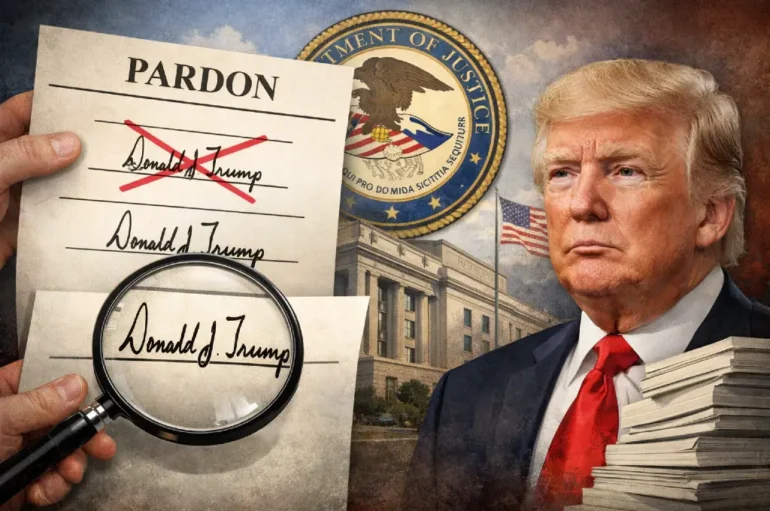
If you’ve seen headlines about the Justice Department Replaced Identical Trump Signatures on Recent Pardons, you’re probably asking the obvious question: what exactly happened, and does it matter legally?
Here’s the plain-English version. In November 2025, several pardon documents posted on the Justice Department’s website appeared to carry the exact same Donald Trump signature. That raised eyebrows fast, because handwriting experts say truly handwritten signatures do not match perfectly across separate documents. After the similarity drew online attention, the Justice Department replaced the posted versions with new copies showing different signatures and said the originals were the result of a “technical error” tied to staffing disruptions during a government shutdown. Legal experts, meanwhile, said the bigger issue is presidential intent, not whether the visible signature on a posted PDF was handwritten, scanned, or mechanically reproduced.
That’s the core story. But the real reason this became such a big deal is the politics, the optics, and the law all collided at once.
What happened with the pardon signatures?
The controversy centered on several pardons dated November 7, 2025, including clemency for Darryl Strawberry, Glen Casada, and Michael McMahon. According to Associated Press reporting, the versions first posted online showed identical Trump signatures on multiple documents. After online scrutiny, the Justice Department swapped in updated copies with different-looking signatures. The administration said Trump had in fact signed all of the pardons himself and blamed the duplicate-looking versions on a technical posting problem.
That sequence matters because it created two separate questions:
- Were the online documents posted incorrectly?
- Or were the pardons themselves executed using a copied or automated signature?
Those are not the same thing. And a lot of the public confusion came from treating them as if they were.
Why the Justice Department replaced the identical signatures
The short answer is simple: the duplicate-looking signatures created an authenticity problem in the public record.
According to AP’s reporting, the Justice Department said the copies were replaced because of a “technical error” associated with staffing disruptions during a government shutdown. In other words, the department’s explanation was not that the pardons were invalid, but that the online versions did not accurately reflect the signed documents.
That gives us the most likely explanation for why the Justice Department replaced identical Trump signatures on recent pardons:
1. To correct the public-facing record
When official clemency records appear online with pixel-for-pixel identical signatures, the first assumption many readers make is that the documents were mass-produced or mechanically stamped. Replacing them with different versions was an attempt to align the public record with the administration’s claim that Trump personally signed the pardons.
2. To contain a credibility problem
This story hit a political nerve because Trump had sharply criticized Joe Biden’s use of an autopen on official documents. That meant identical Trump signatures on pardons were always going to get extra scrutiny. Replacing the files was likely as much about restoring credibility as fixing a document workflow issue.
3. To avoid deeper confusion about pardon validity
Once a clemency document looks questionable, people start asking whether the pardon itself is void. Legal experts say that is usually the wrong first question. Still, agencies often move quickly to clean up records when document integrity becomes part of the story.
Why identical signatures drew immediate scrutiny
This part is easy to understand even without a law degree.
Two forensic document experts told the AP that the signatures on several of the originally posted pardons were identical. That is significant because natural handwriting varies every time. One expert cited by AP, Tom Vastrick of the American Society of Questioned Document Examiners, said a basic principle of handwriting analysis is that no two signatures will share the exact same design features in every respect.
So the issue was not that Trump’s signature looked similar from document to document. That’s normal. The issue was that the initial versions appeared exactly the same.
Here’s a simple breakdown:
| Question | Why it mattered |
|---|---|
| Were the signatures visually identical? | If yes, that strongly suggests digital duplication rather than natural handwriting. |
| Did DOJ replace the files quickly? | Yes, which signaled the department recognized the optics problem. |
| Did DOJ say the pardons were invalid? | No. DOJ described the issue as a technical error in the posted documents. |
| Do experts say identical signatures prove the pardons are void? | No. Legal validity turns more on presidential intent than signature appearance alone. |
The bigger political problem: Trump’s autopen criticism
This story would have been smaller under almost any other president.
But Trump had repeatedly attacked Biden over autopen use and claimed some Biden actions were illegitimate because they were signed that way. That criticism is a big reason the duplicate-signature issue exploded. It made the administration look vulnerable to the same kind of argument it had used against its political opponents.
That doesn’t automatically prove hypocrisy in a legal sense. But politically, it was damaging because the contrast was so obvious:
- Trump camp criticized autopen use.
- Trump pardon PDFs appeared with identical signatures.
- DOJ then replaced the documents after people noticed.
That sequence practically guaranteed a backlash.
Are pardons invalid if the signature was copied, scanned, or autopen-generated?
This is the question most readers really care about.
The answer, based on the strongest legal sources available, is probably no. A presidential pardon generally turns on the president’s decision and intent, not on whether a specific handwritten flourish appears on a PDF posted online.
There are three key legal points here.
1. The Constitution gives the president broad clemency power
Congress’s Constitution Annotated explains that the president’s pardon power under Article II is broad, with only limited textual constraints. The Constitution does not spell out a handwritten-signature requirement for clemency.
2. DOJ has recognized autopen-style signing in other presidential contexts
In a Justice Department Office of Legal Counsel opinion, DOJ concluded that the president may sign a bill by directing a subordinate to affix the president’s signature, including via autopen. That opinion dealt with legislation, not pardons specifically, but it matters because it shows federal executive-branch lawyers do not treat physical pen-to-paper signing as the only legally meaningful form of presidential execution.
3. A federal appeals court said a writing is not necessarily required
In Rosemond v. Hudgins in 2024, the U.S. Court of Appeals for the Fourth Circuit said the absence of a written clemency warrant does not by itself prove that clemency did not occur. The court explained that a writing is not a necessary constitutional requirement for the president’s exercise of clemency power.
That doesn’t mean process never matters. It does. But it means the legal standard is not as simple as “identical signature equals invalid pardon.”
What the Justice Department’s clemency process tells us
The DOJ’s Office of the Pardon Attorney exists to assist the president in the exercise of executive clemency. Justice Department materials and regulations show a formal administrative process around clemency petitions and grants, but that process supports the president’s constitutional power rather than replacing it.
That distinction helps explain why this controversy is more about record integrity and transparency than automatic legal nullity.
A flawed posting process can still be a real problem because it affects:
- public trust,
- historical recordkeeping,
- political accountability,
- and confidence in how sensitive documents are handled.
So even if the pardons remain legally sound, the document swap still matters.
Why this story resonated beyond the paperwork
The reason people kept sharing this story is that it touches three anxieties at once.
Document authenticity
People expect a pardon document to be one of the most carefully handled pieces of paperwork the government produces. When multiple signatures look cloned, trust drops immediately.
Transparency
The Justice Department replaced the files only after outside observers noticed the issue. That invited the criticism that the correction was reactive, not proactive.
Double standards
When one administration attacks a rival for mechanized signatures and then faces its own signature controversy, the public naturally sees a double-standard story, whether or not the legal facts line up perfectly.
FAQ: Justice Department Replaced Identical Trump Signatures on Recent Pardons
Did the Justice Department admit the pardons were fake?
No. The department described the issue as a technical error affecting the posted documents and maintained that Trump personally signed the November 7, 2025 pardons.
Which pardon recipients were tied to the controversy?
Reporting identified pardons for Darryl Strawberry, Glen Casada, and Michael McMahon among the documents that initially showed identical signatures.
Do identical signatures prove autopen use?
They strongly suggest some kind of duplication in the visible document image, but they do not by themselves prove the underlying clemency decision was unauthorized. That legal question turns on intent and authorization.
Can a president legally use an autopen?
DOJ’s Office of Legal Counsel has said a president may direct a subordinate to affix the president’s signature to a bill, including by autopen. Legal commentators and court reasoning cited in recent coverage indicate that presidential clemency validity likewise hinges mainly on the president’s decision, not the physical mechanics of signing.
Does a pardon need a handwritten signature to be valid?
Available legal authority suggests no. The Constitution does not expressly require a handwritten signature for a pardon, and the Fourth Circuit has said a writing is not a necessary constitutional requirement for clemency.
Key takeaways for readers and publishers
If you’re summarizing this topic for an audience, these are the most defensible conclusions:
- The Justice Department replaced online pardon documents after observers noticed identical Trump signatures.
- DOJ said the issue was a technical error tied to staffing disruptions during a government shutdown.
- Forensic experts said truly handwritten signatures do not appear identically across separate documents.
- Legal experts say the validity of a pardon turns primarily on presidential intent, not the visible signature style on a posted PDF.
- The controversy became much bigger because Trump had criticized Biden’s autopen use.
Final thoughts
The best way to understand why the Justice Department Replaced Identical Trump Signatures on Recent Pardons is to separate the paperwork issue from the legal issue.
The paperwork issue is straightforward: multiple pardon documents appeared online with identical signatures, that looked suspicious, and DOJ replaced them after the discrepancy became public. The legal issue is narrower and less dramatic than social media made it seem. Based on the Constitution, DOJ guidance, and the Fourth Circuit’s reasoning in Rosemond v. Hudgins, a pardon’s validity depends far more on whether the president actually authorized the clemency than on whether the copy posted online showed a wet signature, an autopen-style signature, or a duplicated image.
So yes, the optics were bad. Yes, the replacement raised legitimate transparency questions. But no, the available evidence does not show that the pardons became invalid just because the Justice Department replaced identical Trump signatures on recent pardons. What it does show is how fragile public trust becomes when official documents look inconsistent, especially in a political environment where signature authenticity has already become a partisan weapon.