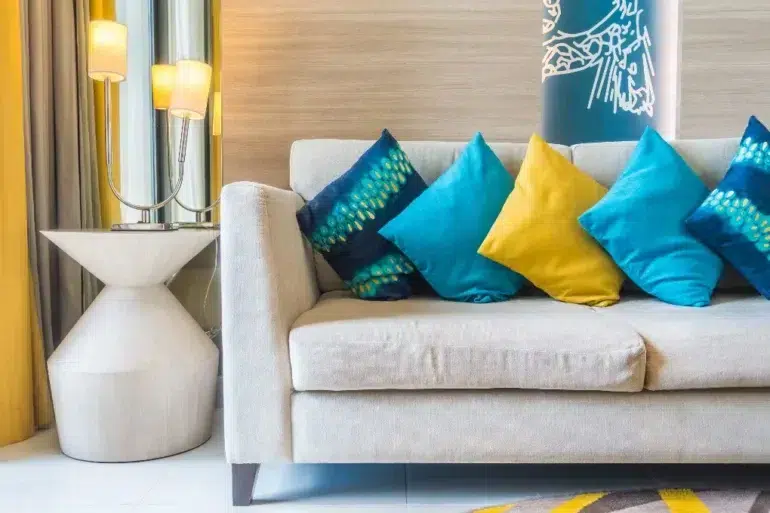
The fabric on a sofa, a chair, or a set of curtains is not a detail. It is one of the most consistently present surfaces in a home, one that every person in the household touches, looks at, and lives alongside every day. The choice between a natural fibre and a synthetic one is therefore not a question of aesthetics alone. It is a decision about how a room feels over time, how it performs under regular use, and what it asks of the people who maintain it. Understanding why natural fibres perform differently in domestic settings is useful for anyone making choices about the materials in their home.
How Fabric Choice Shapes the Room Over Time
The most immediate benefit of choosing natural fabric for upholstery is the way it responds to use. Linen, for instance, softens gradually with every wash and every season of contact, developing a texture that synthetic weaves do not replicate and cannot approximate. A sofa covered in linen after three years of household use looks more settled than it did when new, rather than more worn. This is the property that makes fabric choice so important in a domestic context. Choosing made-to-measure IKEA slipcovers is one practical expression of this principle: the removable cover can be washed regularly and will improve with each wash, while the underlying frame and cushion structure continue to perform exactly as they did when first purchased.
Natural Fabric as the Practical Choice for Households
Cotton shares many of linen’s properties in a domestic setting. It breathes, it washes cleanly, and its surface does not trap the kinds of particles that accumulate in synthetic fabrics over time. For households with children, pets, or allergy sufferers, the distinction matters considerably more than it might at the point of purchase. A natural fibre cover can be removed and laundered at a temperature that genuinely sanitises the fabric. A fixed synthetic cover can be cleaned at the surface but not through it, and the difference, over months and years, is significant. Dust, allergens, and fine particles settle into synthetic weaves in ways that surface cleaning does not address. Natural fabric is not simply a preference; in many domestic situations, it is the more practical and healthier choice.
Why Synthetic Upholstery Works Against the Home
The environmental argument for natural fibres in the home is also increasingly difficult to ignore. Synthetic upholstery fabrics are petroleum derivatives; they do not biodegrade, and they shed microplastic particles with every wash and every contact. These microplastics accumulate in the home environment, in wastewater, and in the broader ecosystem. Natural fibres, by contrast, are biodegradable and do not shed microplastics. This does not mean that every natural fabric is made without environmental cost, but it does mean that the fundamental structure of the material is compatible with the natural world in a way that synthetic fibres are not.
What the Research Says About Natural Fibres at Home
The preference for natural fibres in domestic settings is not simply anecdotal. According to Cotton Incorporated’s Lifestyle Monitor on natural fibres in the home, the majority of consumers strongly prefer cotton and other natural fibres for their home textiles, with comfort, quality, and the way the material feels over time cited consistently as the primary reasons. The research highlights that people are also becoming more attentive to fibre content in their home textile choices, not just for feel but for health and environmental reasons. When people live with fabric on a daily basis, its properties become tangible in a way they do not when the same material is encountered in a shop. A sofa cover, a bed, a set of curtains: these are materials experienced at close range, every day, and the difference between natural and synthetic registers in the body before it registers in the mind.
The Case for a Cover That Fits the Sofa Precisely
The question of fit also plays an important role in how a sofa cover performs and how long it stays in use. A cover that fits the sofa precisely does not shift, bunch, or require constant readjustment. It sits where it is meant to sit, looks how it is meant to look, and is more comfortable to use because it does not impose itself on the person sitting on the furniture. This is the practical argument for a cover that is made to the measurements of the specific sofa rather than a generic size. The difference between a well-fitted cover and one that does not quite correspond to the sofa beneath it is visible within weeks, and the well-fitted one simply remains in use longer because it continues to function as intended.
Friction in the Home and How Materials Create It
There is a wider point here about the relationship between domestic comfort and the quality of the materials a home contains. A room in which the upholstery is natural, well-fitted, and washable is a room that requires less management than one where the materials work against the people living in it. The sofa that cannot be cleaned properly, the cover that shifts out of position, the fabric that looks and feels different from how it was described: each of these represents a form of low-level friction in daily domestic life. This kind of friction is easy to overlook when it is new and relatively minor, but it accumulates over time and eventually shapes how a person feels about the room itself. Removing that friction by making better initial choices about material and fit is one of the more reliable ways to improve how a home feels to live in day after day.
What Linen Brings to a Room That Synthetic Fabric Cannot
Linen in particular has properties that make it especially well-suited to living rooms and areas of the home that receive sustained use. Its natural structure allows it to regulate temperature in a way that synthetic alternatives do not: it stays cooler in warm weather and retains warmth in cooler months. It resists odours more effectively than synthetic fabrics because of its natural composition. And its appearance, even when slightly rumpled from regular use, has a quality that is broadly understood as lived-in rather than neglected. These are not incidental features. They are properties that linen brings to any surface it covers, and that justify its place in a considered home.
Furniture That Stays in Use Longer
The case for natural fabric in the home is also a case for thinking about furniture differently. A sofa that has a removable, washable, natural cover is a sofa that can be maintained and refreshed over many years. The frame and the internal structure of a well-made sofa will last for a decade or longer; what typically wears first is the cover. If that cover can be replaced without replacing the sofa, the economics change significantly. The environmental calculation changes too, since a reupholstered sofa represents a fraction of the material and energy cost of a new one. The choice of a removable natural cover is therefore not just a choice about comfort or aesthetics; it is a choice about how long a piece of furniture remains in use and how much value it delivers over its lifetime.
Natural Fabric as the Baseline for a Home That Works
A home is not improved by the accumulation of things, but by the quality and appropriateness of the things it contains. Natural fabric, in the context of upholstery, is appropriate in a way that synthetic fabric is not, for reasons that are practical, environmental, and sensory. The sofa that is covered in linen and can be washed when needed is a sofa that belongs in the home for a long time. The cover that fits correctly, feels good to the touch, and ages in a way that adds rather than detracts from the room’s character is a cover worth having. These are not premium considerations. They are the baseline for a home that functions well over time.