Last updated: 26 June 2026 · Status: Seedance 2.5 is a preview / pre-launch model
ByteDance previewed Seedance 2.5 on 23 June 2026 at its Volcano Engine FORCE conference, just months after Seedance 2.0 became the model to beat — Seedance 2.0 tops the Artificial Analysis arenas with an ELO of 1,344 for image-to-video and led blind-preference testing ahead of Kling 3.0, Veo 3 and Runway Gen-4.5. So the real question in any Seedance 2.5 vs Seedance 2.0 comparison isn’t “which is better on paper” — it’s “what genuinely changed, and is it worth waiting to upgrade?” If you’re deciding which video model to wire into a production pipeline, you can also route it alongside text models through a gateway like OrcaRouter, which serves Seedance 2.5 behind one endpoint.
Quick take: Seedance 2.5 doubles clip length (30s), quadruples reference inputs (up to 50), and adds region-level editing, 3D camera staging and native 4K. But 2.0 is the proven, independently benchmarked baseline and ships today; 2.5’s numbers are vendor preview claims. Upgrade for length and consistency — once it’s public and verified.
⚠️ Accuracy note: Seedance 2.0 has been generally available since early 2026 and is independently benchmarked. Seedance 2.5 was previewed 23 June 2026 with a public launch expected early July 2026; its headline specs are vendor claims, not yet third-party tested.
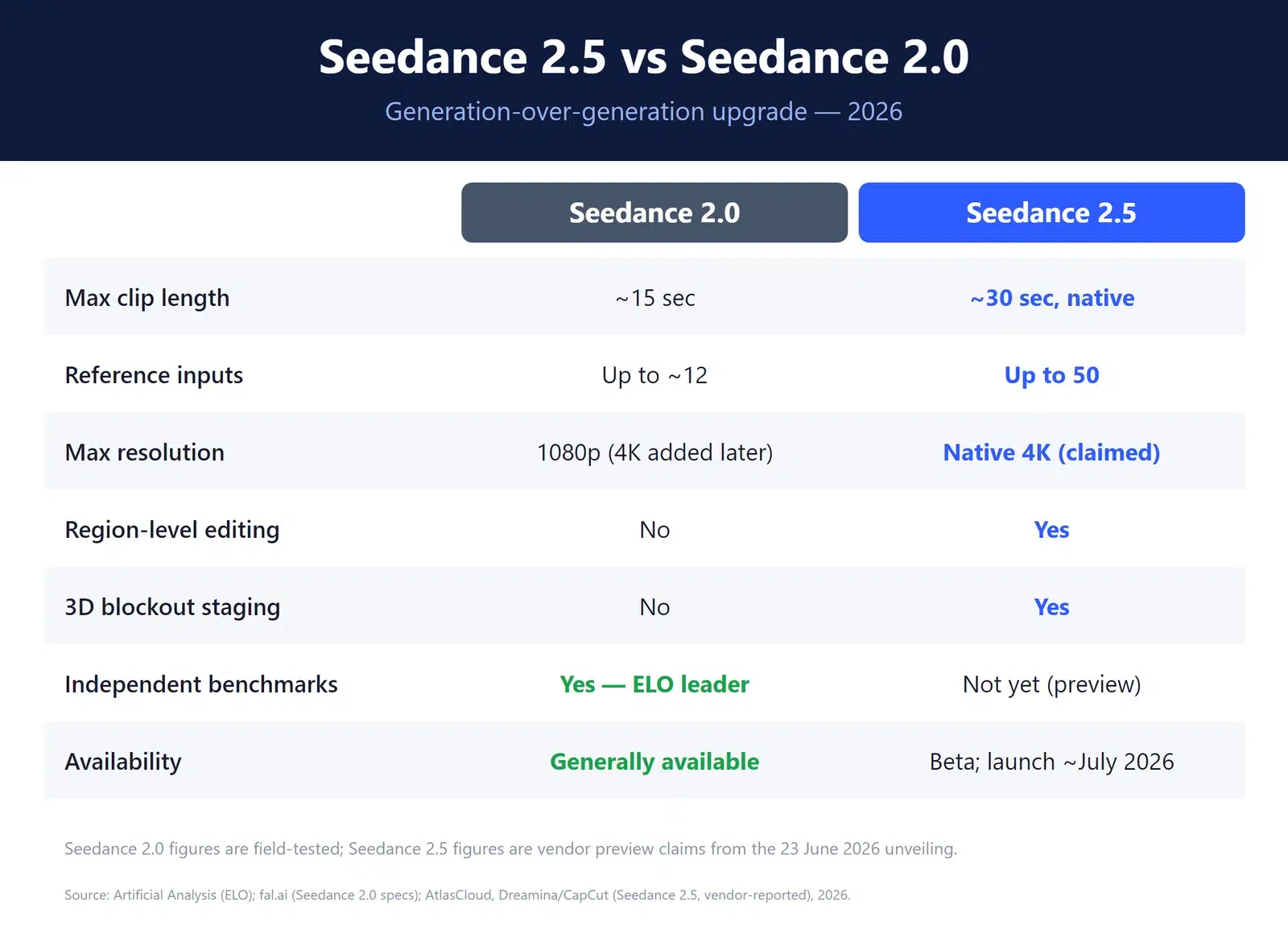
Generation-over-generation upgrade. Seedance 2.0 wins on proof; Seedance 2.5 wins on ambition. Source: Artificial Analysis, fal.ai, AtlasCloud (Seedance 2.5 vendor-reported).
The credible baseline: why Seedance 2.0 matters
Seedance 2.0 isn’t a weak predecessor you’re rushing to escape — it’s the current independent leader. It tops the Artificial Analysis image-to-video arena (ELO ~1,344) and led text-to-video at ELO 1,269 earlier in 2026, generates up to 1080p (with a later native-4K upgrade), runs natively up to ~15 seconds, and accepts up to roughly 12 reference inputs: 9 images, 3 videos and 3 audio clips. That track record matters: every Seedance 2.5 claim inherits a credible lineage, so the upgrades are plausible — but still unproven.
What’s actually new in Seedance 2.5
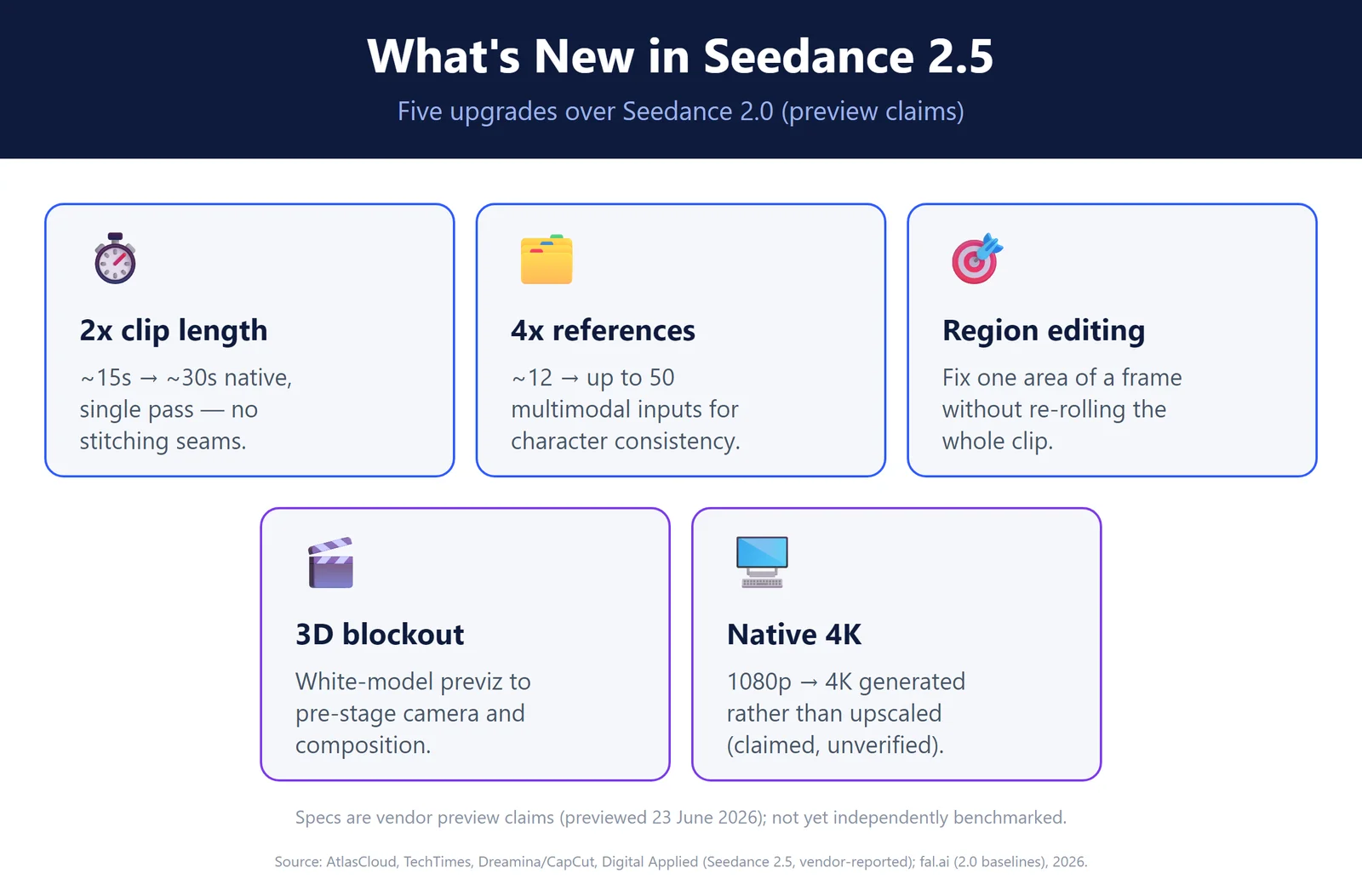
The five upgrades over 2.0. The first three target AI video’s hardest problems; the last two add directorial control. Source: AtlasCloud, TechTimes, Dreamina/CapCut, Digital Applied (Seedance 2.5 vendor-reported).
1. Clip length: ~15s → ~30s, native single pass
The headline change. Seedance 2.5 generates roughly 30-second clips in one native pass, double the ~15 seconds of 2.0 — no stitching multiple shorter shots together. For a full social ad or a continuous narrative beat, that removes the seams and continuity drift you get from chaining clips. It’s the single most consequential upgrade.
2. References: ~12 → up to 50
Seedance 2.0 already supports a strong reference stack. Seedance 2.5 pushes it to up to 50 multimodal references — images, video, audio, 3D models and style cues. For commercial work, this is the feature most likely to matter: it’s purpose-built to keep a product, mascot or actor identical across an entire campaign.
3. Region-level editing (new capability)
Seedance 2.0 supports clip, character, action and storyline edits plus extension. Seedance 2.5 adds region-level editing — change one element or area of a frame without re-rolling the whole generation. Fix a wrong logo or a bad hand without sacrificing the parts that already worked. If it holds up, it’s a real time-and-cost saver.
4. 3D blockout camera staging (new)
Seedance 2.5 introduces a 3D “white-model” pre-visualization input: feed a low-fidelity 3D blockout plus style references, and the model renders it into a stable, detailed sequence. That shifts framing from prompt luck toward deliberate, frame-level staging — something 2.0 doesn’t offer.
5. Native 4K (claimed)
Seedance 2.5 claims native 4K output, generated rather than upscaled. Note that 2.0 was itself upgraded toward native 4K, so the resolution gap may be smaller in practice than the marketing implies. Treat 4K and frame-rate specifics as unconfirmed.
Seedance 2.5 vs Seedance 2.0: the spec gap
| Capability | Seedance 2.0 | Seedance 2.5 (preview) |
|---|---|---|
| Max clip length | ~15 sec | ~30 sec, native |
| Reference inputs | ~12 (9 img / 3 vid / 3 audio) | Up to 50 |
| Resolution | 1080p (native 4K added later) | Native 4K (claimed) |
| Region-level editing | No | Yes |
| 3D blockout staging | No | Yes |
| Independent benchmarks | ✅ ELO leader | ❌ Not yet |
| Availability | Generally available | Beta; launch ~July 2026 |
Seedance 2.0 figures are field-tested; Seedance 2.5 figures are vendor preview claims from the 23 June unveiling.
Is it worth upgrading?
The honest answer depends on what you ship.
Upgrade (when it’s public) if you produce 20–30s ads or product videos, fight constant character/brand drift across shots, or re-render repeatedly to fix small flaws. The 30-second pass, 50-reference system and region editing are aimed squarely at those problems, and no current model matches them.
Stay on Seedance 2.0 for now if you need to ship today, your clips are already ≤15 seconds, or you require independently verified quality for a client deliverable. 2.0 is the proven ELO leader and runs at known pricing — roughly $0.022/sec (Fast) to $0.247/sec (Pro) on fal.ai — while 2.5’s pricing isn’t announced.
The responsible call: plan to adopt Seedance 2.5, but verify before migrating a production pipeline. Run a side-by-side test the moment the public model lands and third-party benchmarks confirm the claims.
Frequently asked questions
What’s the biggest difference between Seedance 2.5 and 2.0? Clip length and references: ~30s vs ~15s native, and up to 50 references vs ~12. Region-level editing and 3D staging are also new.
Is Seedance 2.5 out yet? Not publicly. It was previewed 23 June 2026, with launch expected early July 2026; an enterprise beta is recruiting now.
Is Seedance 2.0 still good? Yes — it’s the current independent ELO leader for image-to-video (~1,344), ahead of Kling 3.0 and Veo 3.
Should I wait for Seedance 2.5 or use 2.0 now? If you need ~30s clips or heavy character consistency, wait. If you’re shipping ≤15s clips today on a verified model, 2.0 is the safe pick.
How much does Seedance cost? Seedance 2.0 runs ~$0.022–$0.247/sec on fal.ai depending on tier; 2.5 pricing is unannounced.