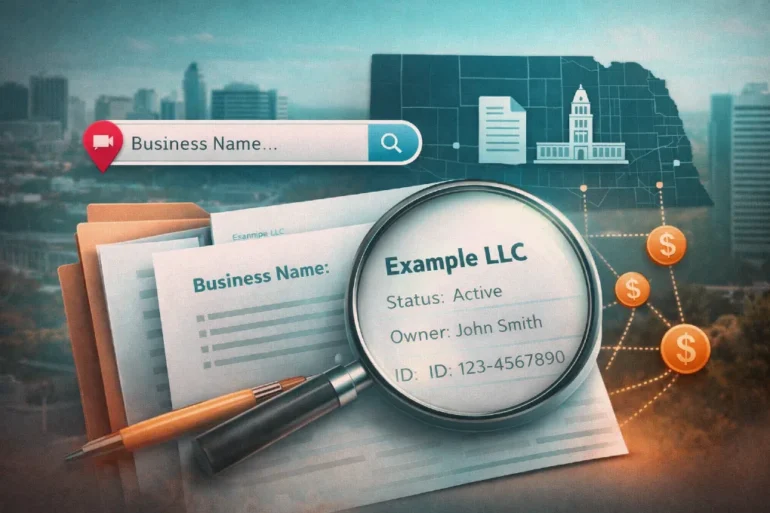
If you are trying to verify a company in Nebraska, check whether a name is already taken, or review the public record before doing business with someone, the Nebraska Business Entity Search is one of the first tools you should use. It is the state’s official lookup system for corporations, LLCs, limited partnerships, trade names, trademarks, and service marks, and it can also lead you to certificates of good standing and filed document copies.
That makes the Nebraska Business Entity Search useful for more than just entrepreneurs. Attorneys, lenders, vendors, investors, job seekers, and even everyday consumers may need to confirm whether a business is actually registered and in good standing. Nebraska’s Secretary of State says the search is free, and the Business Services Division handles registrations for corporations, LLCs, LPs, LLPs, trade names, and trademarks.
The search also matters because registration status is not a minor detail. Nebraska warns that businesses that fail to file required annual or biennial reports can be administratively dissolved or revoked, and once that happens, the entity may no longer be in good standing or able to obtain a certificate of good standing that many lenders require.
So if you want to find ownership and registration details the right way, this article will walk you through what the Nebraska Business Entity Search is, what it can reveal, what it cannot reveal, how to search smarter, and how to use the results before starting a business or signing a contract.
What Is the Nebraska Business Entity Search?
The Nebraska Business Entity Search is the official public lookup tool linked from the Nebraska Secretary of State’s Corporate and Business page. The state describes it as a free search of the corporate and business database for information on all entities, trade names, trademarks, and service marks. From the same area, users can also order certificates of good standing and copies of filed documents.
In practical terms, this means the system helps you answer questions like these:
- Is this Nebraska company registered?
- Is the business name already on record?
- Is the entity active or no longer in good standing?
- Who is the registered agent?
- What type of entity is it?
- When was it filed or registered?
- Can I order official records or proof of good standing?
Those are not small questions. For a new founder, the search helps prevent filing under an unavailable name. For a buyer or vendor, it helps confirm you are dealing with a real entity. For a lender or business partner, it provides a quick public-record checkpoint before moving forward.
Why People Use the Nebraska Business Entity Search
The search intent behind this topic is usually very specific. People are rarely looking up the state database out of curiosity. They normally need a clear answer fast.
Here are the most common reasons people use the Nebraska Business Entity Search:
- To check whether a business name is already taken
- To verify that an LLC or corporation is registered in Nebraska
- To confirm a company’s status before signing a contract
- To find a registered agent or registered office
- To order a certificate of good standing
- To review filed documents
- To confirm whether an entity is active, dissolved, or revoked
Nebraska itself emphasizes the importance of checking names before filing. The Secretary of State warns business owners not to spend money on signage, letterhead, or branding until the company has been formally created and the name issue is settled, because a proposed name may still be rejected when documents are actually filed.
That is why the Nebraska Business Entity Search is such a practical first step. It saves time, money, and filing headaches.
What Information Can You Find in a Nebraska Business Entity Search?
This is where many readers get most interested. They want to know what the search actually shows once they run a company name.
Nebraska’s official pages say the database contains information on entities, trade names, trademarks, and service marks, and that users can order filed-document copies and certificates of good standing from the system. The Secretary of State also notes that registered-agent information and entity names are public records that appear in filings and can be reviewed through the online search system.
Depending on the record and entity type, users typically look for details such as:
| Detail | Why It Matters |
|---|---|
| Exact legal business name | Confirms the official name on file |
| Entity type | Shows whether it is an LLC, corporation, LP, LLP, or another filing type |
| Status | Helps you see whether the company is active, dissolved, revoked, or otherwise not in good standing |
| Filing or registration date | Useful for confirming how long the entity has existed |
| Registered agent | Important for legal notices and service of process |
| Registered office or designated office | Helps confirm where official business communications go |
| Filed documents | Can support due diligence or formation review |
| Certificate of good standing availability | Important for banks, lenders, and many formal transactions |
Nebraska’s own formation guidance confirms that the registered agent and registered office must be listed in formation documents and continuously maintained in the state. The state also says failure to maintain a registered agent or office can lead to administrative dissolution.
That means a public record is not just a formality. It is part of how the state tracks whether a business is properly maintained.
Does the Nebraska Business Entity Search Show Ownership Details?
This is where the topic gets more nuanced. Many users search the Nebraska Business Entity Search because they want “ownership details,” but state business searches do not always show true beneficial ownership in the way people expect.
Nebraska’s Secretary of State specifically points users to the federal beneficial owner report requirement and explains that certain corporations, LLCs, and similar entities created in or registered to do business in the United States must report information about their beneficial owners to the U.S. Treasury’s Financial Crimes Enforcement Network, or FinCEN.
That is an important distinction. The public state search can help you find entity records, registration details, and registered-agent information, but it is not the same thing as a full beneficial-ownership database. In other words, when people use the Nebraska Business Entity Search, they may find official registration clues, but not necessarily the ultimate human owners behind the company in every case.
So if your real goal is ownership verification, treat the state search as a starting point, not always the final answer.
How to Use the Nebraska Business Entity Search Step by Step
The process is fairly straightforward, but it helps to know how to approach it so you do not miss what matters.
1. Start with the official Nebraska Secretary of State business page
Go to the Corporate and Business section of the Nebraska Secretary of State website. That page links directly to the state’s free corporation and business search tool.
2. Search the exact business name first
Use the exact legal name if you know it. Nebraska says documents submitted for filing must contain the complete exact true business entity name, and the office recommends checking the corporate name filed with the state by doing a free search through the official system.
3. Run broader keyword variations if needed
If the exact name does not work, try:
- Removing punctuation
- Removing “LLC,” “Inc.,” or “Corp.”
- Searching a distinctive keyword in the name
- Trying a likely alternate spelling
Nebraska’s special-request search options also mention corporate records can be ordered by entity type, date registered or incorporated, keywords in the name, and location, which shows that keyword-driven matching is a recognized part of the state’s records workflow.
4. Review the status carefully
Do not stop after finding a name match. Check whether the business appears active, delinquent, dissolved, or revoked. Nebraska warns that missing required annual or biennial reports can lead to administrative dissolution or revocation.
5. Review agent and filing details
Look for the registered agent, office details, filing dates, and entity type. These details help verify whether the company matches the business you think you are dealing with. Nebraska’s guidance makes clear that registered agent and office information is part of core business filings.
6. Order official documents if needed
If you need proof beyond the search results, Nebraska allows users to order certificates of good standing and copies of filed documents from the same corporate-and-business search area.
How to Check if a Business Name Is Available in Nebraska
One of the biggest misconceptions around the Nebraska Business Entity Search is that a quick online name lookup automatically guarantees you can register that name. Nebraska says that is not how it works.
The state’s Name Procedures page explains that inquiries about name availability must be submitted in writing by fax, email, or mail, and even then, any written response is only a courtesy service and not a guarantee of acceptance. The final decision is made only after the actual filing is submitted and reviewed by staff.
Nebraska also says names cannot be the same as another name already on record, and when similarity issues arise, staff reviews the name against established criteria. In some cases, obtaining consent from the owner of a similar name may be an option.
That means the smart process looks like this:
- Use the Nebraska Business Entity Search for a practical first screen
- Follow Nebraska’s written name-availability procedure if needed
- Avoid spending on branding before the filing is actually accepted
That last part matters more than many first-time founders realize.
What Business Types Appear in Nebraska’s Records?
Nebraska’s Business Services Division says it records registrations for corporations, limited liability companies, limited partnerships, limited liability partnerships, trade names, and trademarks. The state’s new-business page also discusses sole proprietorships, corporations, LLCs, and partnerships, while noting that sole proprietors may wish to file a trade name application.
That broad scope makes the Nebraska Business Entity Search helpful for several different use cases.
For example:
- An entrepreneur may check an LLC name
- A lender may verify a corporation’s good-standing status
- A consumer may check whether a trade name is tied to a real filing
- A vendor may confirm the registered agent for legal notice purposes
This is one reason the topic performs so well in search. It is not only about forming a business. It is also about verifying identity, status, and credibility.
Why Registration Status Matters So Much
A lot of users think a company either exists or it does not. In reality, business status can change over time, and that can affect contracts, financing, compliance, and trust.
Nebraska says businesses registered in the state must file annual or biennial reports during the proper reporting periods to maintain active registration. The state also warns that failure to file can result in administrative dissolution, and that a dissolved entity may continue to exist only for limited wind-up purposes rather than ordinary ongoing business.
Nebraska also notes that a company that is not in good standing may be unable to obtain a certificate of good standing, which many lenders require before making a loan.
So when you use the Nebraska Business Entity Search, the real value is not just finding a name. It is understanding whether the entity is currently positioned to lawfully operate and complete the transaction you have in mind.
Common Real-World Uses for the Nebraska Business Entity Search
The best way to understand the tool is to look at how people actually use it.
Starting a new LLC
A founder wants to register a new Nebraska LLC and starts with the Nebraska Business Entity Search to see whether a preferred name is already in use. They find a similar name on file, realize branding is risky, and avoid wasting money on signs and printed materials before filing. Nebraska explicitly warns against spending on signage before availability is truly settled.
Vetting a contractor or vendor
A business owner receives a proposal from an unfamiliar Nebraska company. Before signing, they use the search tool to verify the legal name, entity type, and status. If the company appears inactive or dissolved, that is a major red flag. Nebraska confirms inactive status can result from missed reporting obligations.
Getting financing
A small company applies for a line of credit. The bank requests a certificate of good standing. The owner first confirms the company’s record through the Nebraska Business Entity Search and then orders the official certificate through Nebraska’s linked business services tools.
Legal service or compliance review
An attorney or compliance team needs the registered agent and official office information for notice or service purposes. Nebraska’s public filing structure makes that agent information central to the record.
Mistakes to Avoid When Using the Nebraska Business Entity Search
Even though the tool is simple, users still make a few predictable mistakes.
Assuming a name match means the name is automatically approved
Nebraska clearly says name availability feedback is not a guarantee of acceptance and that final review happens only after filing.
Looking only at the business name
The name is only the starting point. You should also check status, entity type, filing date, agent information, and whether filed documents or a certificate of good standing are needed.
Confusing registered-agent data with true ownership
The registered agent is not always the owner. Nebraska’s own references to federal beneficial owner reporting make clear that ownership information can be a separate issue.
Ignoring reporting obligations after formation
A lot of business owners use the Nebraska Business Entity Search when starting out, then forget about it later. But Nebraska says annual or biennial reporting is required to maintain active registration, and thousands of entities are dissolved each year for noncompliance.
Nebraska Filing and Maintenance Details Every Owner Should Know
The value of the Nebraska Business Entity Search becomes even clearer once you understand how Nebraska treats maintenance and compliance.
Nebraska’s new-business information page says:
- There is not a general business license in Nebraska
- Corporations and LLCs must file formation documents with the Secretary of State
- Registered agents and registered offices must be maintained in the state
- Failure to maintain the agent or file required reports can lead to administrative dissolution
- Online filing is available through the state’s systems
- Documents and contact information included in filings become public records viewable online, so personal contact details should not be embedded inside the document itself unless required
That public-record aspect matters. When people talk about the Nebraska Business Entity Search, they are talking about a search that sits on top of actual public filings with real consequences.
Can You Order Official Records Through Nebraska’s Search Tools?
Yes. Nebraska’s Corporate and Business page says the system can be used to order certificates of good standing and copies of filed documents. The state also offers subscriber access and special corporate search requests, including record batches by entity type, registration date, keywords, and location.
This is useful when a normal search result is not enough.
For example, you may need:
- A certificate of good standing for banking or licensing
- Filed articles of incorporation or organization
- Proof of change of registered agent
- Historical records for due diligence
- Record batches for research or compliance work
Nebraska even lists pricing for certain corporate special-request data batches at $15 per 1,000 records.
That is a reminder that the Nebraska Business Entity Search is both a public lookup tool and a gateway to deeper document retrieval.
Frequently Asked Questions About Nebraska Business Entity Search
Is the Nebraska Business Entity Search free?
Yes. Nebraska’s Secretary of State describes the Corporation and Business Search as a free search of the corporate and business database.
What can I search for in the database?
The state says the system includes information on entities, trade names, trademarks, and service marks.
Does the search prove a name is available?
Not by itself. Nebraska says name-availability feedback is a courtesy and not a guarantee of acceptance. Final approval happens only after filing review.
Can I see who owns a business?
Sometimes you can gather clues from filings and registered-agent records, but the state search is not the same as a full beneficial-ownership database. Nebraska separately points businesses to federal beneficial owner reporting through FinCEN.
Why does status matter?
Because Nebraska says businesses that fail to file required reports can be dissolved or revoked, and an entity not in good standing may not be able to obtain a certificate of good standing.
Final Thoughts
The Nebraska Business Entity Search is one of the most useful official tools available to anyone forming, verifying, or researching a business in Nebraska. It gives you a practical way to check whether a business exists, confirm its registration status, review key public-record details, and access official documents through the Nebraska Secretary of State’s system.
Just as important, it helps you avoid expensive mistakes. Nebraska’s own guidance makes it clear that names can be rejected even after early checks, reporting failures can lead to dissolution, and registered-agent records must be kept current to avoid compliance problems.
If you are using the Nebraska Business Entity Search to find ownership and registration details, the smartest approach is to treat it as a foundation. It is excellent for public business-record research, but you should still read the underlying filings, verify current status, and understand the difference between registered-agent information and true beneficial ownership. For readers who want broader context on how a registered agent fits into U.S. business law, that background helps make Nebraska’s filing system even easier to understand.