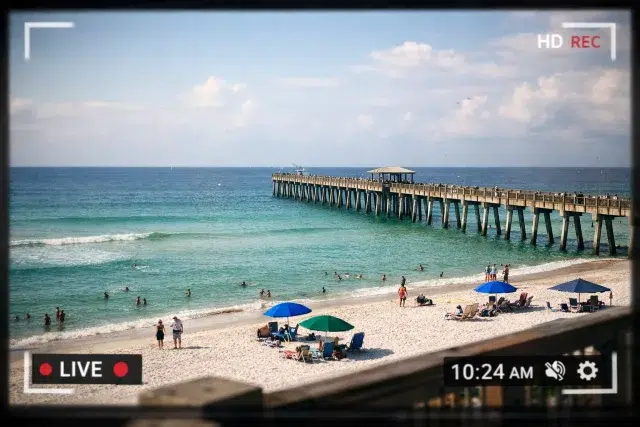
If you are heading to Florida’s Gulf Coast, or you just miss the sound of waves, the Navarre Beach Cam is one of the easiest ways to see what is happening on the sand right now. In a few seconds you can get a live look at the shoreline, check whether the water looks calm or choppy, and get a feel for crowds before you even leave the house. That is exactly why the Navarre Beach Cam has become a daily habit for travelers, locals, anglers, photographers, and anyone planning a beach day.
But a live view is only half the story. What most people really want is simple: “Is it sunny or stormy, are the waves rough, and does it look safe to swim today?” This guide breaks down how to use a Navarre Beach Cam the smart way, how to pair it with trustworthy weather and safety data, and what “today’s beach conditions” actually mean in real life.
What the Navarre Beach Cam actually shows (and what it cannot)
A Navarre Beach Cam is essentially your “eyes on the beach.” Depending on the camera location, you might see the pier, the surf line, the sandbar area, or a wider angle that includes the sky and water color. Popular webcam pages often bundle multiple viewpoints, so you can compare the Gulf side with other nearby angles.
Here is what you can usually learn quickly from a Navarre Beach Cam:
- Wave behavior: You can often tell if the surf is small and rolling or steep and breaking hard.
- Wind clues: Whitecaps, blowing sand, and “streaky” water usually mean higher winds.
- Crowd level: Parking and beach density are easy to estimate with a wide shot.
- Sky changes: Dark bands on the horizon can hint at incoming showers or storms.
- Water color and clarity: While not perfect, you can often spot clearer days versus stirred up water.
What a Navarre Beach Cam cannot reliably tell you:
- Rip current risk: Rip currents can be present even on calm, sunny days, and are not always visible.
- Exact water temperature: The scene does not give a reading.
- Lightning distance: A camera view may not show distant lightning or radar trends.
- UV strength: Brightness does not equal safe sun exposure.
Think of the cam as a fast visual check. Then confirm the high stakes details with official forecasts and safety guidance.
How to read “today’s beach conditions” like a local
When people say “beach conditions,” they usually mean a bundle of factors that affect comfort and safety. If you learn to scan these in a consistent order, the Navarre Beach Cam becomes far more useful.
1) Surf and wave period
From the Navarre Beach Cam, look for how waves break:
- Gentle, spaced waves often mean a relaxed swim day.
- Fast, steep breakers can mean stronger currents and tougher entries.
- Constant foam lines can suggest rougher water and more energy.
Even if waves look “fun,” always pair it with rip current guidance. Rip currents are linked with most beach rescues and cause more than 100 deaths per year in the U.S., according to the U.S. Lifesaving Association and NOAA educational materials.
2) Wind direction and strength
Wind can turn a beautiful beach plan into a sandy struggle. On camera, strong wind often shows up as:
- Palm fronds whipping
- Whitecaps across the surface
- Sand blowing in sheets near the shore
Wind also affects water clarity and can push surface chop that makes swimming more tiring than it looks from shore.
3) Visibility and storm hints
Florida weather can flip quickly. If you see a sharp dark cloud line offshore on the Navarre Beach Cam, treat it as a warning to check radar or local forecasts. Cameras are great at showing “what is happening right now,” but they do not show what is building 20 miles away.
4) Beach flags and posted warnings
Many beaches use warning flag systems. If the cam angle includes a flag pole, it can be a helpful clue, but do not rely on it alone. If the camera is distant or the flag is not visible, use official beach or local safety updates instead.
Navarre Beach Cam plus weather data: the best combo for planning
The smartest way to use a Navarre Beach Cam is to pair it with reliable weather and ocean safety information. The camera gives the “feel” of the beach. Forecasts give you the measurable risk factors.
Here is a practical workflow that takes about two minutes:
- Check the Navarre Beach Cam for waves, wind signals, and crowd level.
- Check local forecasts for storms and wind.
- Check rip current guidance before swimming. The National Weather Service recommends reviewing local beach forecasts and talking to lifeguards, and it emphasizes swimming near lifeguards whenever possible.
- Check the UV Index for sun exposure risk. The U.S. EPA explains the UV Index scale (1–11+) and its role as a daily forecast of UV intensity.
Quick “go / adjust / skip” table
| What you see now | What it usually means | Best move |
|---|---|---|
| Calm surf, light breeze, clear sky | Comfortable beach time | Go, but still check rip current info |
| Choppy water with whitecaps | Windier, harder swimming | Consider staying shallow or not swimming |
| Dark clouds offshore | Possible showers or storms | Check radar, plan a shorter visit |
| Very bright sun, minimal clouds | Higher UV exposure risk | Shade plan, sunscreen, protective clothing |
This is not a replacement for official warnings. It is a fast decision helper.
Safety first: rip currents and why a camera is not enough
People often look at a Navarre Beach Cam and assume calm water means safe water. That is a risky assumption.
NOAA’s educational resources and the U.S. Lifesaving Association note that rip currents are involved in the majority of lifeguard rescues at surf beaches, and estimates commonly place U.S. rip current deaths at over 100 per year. The National Weather Service also emphasizes that rip currents can form on calm, sunny days and encourages swimmers to consult beach forecasts and lifeguards.
If you want one simple rule
Swim near a lifeguard whenever possible. The National Weather Service’s rip current safety guidance cites an extremely low drowning chance at beaches with lifeguards, referencing the U.S. Lifesaving Association.
What to do if someone is caught in a rip current
This is where good intentions can turn dangerous. The National Weather Service warns that many people have died trying to rescue rip current victims. Their guidance is to get help from a lifeguard, call 9-1-1 if needed, and use “reach or throw, don’t go” unless you have flotation.
Practical steps from official safety messaging include:
- Alert a lifeguard immediately if one is present
- Call emergency services if needed
- Throw something that floats (cooler lid, life ring, boogie board)
- Avoid entering the water without a flotation device
What the water color can tell you on a Navarre Beach Cam
A lot of people use a Navarre Beach Cam to judge how “pretty” the beach looks, and water color is part of that. While you should not treat it like a scientific measurement, you can still learn useful things:
- Clearer turquoise or green water often happens on lighter wind days.
- Brownish or milky water can indicate stirred up sand from wind or recent rough surf.
- Patchy dark areas might be sea grass beds, deeper troughs, or shadows depending on sun angle.
If you are planning snorkeling-like activities close to shore, camera clarity is a helpful first glance. Still, conditions can shift within hours as wind changes.
Using the Navarre Beach Cam for trip planning (real scenarios)
Let’s make this practical. Here are a few common situations where the Navarre Beach Cam saves time, stress, and disappointment.
Scenario A: You are traveling with kids
You want a beach that feels calm and not chaotic. Use the Navarre Beach Cam to check:
- How crowded the beach looks around your target time
- Whether the surf looks gentle enough for safe wading
- Whether wind is blowing sand into faces and snacks
Then confirm rip current information before anyone gets in the water.
Scenario B: You are chasing sunrise or sunset photos
A Navarre Beach Cam is basically a lighting preview. Check for:
- Cloud layers near the horizon
- Visibility level (haze versus crisp)
- Wind (strong wind can blur sand spray and make tripods annoying)
Photographers often use cams to time their arrival so they are not setting up in peak crowds.
Scenario C: You want a quiet walk, not a swim
Even on higher risk surf days, the beach can still be enjoyable if you stay out of the water. The Navarre Beach Cam helps you choose a time when the shoreline is less busy and conditions look comfortable.
Understanding the UV Index for Navarre Beach days
Sun exposure is one of the most underestimated “beach conditions.” Bright sun can feel amazing, but UV can be intense even when it is breezy.
The U.S. EPA explains that the UV Index forecasts UV intensity on a 1–11+ scale and is meant to help people plan sun protection.
Here is an easy way to think about it:
- Lower UV: you still need protection, but risk rises more slowly
- Higher UV: you can burn quickly, especially midday, and eye protection becomes more important
A Navarre Beach Cam will not tell you the UV Index, so check a UV forecast when planning long beach time.
Sun safety checklist that does not ruin the fun
- Apply broad spectrum sunscreen and reapply after swimming
- Wear sunglasses labeled for UV protection
- Use shade strategically, especially during peak sun hours
- Pack a light long sleeve sun shirt for long walks
This is the difference between “great day” and “why did we stay out so long?”
Where to find Navarre Beach Cam streams and live views
There are multiple places online that host a Navarre Beach Cam view. Some sites collect several camera angles on one page, which is useful when you want a more complete picture of the area.
When choosing which live view to trust, look for:
- A stable stream that updates consistently
- A clear timestamp or “live” indication
- A viewpoint that shows both sky and surf line (best for quick decisions)
If a feed is blurry, outdated, or frozen, switch sources. For planning, freshness matters more than high resolution.
Common questions people ask about Navarre Beach Cam and conditions
Is the Navarre Beach Cam live or delayed?
Most webcam streams are live or close to live, but delays can happen during heavy traffic or technical issues. Use pages that clearly identify the stream and refresh if the scene seems “stuck.”
Can I use the Navarre Beach Cam to check if it is safe to swim?
Use the Navarre Beach Cam as a visual hint only. For swim safety, rely on rip current guidance and lifeguard advice. The National Weather Service specifically recommends checking local beach forecasts and talking to lifeguards.
Why does the water look calm but swimming is still risky?
Rip currents can form even when the surface looks calm. NOAA and the National Weather Service repeatedly warn against assuming good weather equals safe water.
What is the fastest way to decide if today is a good beach day?
Do a quick scan:
- Check the Navarre Beach Cam for surf and sky
- Check rip current information before swimming
- Check UV Index for sun protection planning
That combo covers comfort and safety in a simple routine.
Pro tips for getting the most out of Navarre Beach Cam views
If you want the Navarre Beach Cam to feel like a real planning tool, try these habits:
- Check it twice: once in the morning, once about an hour before you leave. Conditions can change fast.
- Compare angles: one view might look calm while another shows wind or incoming clouds.
- Look beyond the water: flags, people’s behavior, and sky layers are all signals.
- Use it to time your arrival: avoid peak crowds and find your ideal vibe.
- Treat safety info as non-negotiable: the camera is not a substitute for forecasts or lifeguards.
Conclusion
Used the right way, the Navarre Beach Cam is more than a relaxing live stream. It is a quick, visual decision tool that helps you plan around waves, wind, crowds, and changing skies. Pair it with official rip current guidance and the UV Index, and you can make smarter choices for comfort and safety without overthinking your beach day. If you are visiting for a short trip, checking the Navarre Beach Cam before you leave can be the difference between arriving to perfect Gulf views or showing up to windblown sand and rough surf.
Navarre Beach sits along a Gulf Coast shoreline shaped like a barrier island, which is one reason conditions can shift quickly with wind and storms. Keep your routine simple: watch the Navarre Beach Cam, confirm safety guidance, then enjoy the day with confidence.