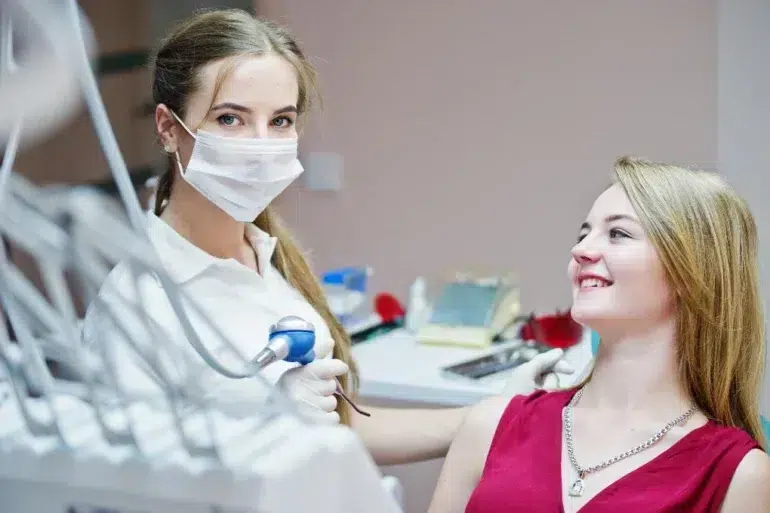
In the past, smile makeovers typically included a heavy focus on restorative procedures to improve functionality and oral health. While repairing damage is still often part of the process, the emphasis has evolved to include a more esthetic approach, enhancing the appearance of a patient’s mouth, teeth, and smile.
New biocompatible materials and modern technologies can help with this.
Alignment First, Everything Else Second
Nowadays, most cosmetic dentists consider alignment as the basis rather than an optional process. This has a logical explanation. If you attach composite to a slightly rotated tooth, or apply a veneer to a crowded arch, you’re enhancing an imperfect basis. The aesthetic effect deteriorates more quickly, and the underlying malocclusion itself remains.
The sequence of smile design is different. The treatment plans the position of the tooth, proportion, and gum line before any irreparable work is performed. Composite bonding to repair chipped rims, professional whitening, and any other final details are all planned after the alignment is completed. This is incredibly more important than most patients understand.
Aligning teeth also has a hygiene advantage that is often ignored. Crowded or intersecting teeth form pockets where plaque builds up in areas that are not accessible to brushing. Cleaner teeth are genuinely easier to take care of, and the long-term health advantages to the gums – such as reducing the risk of gingivitis – are an actual clinical benefit rather than a promotion line.
How Technology Removed The Friction
For a long time, orthodontic treatment meant metal brackets, wires you could see when people smiled, and a social cost that frequently didn’t seem worth it for adults. That’s changed a lot. Adult uptake of orthodontic treatment has grown steadily in recent years, and much of that growth is being driven by a single factor: the near invisibility of modern clear appliance systems.
Adults who need movement but don’t want to draw attention to the process now largely turn to clear aligners for teeth as the go-to option. They’re removable, which means no dietary restrictions, and no having to thread interdental brushes around wires and brackets. Just brush and floss as normal, which isn’t an option with bonded brackets.
The putty tray impression process has been supplanted by a wand-based intraoral scanner that patients overwhelmingly prefer. The scan feeds straight into treatment planning software, which generates a simulation of the movement of your teeth over treatment – usually somewhere between six and eighteen months depending on complexity. This simulation is important. It lets patients see where they’re going to end up before they start marching there. The black box aspect of orthodontic treatment – “trust us, this will work” – has largely disappeared.
What Aligners Can and Can’t Do
Aligners are able to handle a broad spectrum of cases from mild crowding and spacing to more moderate rotation and bite correction. Serious malocclusions – significant overbites, underbites, or cases involving skeletal movement – may still require the expertise of an orthodontist over a general cosmetic dentist. Knowing the difference is part of any honest initial consultation.
For suitable cases, aligners leverage small tooth-colored attachments bonded to select teeth to create the grip required for movement. They are barely visible and come off at the end of treatment. The mechanics are way more elegant than they appear from the outside.
One thing they never compromise: enamel. Porcelain veneers and crowns require the removal of non-regenerative tooth structure. It’s a needed trade-off in some situations. But it’s also permanent. Aligners move teeth without any contact to the enamel surface. That is why they are increasingly becoming the first consideration for patients who have healthy teeth but simply want a different position or alignment.
The Retention Stage People Skip
Treatment completion doesn’t mark the end of treatment. Teeth tend to shift back to their original position after moving, in a process known as orthodontic relapse. Retainers help to prevent this from happening as long as they are worn as directed after treatment. This is also the most common reason why people need retreatment after several years.
In most cases, patients are required to wear retainers every night for the rest of their lives after the post orthodontic phase. Although it is much easier than the initial treatment, it is something that will go on for a long period of time. Knowing this beforehand will help you be more compliant and have better long-term results.
Treating It As A Health Decision, Not A Vanity One
The term cosmetic dentistry has some baggage attached to it that can work to its disadvantage. It sounds optional in the most superficial sense – it helps how things look, not how they work. To some extent, that is true.
But underselling what alignment treatment can deliver over a lifetime doesn’t help anybody: a bite that works properly, teeth that are easier to keep clean, and a foundation that supports whatever cosmetic finishing work comes next.