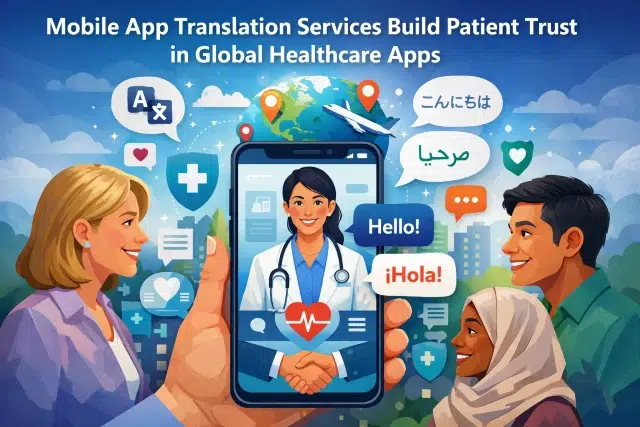
People rarely open healthcare apps on a whim. Unlike checking the weather or scrolling through shopping apps, there’s usually a reason behind each tap, sometimes an unspoken worry, sometimes a question they aren’t ready to voice. Even routine health decisions carry real weight.
Context matters because it changes the intended message. A mobile app translation service helps in communicating with someone who may already be anxious, distracted, or worried about misunderstanding.
Success comes from technically perfect translation alone. It comes from smooth, seamless language that doesn’t distract, slow users down, or plant unnecessary doubt. Trust quietly builds in those moments.
1. When Words Don’t Get in the Way, Patients Breathe Easier
Confusion is exhausting. In healthcare, it’s also unsettling. A patient reading an instruction should not have to pause and wonder whether they’re interpreting it correctly. When content is translated too literally, the words might be technically correct, but their meaning can be different. That builds discomfort. Patients reread. They hesitate before tapping the next button. Some close the app altogether and decide to deal with it later. Others look for confirmation elsewhere, which is a good sign for long-term trust.
Effective translation removes friction, anticipating where a sentence might confuse and adjusting it before questions arise. It reads naturally on a phone, not like formal documentation. When patients move through an app without stopping to decode it, something subtle happens. They relax. They trust the flow. They assume the app knows what it’s doing. That assumption is fragile. Language protects it.
2. Cultural Context Changes How Care Feels, Not Just How It Reads
Healthcare language carries unspoken rules. How direct is too direct? How much reassurance is enough? When does formality feel professional, and when does it feel cold? These questions don’t have universal answers. An app that speaks too bluntly might feel efficient in one region and insensitive in another. A softer tone that works well in some markets may sound evasive elsewhere. Translations that ignore these nuances don’t usually fail dramatically; they fail quietly. Users don’t complain. They just don’t fully trust what they’re reading.
Culturally aware translation adapts without drawing attention to itself. It doesn’t overcorrect or dramatize. It simply aligns with how health conversations already happen locally. When that alignment is missing, patients feel like outsiders using a system that wasn’t built for them. When it’s present, they feel acknowledged. And that feeling matters more than most UX teams realize.
3. Consistency Over Time Creates a Sense of Reliability
Trust isn’t built in a single interaction but grows through repeated experiences. Patients return to healthcare apps again and again. Over weeks or months, they internalize certain terms. They learn what labels mean. They recognize patterns, and this familiarity reduces cognitive effort, which is especially important when someone isn’t feeling their best.
Inconsistent terminology disrupts that familiarity. Even small shifts can cause hesitation. A term that changes slightly from one screen to another introduces doubt. Patients wonder whether something has changed medically or whether they simply misunderstood before.
Maintaining consistency across updates, features, and languages is harder than it looks. As products evolve, language tends to fragment unless it’s actively managed. This is often where collaboration with a software localization agency becomes critical, not for translation volume, but for continuity. From the user’s perspective, the benefit is simple: the app feels steady, predictable, and safe. That steadiness becomes part of the trust relationship.
4. Consent and Privacy Feel Different When the Language Feels Honest
Few things make users more uneasy than consent screens they don’t fully understand. Especially in healthcare, where data is personal, and consequences feel serious. When permission requests are poorly translated, they often sound either overly legal or oddly vague. Both trigger suspicion. Even if patients agree, they do so with a lingering sense of discomfort.
Clear, well-adapted consent language does the opposite. It explains without overwhelming, reassures without downplaying, and treats the user as capable of understanding, not as someone to be rushed through a process. Patients sense immediately whether language is clarifying or hiding information, even if they don’t consciously think about it. Trust grows when people feel informed rather than managed.
5. Localized Support Language Makes Problems Feel Smaller
No healthcare app is perfect. Errors happen. Appointments fail to book. Results take longer than expected. When users hit these moments, they’re already slightly stressed. Support content becomes the voice of the app in those situations. If that voice sounds generic or disconnected from local realities, frustration increases. It feels like being handed a script instead of help.
Localized support content changes that are dynamic. It reflects how healthcare actually works in that region. It anticipates common questions. It uses language that feels grounded, not automated. Even when the issue isn’t resolved immediately, patients feel acknowledged. That acknowledgment goes a long way in preserving trust during imperfect moments.
Conclusion
Healthcare apps don’t earn trust by claiming to be trustworthy. They earn it through dozens of small decisions that users rarely notice individually. Language is at the heart of these decisions, not decoration, not SEO, but the very framework that makes the app usable and trustworthy.
When translation is done with care, patients move through the app without any difficulty. They understand what’s happening and feel respected. Moreover, they don’t second-guess every instruction. Over time, that ease becomes confidence. And confidence becomes trust. It’s quiet. It’s gradual. And once it’s there, it’s one of the hardest things for competitors to take away. That’s the real power of getting language right in global healthcare apps.