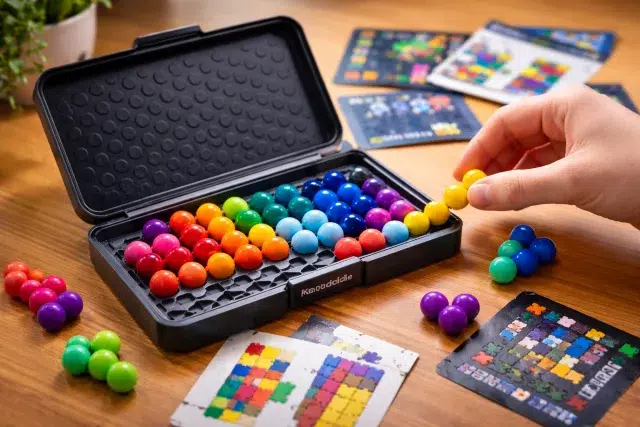
If you enjoy puzzles that truly make you think, the Kanoodle Game might just become your new favorite obsession. At first glance, it looks simple. A small board, a handful of colorful pieces, and a challenge booklet. But once you start arranging those pieces into the right shape, you quickly realize this is more than just a casual pastime.
Let’s take a deep dive into why this clever little game has become a must-have for puzzle lovers everywhere.
What Is the Kanoodle Game?
The Kanoodle Game is a logic-based puzzle game that challenges players to arrange differently shaped pieces into specific patterns. It usually includes:
• A puzzle board
• 12 uniquely shaped pieces
• A challenge guide with multiple difficulty levels
Players must place the pieces on the board to match a provided layout or solve a 3D structure challenge. It sounds straightforward, but as the levels increase in complexity, it becomes a true mental workout.
At its core, the game is rooted in spatial reasoning, a cognitive skill linked to success in math, science, and engineering. According to research from the American Psychological Association, strong spatial skills correlate with better performance in STEM fields.
That alone makes this puzzle more powerful than it first appears.
Why the Kanoodle Game Is So Popular
Puzzle games have always had a loyal fan base, but the Kanoodle Game stands out for a few key reasons.
1. It’s Easy to Start, Hard to Master
Beginners can jump in without needing complicated instructions. However, advanced challenges require patience, strategy, and creative thinking.
This balance makes it appealing to both children and adults.
2. Portable and Travel-Friendly
Unlike bulky board games, the Kanoodle Game fits in a small case. It’s perfect for:
• Road trips
• Flights
• Waiting rooms
• Classroom breaks
You can take it anywhere without worrying about losing pieces.
3. Multiple Difficulty Levels
Most versions include over 100 challenges, ranging from simple starter puzzles to expert-level brain teasers.
This gradual progression keeps players engaged over time.
Cognitive Benefits of Playing the Kanoodle Game
One of the biggest reasons parents and educators love the Kanoodle Game is its educational value.
Let’s explore the science behind it.
Boosts Problem-Solving Skills
Each puzzle requires analyzing shapes, predicting outcomes, and adjusting strategies. These are classic problem-solving techniques that strengthen the brain.
Studies from Harvard University suggest that logic-based puzzles enhance executive functioning, which helps with planning and decision-making.
Improves Spatial Awareness
Spatial awareness involves understanding how objects relate to each other in space. This skill is essential in geometry, architecture, engineering, and even everyday tasks like packing a suitcase efficiently.
When players rotate and reposition pieces in the Kanoodle Game, they train their brains to visualize solutions.
Encourages Patience and Focus
In today’s digital world, attention spans are shrinking. Unlike fast-paced mobile games, this puzzle requires sustained concentration.
Over time, this builds mental endurance.
Strengthens Memory
Remembering which pieces have already been tested and which configurations failed improves working memory.
According to research published in Frontiers in Psychology, strategic board games can enhance memory retention and cognitive flexibility.
How the Kanoodle Game Supports STEM Learning
Educators increasingly use puzzles in classrooms to reinforce STEM concepts.
The Kanoodle Game aligns perfectly with:
• Geometry principles
• Logical reasoning
• Pattern recognition
• 3D visualization
When children manipulate shapes to fit a solution, they are essentially practicing real-world mathematical thinking.
This hands-on learning approach mirrors the principles behind tactile learning methods supported by modern education research.
Different Versions of the Kanoodle Game
Over time, several variations have emerged, each offering a slightly different experience.
Classic Version
The original includes 2D and 3D puzzles with over 200 challenges.
Kanoodle Extreme
Designed for advanced players who want tougher challenges.
Kanoodle Genius
A compact version aimed at younger audiences.
Kanoodle Head-to-Head
Adds a competitive twist, allowing two players to race against each other.
Each version maintains the core mechanics while adding new elements to keep things fresh.
Real-Life Scenario: A Family Game Night Transformation
Imagine this.
A family of four is looking for a way to reduce screen time. Instead of turning on the television, they bring out the Kanoodle Game.
At first, the kids giggle at the colorful pieces. Soon, they’re debating strategies and helping each other rotate shapes. The parents join in, and what started as a small activity turns into an hour of focused, laughter-filled challenge.
That’s the magic of tactile puzzle games.
They create shared experiences without requiring WiFi or batteries.
Tips to Master the Kanoodle Game
If you want to improve faster, try these strategies.
Start With Corners
Placing corner or edge pieces first can help establish structure.
Rotate Pieces Physically
Sometimes the solution appears when you physically rotate the board instead of just imagining it.
Work Backward
Look at empty spaces and determine which shapes could logically fit there.
Don’t Force It
If a configuration feels wrong, step away and return later with fresh eyes.
Patience often unlocks the solution.
Kanoodle Game vs Digital Puzzle Apps
You might wonder how this compares to mobile brain-training apps.
Here’s a quick comparison:
| Feature | Kanoodle Game | Mobile Puzzle Apps |
|---|---|---|
| Screen-Free | Yes | No |
| Tactile Experience | Yes | No |
| Battery Required | No | Yes |
| Portability | High | High |
| Social Play | Yes | Limited |
While apps offer convenience, physical puzzles provide sensory engagement that screens simply cannot replicate.
Frequently Asked Questions
Is the Kanoodle Game suitable for adults?
Absolutely. Many adults find advanced levels surprisingly challenging.
What age group is ideal?
Most versions are recommended for ages 7 and up.
How long does one puzzle take?
Beginner puzzles may take minutes. Expert levels can take much longer.
Does it help academic performance?
While it is not a direct academic tool, the cognitive skills it develops align with research-backed learning principles.
Why Screen-Free Brain Games Matter Today
In an era dominated by smartphones and streaming platforms, hands-on puzzles provide balance.
According to Common Sense Media, children aged 8 to 12 spend an average of 5 hours per day on screens. Reducing that time with meaningful alternatives is increasingly important.
Physical puzzles like this encourage mindful engagement instead of passive consumption.
In fact, many educators draw comparisons between traditional logic puzzles and concepts found in recreational mathematics, including ideas explored in <a href=”https://en.wikipedia.org/wiki/Mathematical_puzzle” target=”_blank”>mathematical puzzles</a>.
The point is simple.
Challenge the brain, and it grows stronger.
Actionable Ways to Use the Kanoodle Game Daily
Here are practical ways to integrate it into your routine:
• Morning brain warm-up before school
• Midday work break to refresh focus
• Family challenge night competition
• Classroom logic station activity
• Travel entertainment option
Consistency is key. Just 15 minutes per day can sharpen cognitive agility over time.
The Long-Term Value of the Kanoodle Game
Unlike trendy gadgets that fade quickly, the Kanoodle Game holds long-term value because it grows with the player.
As skills improve, harder challenges keep things interesting.
It is not just a toy.
It is a brain-training tool disguised as entertainment.
Conclusion
The Kanoodle Game is more than a colorful puzzle. It is a powerful brain-boosting challenge that strengthens problem-solving skills, enhances spatial awareness, and encourages focused thinking across all age groups.
Whether you are a parent seeking educational play, an adult looking to sharpen your mind, or a teacher searching for engaging classroom tools, this puzzle offers lasting value. Its portability, variety of challenges, and research-backed cognitive benefits make it a smart addition to any household.
In a world filled with digital distractions, choosing hands-on logic puzzles like the Kanoodle Game is a simple yet effective way to invest in mental growth.