

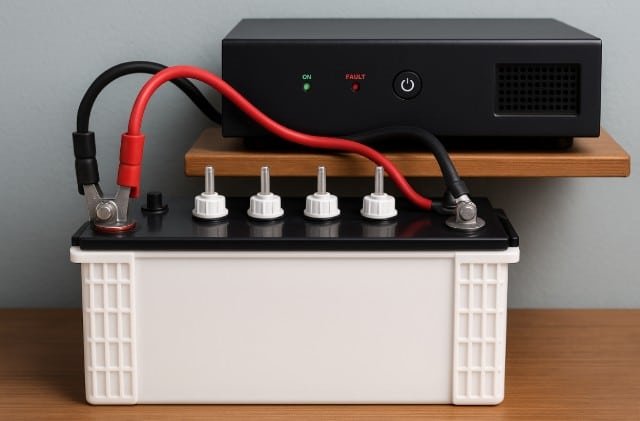
You rely on inverters for power backup, and the inverters depend on batteries for storing and delivering that energy when you need it most. Pick the wrong battery, and your power backup could ghost you at the worst possible moment. Pick the right one and you are set to go for years to come.
While inverter batteries are not much talked about, it is important to learn how to pick the right inverter battery. Here are key aspects that you must know in order to choose the right model and take good care of it.
Key Inverter Battery Types
There are 4 types of inverter batteries. The table below explains each type and how it works.
| Battery Type | Key Features | Best For |
| Tall Tubular Batteries | Taller and narrower, extended backup times | Areas with long power cuts, homes with good storage space |
| Short Tubular Batteries | Slimmer and shorter, efficient performance | Limited space; moderate power cuts |
| Short Tubular Jumbo Batteries | Compact size, high backup capacity, combines the benefits of tall & short tubular | Diverse power needs; balance of space + backup |
| Flat Plate Batteries | Minimal space required, low maintenance, affordable, reliable performance | Budget-conscious users, frequent power cuts |
Essential Inverter Battery Features for Reliability

Now, most inverter batteries have some essential features that are absolutely non-negotiable if you’re looking for reliability in the first place. They are:
Long life cycles
Inverter batteries should be designed in such a manner that they can handle deep discharges, which ensures they have a long lifespan of at least 4-6 years.
Low Maintenance
Inverter batteries should be made in such a way that requires minimal maintenance. The more maintenance they need, the more they’d be an inconvenience.
Good performance Output
Inverter batteries, while being low maintenance, should also have a high power output, so that you can power the maximum appliances during the event of a power cut.
Factors That Affect Battery Longevity
Good quality inverter batteries can last you for years, but there are certain factors that you need to take care of. They are:
Depth of Discharge (DoD)
Depth of Discharge (DoD) is an important number that tells you how much an inverter battery is used up. If you keep deep discharging the battery, it will wear out faster and last less long.. Keeping a reasonable DoD can help the battery last longer.
Temperature
The temperature has a big effect on the chemical reactions that happen inside the battery. Hot or very cold temperatures speed up the process of breaking down. It is best to put inverter batteries in a place that gets good air flow and stays within the temperature range that the manufacturer recommends.
Overcharging and Undercharging
If you charge a battery too much or too little, it can be damaged beyond repair. Advanced charge controllers in inverter systems can help reduce these dangers by controlling the charging process. Users should make sure that their inverter systems have the right charging methods to keep these bad things from happening to the life of the inverter battery.
Regular Maintenance
To make sure that inverter batteries work well and last as long as possible, they need to be maintained regularly. This means inspecting and adding more electrolyte (for lead-acid batteries), cleaning the terminals, and making sure the area is clean and free of corrosion. Regular maintenance keeps problems like sulfation from happening and makes the battery work better overall.
How to Choose the Right Battery Model
Now, how do you choose the right battery model? Here’s a step-by-step process on how you can do that.
Figure out how much power you need
The greatest inverter battery for your area depends on how much electricity it uses. First, you need to figure out how much power you need. For example, if you need 60 watts for three tube lights, 210 watts for three fans, and 140 watts for two laptops, it adds up to a total power requirement of 410 watts.
Calculate how much the battery will last
How long do you need the power backup for? It is a crucial part of the battery’s needs. For now, let’s say you need a backup for four hours.
Check the Battery Voltage
Most of the time, the battery voltage is 12 V, 24 V, or 48 V. Check the voltage in the capacity part of the product description for your inverter. Let’s say you checked and found that the voltage is 12 V.
Calculate the Correct Battery Capacity
You may figure out the battery capacity using this easy formula:
Your power needs x backup time/inverter battery voltage
Based on the values above, you need a battery with a capacity of 410 times 4 divided by 12, which is 136.6. So, you will need a battery that can hold about 136 Ah.
Conclusion
With energy needs increasing every now and then, it is important to ensure that your power backup is on point. Picking the right inverter battery becomes absolutely crucial in this regard; it should be low in maintenance and high in performance.


