Is Your ERP Ready for the Future of Business?
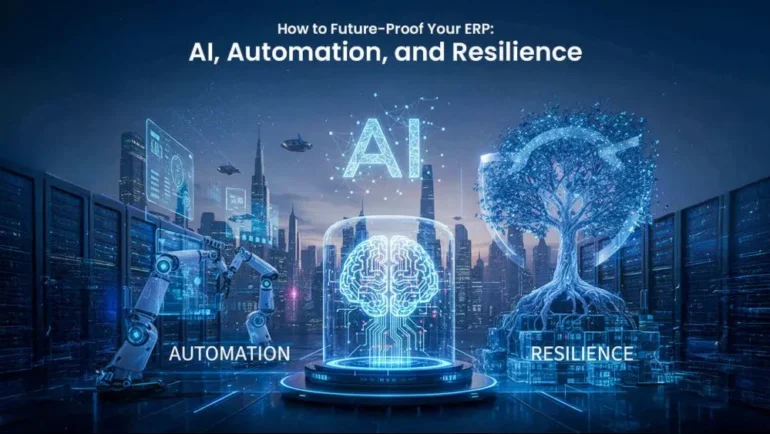
Enterprise resource planning (ERP) systems have made the move from back-office tools to drivers of business innovation. Research from prominent ERP analysts shows that 68% of companies consider ERP as the backbone of their digital transformation efforts/ integral to their digital strategy. However, as business models evolve and customer expectations soar, old-school ERP systems and traditional strategies prove far too inflexible, hindering growth and even exposing companies to risk. But as digital disruption becomes more persuasive, the future requires something more. These modernized, future-proof ERP systems are more than just a technical upgrade; they give you resiliency, flexibility, and the scalability to succeed over the long run. But when it comes to future-proofing your ERP, simply upgrading to the latest version is not enough. It means integrating the power of AI into ERP systems, implementing ERP automation solutions, and establishing a strong ERP architecture that not just survives but is able to thrive in both technical and business disruption.
Let’s take a look at how organizations can make this transformation happen.
The Importance of Future-Proofing Your ERP!
Today’s businesses live and work in a world of constant change. Supply chains change, customer tastes evolve, and regulatory demands become more complicated, much faster than legacy systems can adapt. Meanwhile, companies continually feel pressure to work more efficiently and manage recurring tasks faster while minimizing the manual workload.
And in today’s speedy tech-driven era, customer and employee expectations are growing sky high, demanding frictionless data-driven experiences that are timely and trustworthy. Without deliberate ERP modernization strategies, even the most established systems lose relevance and slow the organization down. Such challenges are addressed by a future-proof ERP that combines scalability, automation, and intelligence to ensure technology is a competitive enabler, not an obstacle to growth.
How Do You Future-Proof Your ERP: ERP Modernization Strategies
An ERP system that is future-proofed is built to grow and adapt along with a business and its surrounding industry. Here are some ERP modernization strategies that you can consider:
- Choose open-source ERP platforms such as Moqui and Apache OFBiz to gain flexibility and control.
- Give preference to cloud-native offerings and strong integration options
- Leverage AI-driven automation for better intelligence and operational efficiency
- Emphasis on resilient ERP architecture – modular architecture, automatic monitoring, and quick scalability.
- Train with iterative improvement and system updates that have minimal user interruption.
- Need to be able to accommodate explosive growth and spikes in transaction volume without completely re-architecting a system.
Core Pillars of a Future-Proof ERP
1. AI in ERP Systems
ERP systems have been reactive tools for most of their history: they recorded transactions and generated reports after the fact. But the advent of AI in ERP systems is challenging the status quo. By integrating AI/ML with ERP data, companies now have predictive knowledge instead of just getting historical information. AI can predict consumer demand, streamline supply chains, and even tailor customer interactions to individuals. It also aids in automating financial close processes, improves customer support with intelligent case routing, and analyzes workforce productivity to help drive productivity gains.
Real-world adoption shows the impact. Open-source ERP solutions like the Moqui ERP framework can be augmented with AI modules for demand planning and fraud detection. AI-powered ERP automation is turning ERP into a decision-making machine, providing the ability to foresee changes in the market, deliver better service, and make faster, more intelligent business decisions.
2. ERP Automation Solutions
Automation is the cornerstone for a future-proof ERP software. Today’s ERP automation offerings also manage order-to-cash workflows, payroll, procurement, compliance reporting, and so on. And in the process, they minimize manual errors, speed up cycle times, and enhance data accuracy. The aim isn’t to replace people but to liberate them from day-to-day chores like scheduling and rescheduling meetings or manually transferring data from one office system to another so that they can focus on more strategic, value-added work.
The use cases are tangible and measurable. Automated capture of invoices, along with purchase order processing, reduces financial cycles, which helps to eliminate expensive downtime as part of manufacturing predictive maintenance. Further, smart workflow management makes sure tasks get to the right person at the right time, without any hiccups. With these benefits, they can scale, run efficiently, and be reliable.
In today’s modern times, ERP automation is branching out beyond basic scripts into RPA, IoT integration, and AI-driven workflows. The solution is faster financial close, improved compliance, and increased operational agility. Automation is the link between ERP of today and the intelligent enterprise of tomorrow.
3. Building a Resilient ERP System
An ERP solution that is future-proof must also be resilient. This enables it to endure disruptions and adjust to new and surprising shifts, whether they are market dynamics, supply chain derailments, or technological advancements. A resilient ERP architecture is designed for adaptability and ongoing growth.
A fundamental part of this resilience includes a smart move to open-source ERP platforms. Some legacy, in-house systems are inflexible and expensive to modify or update. Open-source ERP systems, on the other hand, provide a flexible and modifiable solution. Two such examples include the Moqui Framework and the Apache OFBiz ERP.
- Moqui ERP Framework: The Moqui Framework provides unparalleled flexibility and great scalability to accommodate applications as they grow. Businesses are able to customize the system to meet their specific needs and not be locked into a single vendor’s roadmap because of its flexible open-source nature. This makes it well-suited to complex and changing business environments.
- Apache OFBiz ERP: Another open source ERP system that offers an end-to-end suite of business automation tools for a multitude of business applications. Due to its modular architecture and open-source roots, businesses can develop robust solutions and adapt and connect them to other solutions as the business evolves.
Companies such as NOI Technologies are experts at building custom, scalable, and robust ERP applications on these open source frameworks, providing businesses with systems that aren’t simply for today, but for tomorrow as well.
The Path To Digital Transformation: Securing Your Business Future
The next generation of ERP is not just powerful but adaptive as well. Leveraging AI in ERP systems, ERP automation solutions, and robust ERP architecture can help organizations protect their investments and seek new possibilities. The success of open-source ERP frameworks such as Moqui Framework and Apache OFBiz is proof that you can gain enterprise-level power and resilience at a lower price tag with complete flexibility. The route to future-proof ERP is clear – automation, intelligence, and resilience need to be at the very core. Those who do will lead with confidence in an uncertain world.