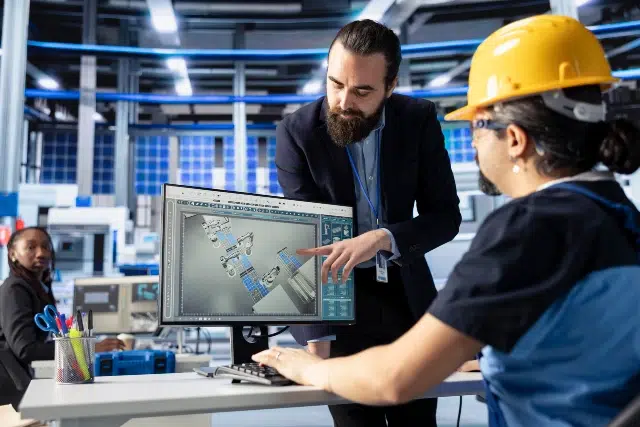
Have you ever wondered how manufacturing plants maintain such steady output when every shift brings new variations in speed, demand, and equipment conditions? Modern production lines require accuracy, coordination, and responsiveness that traditional systems cannot consistently deliver.
Manufacturers now depend on environments where machines communicate, processes adapt instantly, and data guides decisions without delay. These capabilities help prevent errors, stabilize equipment behavior, and support continuous improvement across every production layer. This is where a smart factory digital manufacturing framework strengthens industrial performance through automation, sensing, and analytics.
It connects equipment, processes, and data streams into a unified operational ecosystem. Its growing importance makes it valuable. Keep reading to understand how the smart factory model increases reliability, consistency, and production efficiency.
Digital Foundations that Shape the Smart Factory Ecosystem
Smart production environments rely on technologies that collect data, refine workflows, and support equipment performance under variable operating conditions. These digital building blocks guide coordinated movement and real-time decision-making.
- Automation Structures that Improve Mechanical Execution
Advanced controllers, robotics, and automated cells help stabilize movement sequences and reduce operational variation. These tools enhance performance by enabling accurate, repeatable production cycles.
- Industrial Internet of Things (IIoT) as the Data Engine
The IIoT comprises connected sensors, instruments, and edge devices that continuously track machine conditions. These insights help optimize resource allocation and improve workflow timing across the smart factory environment.
- Analytics and Artificial Intelligence (AI) for Real-time Optimization
AI engines and predictive analytics platforms evaluate machine performance and forecast deviations before they disrupt output. These systems reinforce the adaptability and support faster decision cycles.
How the Smart Factory Model Improves Industrial Efficiency and Reliability
Smart factory environments reshape industrial performance by enhancing operational visibility, improving process control, and strengthening equipment behavior across fast-moving production lines.
- Improved Throughput
Adaptive workflows reduce bottlenecks by adjusting process timing as equipment conditions change.
- Lower Unplanned Downtime
Predictive maintenance identifies failures earlier, helping stabilize equipment availability.
- Stronger Quality Assurance
Automated inspections and guided correction routines maintain uniform product output.
- Optimized Energy Management
Smart scheduling and controlled electrical loads reduce operational waste.
- Better Workforce Effectiveness
Digital task instructions enhance productivity by simplifying complex responsibilities.
- Enhanced Safety Layers
Automated alerts and device-level controls reduce exposure to risky conditions.
These capabilities demonstrate why the approach is strengthening modern manufacturing performance.
Deploying Smart Factory Capabilities Across Industrial Operations
Successful adoption of smart practices requires technology readiness, secure data handling, and structured digital integration across entire production flows.
- Modernizing Equipment for Connected Performance
Organizations retrofit legacy assets using IIoT-ready sensors and compatible communication modules. These upgrades help older machines contribute meaningfully to information flow.
- Establishing Continuous Visibility Across the Shop Floor
Unified dashboards and sensor networks help teams view machine behavior instantly. This transparency enables faster adjustments and more stable operations.
- Aligning Safety and Cybersecurity With Automation Layers
Safety-rated logic, encrypted communication protocols, and protected automation circuits reduce operational risk. These controls ensure smart factory initiatives operate securely and remain compliant with industrial expectations.
When implemented effectively, these practices help manufacturers incorporate these capabilities, delivering long-term performance benefits.
Partnering for Smarter Industrial Transformation
A well-planned smart factory strategy improves production consistency, process accuracy, and equipment responsiveness across demanding manufacturing environments. These coordinated digital capabilities help maintain output stability and reduce unnecessary operational stress. Their analytical capabilities enhance decision-making and support better resource management across production lines.
Facilities seeking meaningful improvements in efficiency and reliability benefit from partnering with reputable electrical professionals who deploy these technologies effectively. They guide organisations through the transition to connected, intelligent manufacturing workflows with clarity and confidence. Take the step toward stronger, smarter manufacturing performance today.