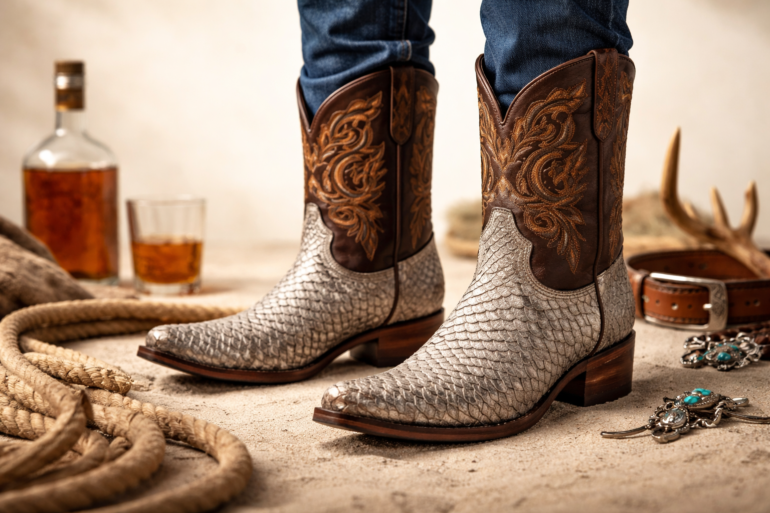
If you have been seeing more exotic textures in Western wear lately, there is a good reason for it. Fish Skin Boots are stepping into the spotlight as a bold option for people who want something different from standard leather without giving up craftsmanship, comfort, or visual impact. They stand out immediately, but they are not just about looks. For many buyers, the appeal comes from the mix of rarity, texture, sustainability, and that unmistakable high-end Western attitude.
What makes this material especially interesting is that fish leather is often made from skins that would otherwise go unused in food processing. The FAO notes that fish by-products can represent 20 to 80 percent of the fish, and those materials can be converted into value-added goods including fish leather. Research and industry sources also point to fish leather’s interwoven fiber structure, which helps explain why it is often described as strong, thin, and flexible when properly tanned and finished.
For Western style fans and luxury shoppers alike, that combination matters. You get a boot that feels fashion-forward, carries a premium look, and often comes with a strong story behind the material. That is exactly why Fish Skin Boots have started attracting attention from shoppers who want more than another pair of ordinary cowboy boots.
What Are Fish Skin Boots?
Fish Skin Boots are boots made with leather produced from fish skins, often from species such as pirarucu, salmon, tilapia, or other fish with distinctive scale patterns. Once the skin is properly tanned, finished, and shaped, it becomes a durable leather material with a surface that looks completely different from cowhide. The texture is the first thing people notice. Depending on the species and finish, the leather can appear scaled, sleek, rugged, polished, or almost architectural in pattern.
In Western fashion, boots have always been about function mixed with identity. Traditional cowhide remains the everyday staple, but exotic materials have long played a role in premium bootmaking. Fish leather fits naturally into that world because it offers the same sense of distinction buyers look for in other exotic leathers, while bringing a more unexpected visual texture to the table.
Why Fish Skin Boots Are Catching On
The rise of Fish Skin Boots is not random. They sit at the intersection of several trends happening at once.
1. Buyers want unique texture
Fashion has become more visual than ever. People want footwear that photographs well, starts conversations, and adds character to simple outfits. Fish leather does that naturally because no two skins look exactly alike. The scale pattern creates movement and depth that standard leather usually does not deliver.
2. Western fashion keeps evolving
Western wear is no longer limited to rodeos, ranch life, or country concerts. It has become a crossover category worn in cities, at fashion events, and in everyday street style. A pair of Fish Skin Boots can still feel Western, but they also lean luxurious and modern, which broadens their appeal.
3. Sustainability matters more to shoppers
Not every exotic leather has an easy sustainability story. Fish leather often comes from skins that are by-products of the food industry, which gives it a stronger circular-economy angle than many people expect. FAO publications highlight fish leather as one of the value-added products that can be made from aquatic processing by-products, helping reduce waste and improve resource use.
4. Luxury is shifting toward story and craftsmanship
Luxury buyers are not only paying for labels anymore. They want material quality, craftsmanship, scarcity, and a story that feels authentic. Fish leather offers all four when it is used well.
Are Fish Skin Boots Durable?
This is one of the first questions buyers ask, and it is fair. At first glance, people often assume fish leather must be delicate. In reality, well-processed fish leather can be impressively strong.
Researchers studying fish skin and fish leather regularly point to collagen structure and fiber arrangement as key reasons for its performance. One recent study described fish skin leather as stronger, more breathable, and thinner than leather derived from lamb or cowhides, while another materials study highlighted the damage tolerance of fish skin due to how collagen microfibers straighten and reorient under strain. That does not mean every pair will outlast every cowhide boot, because construction quality still matters, but it does mean fish leather should not be dismissed as a novelty material.
Durability in real life depends on a few things:
- The fish species used
- The tanning and finishing process
- The overall boot construction
- How often you wear them
- How well you care for them
If the bootmaker uses quality materials and proper construction, Fish Skin Boots can absolutely hold up as wearable fashion footwear rather than just closet pieces.
Fish Skin Boots vs Traditional Leather Boots
Choosing between fish leather and traditional leather is less about which one is universally better and more about what you want from your boots.
| Feature | Fish Skin Boots | Traditional Leather Boots |
|---|---|---|
| Visual texture | Distinctive and exotic | Classic and familiar |
| Weight | Often lighter and thinner | Varies, often thicker |
| Style factor | High statement value | Timeless versatility |
| Availability | More limited | Widely available |
| Care needs | Requires attentive exotic leather care | Usually easier to maintain |
| Conversation factor | Very high | Moderate |
Traditional cowhide boots are still the easiest all-around choice for hard daily wear. But Fish Skin Boots appeal to shoppers who want a luxury edge, standout texture, and a more fashion-driven profile.
Why They Work So Well in Western Fashion
Western style has always embraced materials with character. Smooth leather has its place, but exotic textures bring personality to a boot silhouette that people already know and love. Fish leather works particularly well because it adds visual detail without making the boot feel too flashy for everyday wear.
A pair of dark Fish Skin Boots with a clean square toe can work with raw denim, a crisp white shirt, and a tailored jacket. A more dramatic pair with visible scaling can fit right into concert wear, upscale casual styling, or statement luxury fashion. That range is part of the appeal. These boots can look rugged, refined, or fashion-forward depending on the last, shaft design, finish, and color.
For men, they often pair well with:
- Dark jeans and a fitted button-down
- Western shirts and a suede jacket
- Neutral trousers with a sharp blazer
For women, they can work with:
- Denim and a tucked-in blouse
- Midi dresses with a structured bag
- Tailored shorts and a lightweight jacket
- Monochrome outfits that let the boots take focus
The point is simple. Fish Skin Boots do not need a costume-style outfit. They can become the focal point of an otherwise clean, wearable look.
The Luxury Appeal of Fish Skin Boots
Luxury fashion often comes down to texture, scarcity, and finish. Fish leather checks all three boxes.
First, it has texture that cannot be faked easily. Even embossed leather tends to look repetitive when compared with the natural variation of real fish skin leather. Second, it is still a niche material. A recent research article noted that fish skin leather currently accounts for less than 1 percent of global leather sales, which reinforces the idea that it remains relatively uncommon in the broader market. Third, when bootmakers use refined finishing techniques, fish leather can look extremely polished and expensive.
Luxury shoppers also appreciate pieces that do not feel mass-produced. Fish Skin Boots can deliver that feeling because the material itself already looks special before the design details even come into play.
What to Look for Before You Buy
Not all Fish Skin Boots are created equal. If you are investing in a pair, pay attention to these points.
Leather source and finish
Different fish species create different textures. Some skins offer dramatic scale patterns, while others look more subtle. Ask what species is used and look closely at the finish.
Boot construction
A premium leather means less if the boot is poorly made. Check for:
- Quality stitching
- Clean welt construction
- Solid heel attachment
- Comfortable lining
- Balanced shape and support
Fit
Exotic boots should not be painfully tight. They should feel secure, structured, and wearable from the start, even if there is still a break-in period.
Brand reputation
Choose makers known for Western or exotic boots. Construction standards matter just as much as leather choice.
Intended use
Are you buying them for occasional statement wear, upscale casual outfits, or regular rotation? That will shape what kind of sole, toe shape, and finish makes the most sense.
How to Care for Fish Skin Boots
Care matters more with exotic materials, and Fish Skin Boots are no exception. The good news is that the basic principles are not difficult.
Boot-care guidance from Western brands such as Ariat and Lucchese recommends gentle brushing, air drying, and using conditioners designed for exotic or specialty leathers. Ariat specifically advises brushing gently in the direction of the scales for pirarucu footwear, while Lucchese recommends applying exotic leather conditioner in thin layers and avoiding harsh polish.
Here is a practical care routine:
Basic care checklist
- Brush off dust with a soft brush
- Wipe gently with a slightly damp cloth if needed
- Let boots air dry naturally
- Use a quality exotic leather conditioner every few months
- Store them away from direct heat and excess moisture
- Use boot trees to help maintain shape
What to avoid
- Soaking them in water
- Drying them with a heater or hair dryer
- Using aggressive polish
- Scrubbing against the scale direction
- Leaving them in humid storage for long periods
Good care preserves both the texture and the shape, which is exactly what you are paying for.
Are Fish Skin Boots Sustainable?
This is where the conversation gets more interesting. Fish leather is not automatically sustainable in every case, because tanning methods and supply chains still matter. But compared with materials made from entirely new animal production for fashion purposes, fish leather can have a stronger resource-efficiency argument.
FAO materials describe fish leather as one of the high-value products that can come from aquatic processing by-products, and fish waste management guidance notes that by-products can represent 20 to 80 percent of the fish. That means using skins for leather can help turn underused waste streams into fashion materials rather than discarding them. Some newer research has also focused on chrome-free or more sustainable tanning methods for fish leather production.
So the honest answer is this: Fish Skin Boots can be a more thoughtful choice when the leather comes from food-industry by-products and responsible tanning processes. That does not make every pair automatically eco-friendly, but it does give the category a meaningful sustainability angle.
Common Myths About Fish Skin Boots
Myth 1: They smell like fish
They should not. Properly tanned leather does not retain a fish smell. If it does, that points to poor processing or bad storage, not the material category itself.
Myth 2: They are too fragile to wear often
Quality matters, but fish leather is not just decorative. Its fiber structure is one reason it is taken seriously as a leather material.
Myth 3: They only work for bold fashion personalities
They can be bold, but they can also be subtle. Much depends on color, finish, shaft height, and outfit styling.
Myth 4: They are only for Western outfits
Not true. They work especially well in Western styling, but sleek pairs can also fit luxury casual wardrobes, fashion-forward streetwear, and elevated evening looks.
Who Should Buy Fish Skin Boots?
Fish Skin Boots make sense for several kinds of shoppers:
- Western wear fans who already own classic cowhide boots and want something more distinctive
- Luxury fashion buyers who appreciate unusual materials
- Style-conscious shoppers who want statement footwear without going overly flashy
- Consumers interested in materials with a stronger by-product and circular-use story
- People who enjoy collecting premium boots with unique texture and limited-market appeal
If you are someone who values individuality in your wardrobe, these boots can make a lot of sense.
Final Thoughts
Fish Skin Boots sit in a really interesting space. They have the silhouette and confidence of Western footwear, but they also bring the rarity and texture that luxury shoppers crave. They are not the right choice for every person or every occasion, but that is part of their charm. They feel selective. Intentional. Stylish.
For buyers who want boots that do more than blend in, this category offers a strong alternative to standard leather. The best pairs combine craftsmanship, comfort, eye-catching texture, and a more thoughtful material story. That makes them more than a trend piece. It makes them a serious option for anyone building a wardrobe with personality.
In the end, Fish Skin Boots work best for people who care about detail. If you appreciate premium materials, want your footwear to say something, and like the mix of Western attitude with upscale fashion appeal, these boots are worth a closer look. Their place in modern style feels more relevant than ever, especially as shoppers pay more attention to craftsmanship, material sourcing, and Western fashion.
FAQ
Are Fish Skin Boots real leather?
Yes. They are made from fish skins that have been tanned and finished into wearable leather material.
Are Fish Skin Boots durable for regular wear?
They can be, especially when made well. Durability depends on species, tanning quality, construction, and care. Research on fish skin structure supports the idea that the material can be strong and damage-tolerant.
Do Fish Skin Boots need special care?
Yes. They should be treated like exotic leather boots, using gentle cleaning, proper conditioning, and careful storage.
Are Fish Skin Boots sustainable?
They can be a more resource-efficient option when made from fish-processing by-products and tanned responsibly, but sustainability still depends on how the leather is sourced and processed.
Are they only for Western outfits?
No. They look great with Western wear, but they can also work in luxury casual and fashion-forward wardrobes.
Sources:
Food and Agriculture Organization of the United Nations, fish by-products and fish leather resources.
Peer-reviewed research on fish leather properties and fish skin mechanics.
Boot care references from Ariat and Lucchese.