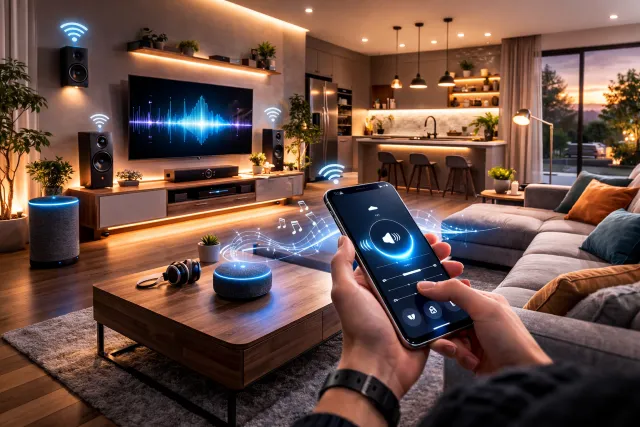
Walk into a modern smart home today and you will notice something subtle but powerful. Music follows you from room to room. Doorbells announce visitors through ceiling speakers. Your favorite podcast resumes exactly where you left it, even if you switch devices. This seamless experience is powered by Cloud Connected Audio, and it is quietly transforming how we live, relax, and interact with our homes.
Not long ago, home audio systems were bulky, wired, and limited to a single room. Today, thanks to cloud computing and wireless connectivity, audio has become intelligent, flexible, and deeply integrated into the broader smart home ecosystem. In this article, we will explore how Cloud Connected Audio works, why it matters, and why it is rapidly becoming the backbone of modern connected living.
What Is Cloud Connected Audio?
At its core, Cloud Connected Audio refers to audio systems that use cloud infrastructure to stream, manage, store, and synchronize sound across devices and locations.
Instead of relying solely on local hardware like traditional stereos, these systems connect to remote servers through the internet. This allows them to:
- Stream music and podcasts on demand
- Sync audio across multiple rooms
- Update software automatically
- Integrate with smart assistants like Alexa or Google Assistant
- Store user preferences in the cloud
According to Statista, the global smart home market is expected to surpass 230 billion dollars by 2028, driven largely by connected devices and IoT integration. Audio systems are no longer standalone gadgets. They are part of a broader digital ecosystem powered by cloud computing.
How Cloud Connected Audio Works in Smart Homes
To understand the impact, you need to see how the system operates behind the scenes.
When you ask your smart speaker to play a song:
- Your voice command is processed through cloud servers.
- The system accesses your streaming account.
- The selected audio is streamed through the internet.
- Multiple speakers sync in real time.
- Your listening preferences are stored and analyzed.
This architecture removes hardware limitations and replaces them with software-driven flexibility.
Key Components of a Cloud Based Audio System
- WiFi or Ethernet connectivity
- Smart speakers or connected amplifiers
- Cloud storage and streaming platforms
- AI voice assistants
- Mobile app control
The beauty of this setup lies in its simplicity for the user. Everything feels instant, but powerful cloud servers handle the heavy lifting.
The Shift From Traditional Audio to Cloud Powered Sound
Traditional home audio systems relied on physical media or direct connections. CDs, aux cables, and local radio dominated the experience.
Cloud Connected Audio changes everything.
Feature | Traditional Audio | Cloud Based Audio
Single Room | Yes | No
Multi Room Sync | Limited | Seamless
Remote Access | No | Yes
Automatic Updates | No | Yes
Voice Control | No | Yes
The difference is not just technical. It is experiential. You move from static listening to intelligent, adaptive sound.
Why Smart Homes Depend on Cloud Connected Audio
Smart homes are built around integration. Lighting, security, thermostats, and appliances communicate with one another. Audio plays a central role in this ecosystem.
Here is why.
1. Seamless Multi Room Audio
Imagine hosting a dinner party. Music plays in the kitchen, living room, and patio without delay or echo. Every speaker remains perfectly synchronized.
This is possible because cloud servers coordinate playback timing across devices.
2. Voice Assistant Integration
Cloud Connected Audio integrates naturally with AI assistants. You can:
- Adjust volume hands free
- Switch playlists instantly
- Control music in different rooms
- Set wake up alarms with streaming services
Research by Juniper Research shows that over 8 billion digital voice assistants will be in use globally. Audio systems are one of their most common applications.
3. Personalized Listening Experiences
Because user data is stored in the cloud, your preferences travel with you.
Your playlists, equalizer settings, and listening history remain accessible whether you are at home or away.
This personalization enhances user satisfaction and increases engagement.
4. Remote Access and Control
Traveling? You can still manage your home audio through your smartphone.
Parents can control volume limits. Homeowners can activate announcements remotely. Updates and patches install automatically.
That level of convenience was unimaginable a decade ago.
Cloud Connected Audio and Home Automation
Modern automation routines rely heavily on audio triggers and responses.
Here are some real world examples:
- Doorbell rings and music automatically lowers
- Smoke alarm triggers voice alerts in every room
- Morning routine plays news briefing and weather report
- Motion sensor activates welcome message
This integration strengthens the overall smart home experience.
The concept aligns with the broader framework of the Internet of Things, where devices communicate seamlessly. You can explore more about this ecosystem on Wikipedia under the term Internet of Things.
Security and Data Protection in Cloud Audio Systems
Whenever cloud services are involved, security becomes a concern.
Reputable audio brands use:
- End to end encryption
- Secure authentication protocols
- Regular firmware updates
- Encrypted streaming connections
According to a report by IBM Security, misconfigured cloud systems are among the most common vulnerabilities. Leading smart audio manufacturers now prioritize automatic updates to address these risks quickly.
Homeowners should still:
- Use strong WiFi passwords
- Enable two factor authentication
- Keep devices updated
Security is a shared responsibility.
Energy Efficiency and Smart Power Management
Cloud enabled audio systems are more energy efficient than older systems.
Many smart speakers enter sleep mode when idle. Cloud processing reduces local hardware demands. Firmware updates optimize performance over time.
As sustainability becomes a priority, energy efficient devices play a growing role in responsible home design.
Real World Case Study: A Fully Connected Home
Consider a family living in a smart home equipped with connected lighting, thermostats, and security cameras.
In the morning:
- Bedroom speakers play a gentle alarm synced with sunrise lighting.
- The kitchen speaker streams a daily news podcast.
- The system reads calendar events aloud.
In the evening:
- The living room sound system automatically switches to movie mode.
- Surround speakers adjust audio based on room acoustics.
- Voice commands dim lights and control volume simultaneously.
This scenario is no longer futuristic. It is standard in many new smart home installations.
Benefits for Homeowners and Property Developers
Cloud Connected Audio is not only attractive to tech enthusiasts.
It offers tangible benefits:
For Homeowners
- Increased property value
- Flexible system upgrades
- Enhanced entertainment experience
- Improved accessibility
For Developers
- Competitive advantage in smart housing
- Scalable infrastructure
- Reduced wiring complexity
- Easier maintenance through remote diagnostics
The National Association of Realtors reports that smart home features significantly influence buyer decisions, particularly among younger demographics.
Frequently Asked Questions About Cloud Connected Audio
What makes Cloud Connected Audio different from Bluetooth speakers?
Bluetooth speakers rely on direct device pairing and limited range. Cloud based systems use internet connectivity, allowing multi room sync, remote access, and advanced integrations.
Does it require constant internet access?
Most features depend on internet connectivity. Some systems allow limited offline playback, but full functionality requires stable broadband.
Is it expensive to install?
Costs vary. Entry level systems are affordable, while whole home installations require higher investment. However, long term scalability reduces upgrade costs.
Can older homes support this technology?
Yes. Wireless connectivity eliminates the need for extensive rewiring. Many systems retrofit easily into existing homes.
The Future of Audio in Smart Living
The next evolution of Cloud Connected Audio will likely include:
- AI driven sound personalization
- Adaptive room calibration
- Advanced spatial audio
- Integration with wearable devices
- Predictive automation based on user behavior
As 5G networks expand and broadband speeds improve, latency will decrease further. Real time synchronization will become even more precise.
Audio will not just respond to commands. It will anticipate needs.
Actionable Tips for Choosing the Right Cloud Audio System
If you are planning to upgrade your smart home, consider these practical steps:
- Evaluate your WiFi coverage first. Strong connectivity is essential.
- Choose brands with strong security reputations.
- Check compatibility with your existing smart devices.
- Look for systems that support multiple streaming services.
- Prioritize scalability for future expansion.
Investing wisely ensures long term satisfaction.
Why Cloud Connected Audio Is More Than a Trend
Trends fade. Infrastructure stays.
Cloud Connected Audio is not just about playing music. It represents a shift from isolated devices to interconnected digital ecosystems.
It supports convenience, personalization, automation, and intelligent living.
As smart homes become mainstream, audio will continue to anchor user interaction. It creates ambiance, delivers information, and connects people emotionally to their spaces.
In many ways, sound is the invisible interface of the modern home.
Conclusion
Cloud Connected Audio is reshaping how smart homes function and feel. It blends cloud computing, wireless technology, and intelligent automation into a seamless listening experience.
From synchronized multi room sound to voice controlled convenience, the benefits are practical and transformative. Homeowners gain flexibility and personalization. Developers gain scalability and appeal. Families gain comfort and connection.
As cloud infrastructure continues to evolve, this technology will only grow more powerful and intuitive. Investing in Cloud Connected Audio today is not just about better sound. It is about building a smarter, more responsive home environment for the future.