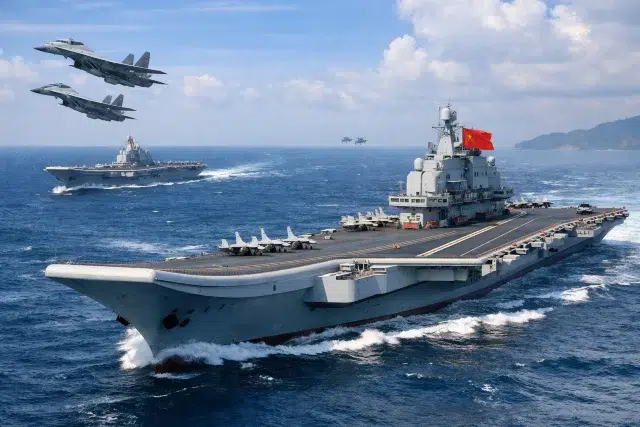
If you have even a casual interest in world affairs, you’ve probably noticed how often aircraft carriers come up when people talk about power. They’re huge, expensive, and packed with symbolism. And lately, one phrase keeps showing up in headlines and analysis: China’s Growing Aircraft Carrier Fleet.
So what’s actually happening here, and why should a regular reader care?
In plain terms, China is building and fielding more carriers, improving how they operate them, and adding newer technology that changes what those ships can do. The result is a steady shift in the balance of maritime power in the Indo-Pacific, and it affects everything from regional security to trade routes and crisis politics. The story of China’s Growing Aircraft Carrier Fleet is not just “more ships,” it’s a fast learning curve, better aircraft, and a navy that’s trying to operate farther from home with more confidence.
Quick definition: what an aircraft carrier really does
An aircraft carrier is basically a floating airbase. It lets a country:
- Launch aircraft without relying on nearby land bases
- Keep aircraft in the air longer through at-sea refueling and quick turnarounds
- Protect ships and sea lanes with fighters and airborne surveillance
- Apply pressure in a crisis by simply showing up and staying nearby
That “show up and stay” part is why carriers matter politically as much as militarily.
The basics of China’s Growing Aircraft Carrier Fleet
China currently operates multiple aircraft carriers and is pushing toward a larger force over the next decade. In the U.S. Department of Defense’s 2025 report, the PLAN’s third aircraft carrier Fujian (CV-18) is highlighted as a major step, including its first sea trials in May 2024, and the report also lays out an ambitious long-term carrier goal.
At the simplest level, China’s Growing Aircraft Carrier Fleet has moved through three phases:
- Learn the carrier basics (training, deck handling, safety, flight cycles)
- Operate more confidently with two carriers (including dual-carrier activity)
- Upgrade technology with a new generation carrier designed for heavier, more capable aircraft and higher sortie rates
Meet the ships: Liaoning, Shandong, and Fujian
Here’s a simple, high-level look at China’s three headline carriers. Numbers vary by source and configuration, so treat them as approximations rather than precise “spec sheet” facts.
Carrier snapshot table
| Carrier | Type / Role | Launch system | Why it matters |
|---|---|---|---|
| Liaoning | First operational carrier (training-heavy) | Ski-jump style system | Built operational know-how and pilot training culture |
| Shandong | First domestically built operational carrier | Ski-jump style system | Improved design maturity and carrier task group routines |
| Fujian (CV-18) | New generation domestic design | Electromagnetic catapults | Enables heavier aircraft and a more advanced air wing |
CSIS notes the step-change clearly: Fujian is larger and uses a more advanced launch approach than the first two carriers, which rely on ski-jump operations.
Why China’s Growing Aircraft Carrier Fleet matters right now
Let’s make this practical. Carriers matter most in three situations:
1) Crisis pressure and signaling
Carriers are tools of presence. When a carrier sails into a region, it’s a message that doesn’t require a speech. It signals readiness, resolve, and the ability to sustain operations nearby.
2) Air power without nearby bases
Land bases can be politically sensitive (other countries may deny access) or vulnerable (missiles, sabotage, cyber disruption). A carrier reduces dependence on permission and proximity.
3) Building a navy that can operate farther from home
The long-term goal isn’t only owning carriers, it’s running them effectively with escorts, submarines, logistics ships, satellites, and trained crews. That is what turns a ship into a system.
This is why analysts treat China’s Growing Aircraft Carrier Fleet as a “capability story,” not a “ship-count story.”
The technology leap: why Fujian changes the conversation
The Fujian is widely viewed as a turning point because it is designed as a flat-deck carrier with catapult-style launches, which generally allows:
- Aircraft to take off with more fuel and heavier payloads
- A broader mix of aircraft types (including fixed-wing early warning aircraft)
- Higher sortie generation potential (more launches over time), depending on training and maintenance
The DoD report explicitly describes Fujian as the PLAN’s first indigenously designed carrier and notes that it is larger than the previous two and a flat-deck design.
CSIS adds that Fujian uses an electromagnetic catapult system and contrasts it with the ski-jump systems of Liaoning and Shandong.
What aircraft might fly from Fujian?
This is where it gets interesting for readers who love “what can it do?” questions.
The DoD report says the PLAN likely intends Fujian’s future air wing to include platforms such as:
- J-35 stealth fighter
- J-15T fighter variant
- J-15D electronic warfare aircraft
- KJ-600 early warning aircraft
- Z-20 helicopters
- UAVs
And there have been public reports of catapult launches from Fujian during trials, including footage discussed by major outlets.
None of this automatically means “ready for major combat tomorrow.” Carriers are complex, and operational mastery takes years. But it does show direction and momentum, which is the core story behind China’s Growing Aircraft Carrier Fleet.
The “hard part” isn’t building the ship: it’s building the ecosystem
A carrier at sea is never alone. It usually sails as the centerpiece of a carrier strike group or task group. That means:
- Air defense destroyers to protect against aircraft and missiles
- Frigates/corvettes for layered defense and patrol
- Submarines for scouting and deterrence
- Logistics ships (fuel, ammo, spare parts)
- Intelligence and surveillance from satellites and maritime patrol assets
- Command-and-control networks to coordinate everything
This is why China’s Growing Aircraft Carrier Fleet is tightly linked to broader Chinese naval modernization, shipbuilding capacity, and C4ISR improvements (command, control, communications, computers, intelligence, surveillance, reconnaissance).
Dual-carrier operations: why two carriers are more than “double”
Operating two carriers at once is not just a flex. It changes real planning math.
With two carriers, a navy can:
- Keep one training while the other deploys
- Rotate maintenance schedules more intelligently
- Complicate an opponent’s tracking and planning
- Conduct larger air operations during exercises
In October 2024, China conducted dual-carrier operations with Liaoning and Shandong, according to both the DoD report and IISS analysis of China’s evolving carrier activity.
That matters because it suggests the PLAN is building confidence in coordinating large naval formations, which is central to the story of China’s Growing Aircraft Carrier Fleet.
How this impacts the Indo-Pacific in everyday language
You don’t need to be a military expert to understand the regional effects. Here are the most practical ones:
More persistent presence
More carriers generally means more time at sea across more areas. That increases routine patrols and the ability to surge forces during crises.
Stronger “gray zone” leverage
A stronger navy can shape behavior without firing a shot. It can escort, shadow, intimidate, or pressure other vessels and coast guards during disputes.
Higher stakes during accidents and close encounters
The more ships and aircraft operating in the same spaces, the more chances for miscalculation. This is one reason defense hotlines, professional conduct, and clear communication matter.
The long-term plan: what China says it’s aiming for
One of the most quoted lines in recent official U.S. assessments is about scale.
The DoD 2025 report states that the PLAN aims to produce six aircraft carriers by 2035 for a total of nine.
Even if timelines slip (they often do in military programs), that goal tells you how Chinese planners see the future: carriers as a regular, expected tool of national power. It also frames China’s Growing Aircraft Carrier Fleet as a multi-decade project, not a short-term burst.
A realistic view: carriers are powerful, but they have limits
It’s easy to talk about carriers like they’re unstoppable. In reality, they come with trade-offs.
What makes carriers vulnerable or constrained?
- They’re expensive to build, crew, maintain, and protect
- They require complex training for safe and effective flight operations
- They can be tracked by satellites and other sensors, especially in high-tension scenarios
- They must operate within a larger strategy (carriers don’t solve every problem)
In other words, China’s Growing Aircraft Carrier Fleet increases options, but it also creates new demands: more escorts, more logistics, more pilots, more maintenance capacity, and more experience.
What should other countries watch for?
If you’re trying to understand whether China’s Growing Aircraft Carrier Fleet is becoming more operationally significant, watch for these signals:
- More frequent and longer deployments farther from China’s coastline
- Higher-tempo flight operations during exercises (more launches and recoveries per day)
- Integration of KJ-600-like early warning aircraft as a routine part of the air wing
- Regular dual-carrier drills that involve realistic escorts and logistics
- Clear evidence of mature maintenance cycles, not just one-off headline events
These indicators matter more than dramatic photos.
Common questions people ask about China’s Growing Aircraft Carrier Fleet
How many aircraft carriers does China have?
China has multiple carriers in service and has advanced its newest carrier program rapidly, with Fujian entering a key stage with sea trials beginning in May 2024 and later commissioning reported by major defense-watch outlets and research organizations in early November 2025.
Is Fujian “as good as” U.S. supercarriers?
Not in overall experience and ecosystem yet. Fujian is a leap forward in design and launch technology, but carrier effectiveness depends heavily on training depth, logistics, joint integration, and sustained operational practice. CSIS notes Fujian’s advantages over China’s earlier carriers while also pointing out areas where it still lags the most capable U.S. carriers.
Why do catapults matter so much?
Catapults help launch heavier aircraft with more fuel and payload. That usually translates into longer range, more flexibility in mission types, and a better chance to field fixed-wing early warning aircraft that extend surveillance.
Could carriers be used in a Taiwan scenario?
Carriers are one piece of a much larger toolkit. The DoD report discusses PLAN activity related to exercises around Taiwan, including carrier task group operations east of Taiwan during a 2024 exercise scenario.
Practical takeaway for readers: what this power shift means
Here’s the simple way to think about it:
- More carriers equals more presence and more political leverage
- Better carrier aviation equals more credible air power at distance
- More experience equals fewer mistakes, tighter routines, and higher readiness
The shift isn’t just about prestige. China’s Growing Aircraft Carrier Fleet influences how neighbors plan their defenses, how alliances posture in peacetime, and how quickly a crisis can escalate if both sides push too hard.
Conclusion: the big picture in plain English
If you strip away the jargon, the story is straightforward. China’s Growing Aircraft Carrier Fleet is turning carriers from a learning project into a more regular tool of state power. The Fujian’s step up in design and launch technology, the move toward more complex dual-carrier operations, and the stated long-term growth goals all point in the same direction: a navy that wants to operate farther out, more often, with more options.
That doesn’t mean automatic dominance. Carrier operations are unforgiving, and real proficiency is built over years of routines, setbacks, and repetition. But it does mean the region is adapting to a new normal where Chinese carriers are more present, more capable, and more central to Beijing’s planning than they were a decade ago.
And if you want one mental image to keep things simple: moving from a ramp-style approach to a more advanced launch system changes what a carrier can lift into the sky, how often it can do it, and how far those aircraft can go. That’s why even the humble phrase ski jump ends up being part of the bigger strategic conversation in the final analysis.