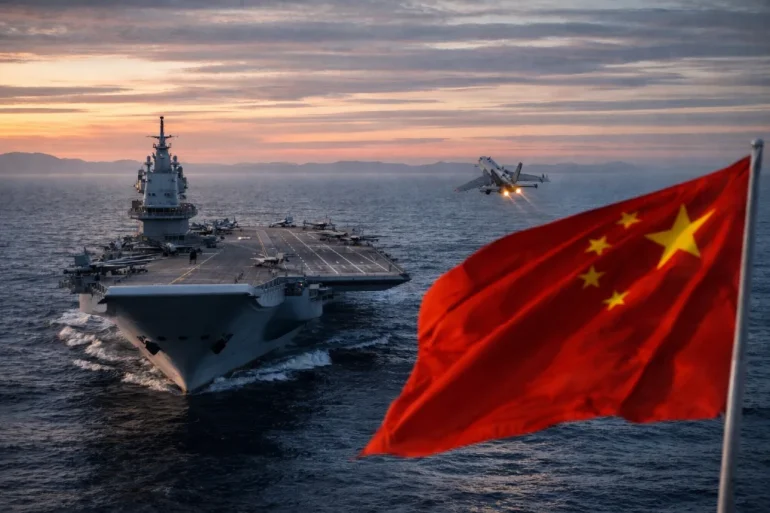
If you have been following naval headlines, you have probably noticed the same theme: China’s Aircraft Carrier Fleet Expansion is no longer a slow, symbolic project. China’s Aircraft Carrier Fleet Expansion is turning into a practical tool that reshapes how power is measured across the Indo-Pacific. For countries around China’s maritime neighborhood, carriers are not just big ships. They are moving airfields that can show up near a disputed sea lane, support a major exercise, or signal political intent without firing a shot.
In this guide to China’s Aircraft Carrier Fleet Expansion, we will keep it simple: what China has built, what it can do, and where the limits still are.
Quick definition: why carriers change the game
An aircraft carrier is a floating runway designed to launch and recover fixed-wing aircraft. In peacetime, it is a high-profile symbol of presence. In a crisis, it can provide:
- Air defense for a naval force operating far from home
- Strike options against ships and land targets
- Persistent surveillance when supported by early-warning aircraft
- A political signal that is hard to ignore
Because a carrier can move hundreds of kilometers per day, it compresses decision time for other capitals. That is the first reason China’s Aircraft Carrier Fleet Expansion matters.
China’s Aircraft Carrier Fleet Expansion: from ski-jump learning ships to a catapult era
For years, China operated two ski-jump carriers based on an older Soviet design line. The U.S. Department of Defense describes the PLAN’s two earlier carriers as “moderate-capability” ski-jump ships, and notes that China launched its third carrier, Fujian, in June 2022 and began sea trials in the first half of 2024. It also assessed Fujian as larger and fitted with an electromagnetic catapult launch system, with an expectation of operational service in the first half of 2025.
That shift is the heart of China’s Aircraft Carrier Fleet Expansion. Ski-jump carriers are useful for training, regional presence, and building muscle memory. But they impose performance limits. Catapults, especially electromagnetic catapults, open the door to heavier takeoffs, higher sortie generation, and new aircraft types.
The current carrier lineup and what each one is good for
When you zoom in on China’s Aircraft Carrier Fleet Expansion, the three carriers look like a structured learning curve:
- Liaoning (CV-16): A refurbished platform that helped China learn the basics of deck operations.
- Shandong (CV-17): A domestically built evolution that improved industrial know-how and routine deployments.
- Fujian (CV-18): A generational leap aimed at building a more complete carrier air wing.
Naval reporting notes that Fujian was officially commissioned into active service on November 5, 2025, and highlights that it is China’s first carrier equipped with electromagnetic catapults.
This matters because China’s Aircraft Carrier Fleet Expansion is not only about owning carriers. It is about making carrier operations repeatable: crews, pilots, maintenance, and a sustainable deployment rhythm.
A simple table: what changes when China adds more carriers
For most readers, the practical question is not “how big is the ship.” It is “what does a larger fleet let China do more often.” Here is the simplest way to think about China’s Aircraft Carrier Fleet Expansion:
| Capability area | 1 carrier | 2 carriers | 3 carriers | 4+ carriers |
|---|---|---|---|---|
| Presence | Occasional, predictable | More frequent | Near-continuous options | Persistent rotations across theaters |
| Training | Limited deck time | Better cycle | Stronger air wing development | Institutional experience accelerates |
| Crisis response | One surge option | Some redundancy | Real flexibility | Multi-axis operations become plausible |
| Deterrence | Symbolic | Regional | Regional plus wider Indo-Pacific | Stronger leverage across hotspots |
As China moves from 2 to 3 carriers and then toward a larger force, the biggest change is not just more steel at sea. It is the ability to keep one carrier deployed, one preparing, and one in maintenance. That fleet rhythm is central to China’s Aircraft Carrier Fleet Expansion.
China’s Aircraft Carrier Fleet Expansion in numbers: fleet growth and industrial depth
Carriers do not operate alone. A carrier needs escort ships, submarines, logistics ships, and sensors. The DoD’s 2024 report states that China has the world’s largest navy by numbers, with a battle force of over 370 ships and submarines. It projects growth to 395 ships by 2025 and 435 by 2030.
That context matters because China’s Aircraft Carrier Fleet Expansion is nested inside a much larger naval modernization wave. A carrier without escorts is vulnerable. A carrier supported by a modern surface and submarine fleet is far more credible.
On the industrial side, CSIS analysis highlights China’s commanding position in global commercial shipbuilding, noting China captured over 53 percent of global market share in 2024 while the U.S. accounted for about 0.1 percent. The shipyard ecosystem that produces commercial hulls can also support naval output, which helps explain why China’s Aircraft Carrier Fleet Expansion looks sustainable over the long run.
What carriers actually do for China’s strategy
When people talk about the “power balance” in Asia, they often jump straight to Taiwan. That is an important context, but China’s Aircraft Carrier Fleet Expansion influences more than one scenario.
1) Extending air cover beyond the coastline
China already has strong land-based airpower. The value of China’s Aircraft Carrier Fleet Expansion is that carriers can extend air cover into areas where land-based aircraft are stretched by distance or where basing access is politically complicated.
In practical terms, China’s Aircraft Carrier Fleet Expansion supports operations in the Philippine Sea, the South China Sea, and potentially farther into the Indian Ocean, especially when paired with replenishment ships.
2) Adding a background pressure tool in gray-zone competition
Many Indo-Pacific disputes play out in “gray-zone” settings: coast guard patrols, maritime militia activity, and incremental steps. A carrier group in the background can change risk calculations, which is a quieter effect of China’s Aircraft Carrier Fleet Expansion.
3) Prestige, diplomacy, and signaling
Carriers are diplomatic tools. Port visits, joint exercises, and media coverage are not superficial. They create perceptions of momentum, and perceptions influence alliances and defense budgets. This is one reason China’s Aircraft Carrier Fleet Expansion produces political effects even when the ships are not in combat.
The Fujian effect: why the catapult changes the air wing
The leap from ski-jump to catapult is not just about launching fighters with heavier fuel and weapons loads. It is about launching specialized aircraft and sustaining higher-tempo flight operations.
The DoD report notes that once combat certified, Fujian will be capable of launching specialized fixed-wing aircraft for early warning, electronic warfare, or anti-submarine missions, increasing power projection capability.
That statement is a big clue about where China’s Aircraft Carrier Fleet Expansion is heading. In carrier warfare, the difference between “some fighters” and a full air wing comes from enabling aircraft that see farther, coordinate better, and protect the group.
A realistic scenario: how this changes operations near the first island chain
Picture a period of high tension where multiple navies increase patrols near Taiwan and the northern Philippines. With ski-jump carriers, China can generate fighter sorties, but it is more limited in launching heavier support aircraft.
With a catapult carrier, China’s Aircraft Carrier Fleet Expansion can support a more layered package:
- Fighters for air superiority and escort
- Airborne early warning for detection and control
- Electronic warfare aircraft to disrupt sensors and communications
- Anti-submarine assets to defend the carrier group
That begins to resemble the “carrier strike group” model that other navies have refined over decades. It does not mean China is already at that level. It means China’s Aircraft Carrier Fleet Expansion is building toward it.
Why Asia’s power balance feels different now
A carrier does not automatically decide a conflict, but it changes the menu of options. For Asian capitals, the shift comes from three overlapping effects tied to China’s Aircraft Carrier Fleet Expansion.
Effect 1: More ways to signal, surge, and sustain
Even if China’s carrier fleet remains smaller than the United States, regional actors measure risk locally. Two or three carriers can already complicate planning for Japan, Taiwan, the Philippines, and India. Four or more can allow simultaneous pressure in separate theaters. This is why China’s Aircraft Carrier Fleet Expansion affects the broader Indo-Pacific, not just one flashpoint.
Effect 2: Deterrence becomes more symmetrical at sea
For decades, U.S. carrier presence was a major asymmetric advantage in Asia. China’s Aircraft Carrier Fleet Expansion does not erase that advantage, but it can narrow the gap in certain operating areas, especially closer to China’s shore-based defenses.
Effect 3: Alliance and budget ripple effects
When navies feel pressure, they respond with better surveillance, longer-range weapons, and more joint planning. The point is not that everyone will build carriers. The point is that China’s Aircraft Carrier Fleet Expansion nudges others to invest in countermeasures, resilience, and situational awareness.
The limits: what still constrains China’s carrier power
This is where it helps to separate headlines from capability. China’s Aircraft Carrier Fleet Expansion is real, but carriers are hard to operate at a high level.
1) Carrier aviation culture and deck experience
The hardest part of a carrier program is not building the ship. It is building the training pipeline and the safety culture that allows high-tempo operations in bad weather, at night, and far from home. China is accumulating experience quickly, but experience cannot be mass-produced overnight. So China’s Aircraft Carrier Fleet Expansion is still in an acceleration phase: ship numbers can rise faster than deep operational confidence.
2) Logistics: the boring backbone that decides endurance
A carrier is only as persistent as its logistics. Fuel, spare parts, munitions, and maintenance capacity decide how long a force can stay on station. The DoD report notes China has a sizable force of replenishment ships supporting long-distance deployments and mentions new fast combat support ships built specifically to support carrier and amphibious operations.
That support fleet strengthens China’s Aircraft Carrier Fleet Expansion, but global endurance remains a steep climb. Long deployments demand reliable resupply rhythms and repair options.
3) Survivability in a missile and drone age
Carriers are powerful, but they are also high-value targets. Modern anti-ship missiles, submarines, and long-range surveillance make carrier operations riskier in contested waters. This is not unique to China. It is the reality every carrier navy faces. In other words, China’s Aircraft Carrier Fleet Expansion increases options, but it also increases what China must protect.
What this means for key regional players
How China’s Aircraft Carrier Fleet Expansion changes the balance is partly about reactions. Here is what the shift can mean in practical defense planning terms.
Japan
Japan is likely to lean into layered defense: submarines, anti-ship missiles, integrated air and missile defense, and stronger maritime domain awareness. A larger Chinese carrier presence increases the need for rapid detection and long-range response.
Taiwan
For Taiwan, China’s Aircraft Carrier Fleet Expansion matters less as an invasion platform and more as a tool of encirclement, air cover, and pressure during a blockade-like scenario. The strategic challenge is not only “stop a landing” but also “keep sea and air lanes usable under sustained pressure.”
The Philippines and Southeast Asia
Southeast Asian states often prioritize coast guard needs, but a carrier presence in the South China Sea raises the stakes. Expect more emphasis on ISR, coastal defense, and partnerships that improve maritime awareness. Those are typical responses to China’s Aircraft Carrier Fleet Expansion that do not require building a carrier of your own.
India
India will watch carrier developments through the lens of the Indian Ocean. Even limited Chinese carrier operations in that region can be politically meaningful, especially when paired with submarines and dual-use port access. This is why China’s Aircraft Carrier Fleet Expansion is not just an East Asia story.
Practical takeaways: how to track capability, not hype
If you want to follow China’s Aircraft Carrier Fleet Expansion without getting pulled into sensational headlines, focus on a few grounded signals:
- Air wing maturity: look for routine, high-tempo flight operations and integrated training.
- Specialized aircraft: early warning and electronic warfare platforms multiply capability.
- Carrier group composition: escorts and submarines show how confident planners feel.
- Replenishment patterns: logistics ships and resupply rhythms reveal endurance.
- Exercise complexity: multi-carrier or multi-theater activity shows growing sophistication.
These signals do not require classified knowledge. They show whether China’s Aircraft Carrier Fleet Expansion is translating into operational power.
FAQs
How many aircraft carriers does China have right now?
China has three operational aircraft carriers: Liaoning, Shandong, and Fujian, with Fujian commissioned into active service in November 2025. That current lineup is the visible foundation of China’s Aircraft Carrier Fleet Expansion.
Why is Fujian considered a big leap?
Fujian is China’s first carrier fitted with an electromagnetic catapult launch system, enabling a wider range of aircraft types and faster flight operations compared with ski-jump carriers. This is the clearest single-step change inside China’s Aircraft Carrier Fleet Expansion.
Does more carriers automatically mean dominance in Asia?
No. China’s Aircraft Carrier Fleet Expansion expands options, but carrier effectiveness depends on trained air wings, escorts, logistics, and operational experience. Quantity helps, yet quality and integration decide outcomes.
What is the bigger trend behind the carrier story?
China’s Aircraft Carrier Fleet Expansion is supported by broader fleet growth. DoD projects the PLAN battle force to grow to 395 ships by 2025 and 435 by 2030.
Conclusion: a shifting balance, not a finished story
China’s Aircraft Carrier Fleet Expansion is already changing Asia’s power balance because it increases China’s ability to sustain naval airpower presence beyond its coastline and to create more flexible crisis options. The commissioning of Fujian, the move toward catapult operations, and the broader growth of the PLAN’s fleet all point in the same direction.
At the same time, China’s Aircraft Carrier Fleet Expansion is not a shortcut to dominance. Experience, logistics, and survivability in a contested environment will decide how effectively China can use these ships in real operations. For the region, the smart response is steady investment in awareness, resilience, and credible deterrence.
If you want a deeper background on the broader carrier program, it helps to view today’s ships as stages of a long learning curve rather than a single leap. That perspective makes it easier to understand why China’s Aircraft Carrier Fleet Expansion is shifting the balance, while still leaving room for uncertainty.