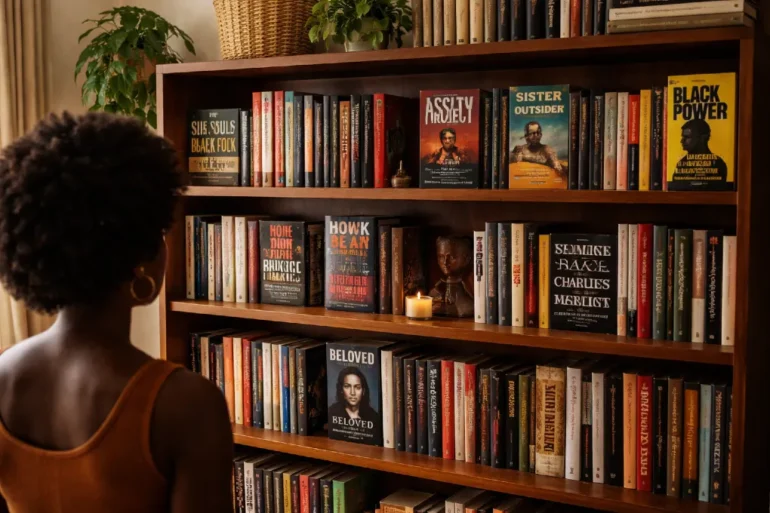
If you have ever finished a book and felt like it unlocked a whole new room in your mind, you already understand why the Blackness Library matters. The Blackness Library is not just a list of titles. It is a way of organizing knowledge, memory, creativity, and lived experience into something you can actually explore one page at a time. It is where Black history feels less like a single chapter and more like a whole bookshelf, full of voices, debates, joy, grief, invention, and survival.
In practice, the Blackness Library can be a personal reading corner, a community collection, a classroom resource, or a digital shelf you build over time. Some places even have a real-world anchor for that idea, like the Blackness Community Library in Dundee, Scotland, which serves its local community with lending, learning, and access to information.
What makes the Blackness Library powerful is simple: it helps you read Black life as complex, global, and deeply human, instead of letting it get flattened into stereotypes or “special month” content. And once you start reading with that mindset, it changes what you notice everywhere.
What the Blackness Library really means
Let’s put a clear definition on it.
The Blackness Library is a curated collection of books and resources that explore Black identity, Black history, Black culture, and Black contributions to the world, across genres and time periods. It can include:
- History and biography
- Novels, poetry, and plays
- Politics, sociology, and cultural criticism
- Art, music, fashion, film, and sports writing
- Children’s books and young adult literature
- Practical titles on business, wellness, and community building
The point is not to treat Blackness as one topic. The point is to treat it as a full universe of thought, with different regions inside it.
And it matters because publishing has not always treated it that way.
PEN America’s research highlights how overwhelmingly white the traditional publishing canon has been, noting analysis that found 95% of American fiction books published between 1950 and 2018 were written by white authors. That kind of imbalance doesn’t just shape what gets published. It shapes what gets taught, what gets reviewed, what gets adapted, and what gets remembered.
A Blackness Library is one practical answer to that gap. It is a way for readers to take control of their own education and curiosity, and to keep the work going long after the headlines move on.
Why the Blackness Library is essential right now
There are moments when interest spikes, and then fades. A real Blackness Library is built for the long game.
1) Representation is still uneven, especially for young readers
The Cooperative Children’s Book Center (CCBC) has tracked diversity statistics in children’s and teen books for decades, documenting how many books are by and about Black, Indigenous, and other people of color. Their long-running dataset exists for a reason: the industry has struggled to reflect the real world.
And the conversation is not just academic. Recent reporting in the UK has flagged sharp concerns about representation in children’s publishing, including a notable decline in Black main-character representation in one recent year-to-year analysis.
2) Curriculum diversity moves slowly
When schools change reading lists, it can take years. Reporting in early 2026 highlighted ongoing debate in England about diversifying the school curriculum and how slowly broad progress can happen.
A Blackness Library helps fill that gap, whether you are a student building context or an adult realizing you want to relearn history through a wider lens.
3) Book access is a community issue, not just a personal one
Libraries are still one of the most direct ways people access knowledge without a paywall. Even a local branch like Blackness Community Library is part of that larger ecosystem of access, study, and public learning.
So when we talk about the Blackness Library, we are also talking about access, literacy, and cultural preservation.
What you will find inside a strong Blackness Library
A good Blackness Library feels balanced. It doesn’t only focus on pain, and it doesn’t only focus on celebration. It holds both, plus everything in between.
Here are the core “shelves” worth building.
Black history that goes beyond the basics
This shelf should include:
- Pre-colonial African history and global trade routes
- The transatlantic slave trade and resistance movements
- Reconstruction, Jim Crow, and civil rights histories
- Caribbean histories, Afro-Latin histories, and Black European histories
- Modern movements, policy debates, and cultural shifts
When your Blackness Library includes multiple regions and time periods, you stop thinking in a single timeline. You start seeing patterns: how power moves, how language changes, how culture survives.
Black literature that shows range, not one mood
A common mistake is building a “serious only” shelf. But Black writing includes every genre, including romance, science fiction, fantasy, satire, horror, mystery, and experimental work.
A Blackness Library that only includes struggle narratives is incomplete. You want stories where Black characters get to be messy, funny, brilliant, petty, tender, ambitious, and ordinary, because ordinary is part of the truth too.
Culture and criticism that teaches you how to see
This is the shelf that helps you notice what you used to miss:
- Essays on music, film, and visual art
- Cultural studies that unpack media, beauty standards, and language
- Writing on fashion, sports, and entrepreneurship
- Food writing and travel writing that connects place to memory
These books don’t just tell you what happened. They teach you how meaning is made.
Community wisdom and practical power
The Blackness Library isn’t only for theory. Many readers want resources that connect ideas to everyday life, including:
- Financial literacy and business leadership
- Wellness and mental health perspectives
- Parenting and education resources
- Career development and workplace navigation
This is where the Blackness Library becomes not just informative, but useful.
How to build your own Blackness Library without getting overwhelmed
You do not need 200 books to start. You need a plan that matches your life.
Step 1: Choose your purpose (one sentence)
Ask yourself why you’re building this Blackness Library. Examples:
- “I want to understand Black history beyond what school taught me.”
- “I want to read Black fiction across genres.”
- “I want resources to support inclusive teaching.”
- “I want my kids to grow up seeing themselves in stories.”
That one sentence will keep you from buying random titles and never reading them.
Step 2: Use the “3 shelf” method
Start with three shelves:
- Foundation (context and history)
- Stories (novels, memoir, poetry, or drama)
- Now (modern culture, journalism, or current debates)
This structure turns the Blackness Library into an experience. History gives you context, stories build empathy, and “now” shows what’s changing.
Step 3: Mix formats so reading stays enjoyable
A sustainable Blackness Library includes:
- Audiobooks for commuting or workouts
- Essays for short bursts of reading
- One longer history title at a time
- Fiction as a reward, not a “break”
Reading is not a punishment. Treat it like a relationship you want to keep.
Step 4: Track your library like a simple system
You can do this in a notes app. Create four lists:
- To read
- Reading
- Finished
- Recommend
Add one line per book: what it’s about, and what it changed for you. Over time, your Blackness Library becomes a map of how your thinking evolved.
A practical Blackness Library starter framework (with categories)
Below is a framework you can copy into your notes. It’s designed to keep your Blackness Library balanced.
| Shelf | Goal | What to include | What you gain |
|---|---|---|---|
| History & Memory | Build context | Surveys, biographies, primary-source based works | Timeline clarity, deeper perspective |
| Literature & Story | Build empathy | Classic and contemporary fiction, poetry, plays | Emotional range, voice and style |
| Culture & Criticism | Build media literacy | Essays on music, film, art, identity | Better “eyes” for nuance |
| Community & Practice | Build usable power | Education, wellness, business, leadership | Actionable tools for life |
When your Blackness Library grows inside a structure like this, it stays readable, not chaotic.
What readers often get wrong about Black-centered reading lists
Let’s be honest. A lot of people start with good intentions and still miss the point.
Mistake 1: Treating Black books like “homework”
A Blackness Library should feel alive. If you only choose books that sound “important,” you will burn out. Mix depth with joy.
Mistake 2: Only reading the most famous names
Classics matter, but so do new voices. If the industry has historically limited access and marketing, your Blackness Library should actively search for titles outside the bestseller bubble.
Mistake 3: Assuming one country’s story is the whole story
Blackness is global. Your Blackness Library should reflect multiple geographies. When you read across regions, you stop assuming one narrative explains everything.
Blackness Library for students and educators
If you teach, mentor, or lead a book club, the Blackness Library becomes even more powerful when it’s organized for learning.
A simple classroom approach
Try building reading “sets”:
- One historical overview
- One memoir or biography
- One novel or poetry collection
- One cultural criticism or journalism piece
This makes the Blackness Library feel connected, not scattered.
Why this matters in curriculum debates
Conversations about what gets taught can become political fast. But the underlying issue is simple: students deserve an honest, complete view of literature and history. Reporting has shown how slowly diversity shifts in standard curricula, even when initiatives exist.
A well-built Blackness Library gives educators options and gives students pathways.
Blackness Library in the real world: community spaces and local libraries
A personal shelf is great, but community collections create ripple effects.
A place like Blackness Community Library in Dundee is a reminder that libraries are not just book warehouses. They are social infrastructure: access to resources, learning opportunities, and local support.
If you want to strengthen your Blackness Library beyond your own home:
- Request titles through your local library
- Join community reading groups
- Attend author talks or cultural events
- Donate books in themes, not random piles (history set, kids set, fiction set)
That is how a Blackness Library becomes a shared asset.
Protecting Black stories in an era of challenges
A modern Blackness Library also has to deal with the reality that books can become targets.
Debates around book bans have included titles by and about Black people, and these controversies can limit what young readers see and learn.
The best response is not panic. It is preparation:
- Keep multiple access routes (library, ebook, audiobook)
- Save your reading lists and citations
- Support independent bookstores and small publishers when possible
- Build kids’ shelves early, before outside pressure shapes their curiosity
A Blackness Library is cultural preservation with practical steps.
Frequently asked questions about the Blackness Library
Is the Blackness Library a real place or an idea?
It can be both. Some communities have physical libraries and collections, and there are also personal and digital versions people build for themselves. A local example of a real library space is the Blackness Community Library in Dundee.
Do I need to be an expert to start a Blackness Library?
No. The whole point of the Blackness Library is to help you learn in layers. Start with one foundation book, one story, and one modern perspective, then expand.
How do I avoid performative reading?
Read with consistency, not just during cultural moments. Take notes, discuss what you learn, and apply it: recommend books, support authors, and share resources responsibly.
What if I don’t know what to read first?
Choose a starting point that matches your purpose. If you want history, start with a clear overview. If you want to feel the power of voice, start with fiction or memoir. The Blackness Library works best when it meets you where you are.
Conclusion: make the Blackness Library part of your life, not a one-time project
A strong Blackness Library is not built in a weekend. It grows the way good habits grow: one choice at a time, shaped by your questions. The payoff is bigger than “being well-read.” You start noticing the deeper story behind headlines. You recognize patterns in culture. You understand how language carries power. And you build a relationship with Black history and creativity that does not depend on trends.
Most importantly, the Blackness Library reminds you that Black stories are not a sidebar. They are central to understanding the modern world, from politics and art to education and community life.
When you keep that bookshelf close, you don’t just read about power. You learn how people build it, protect it, and pass it on.
In the last stretch of your reading journey, it also helps to remember the global connections of the African diaspora, because Blackness has never belonged to only one place. A thoughtful Blackness Library honors that global reality and invites you to keep learning with humility and joy.