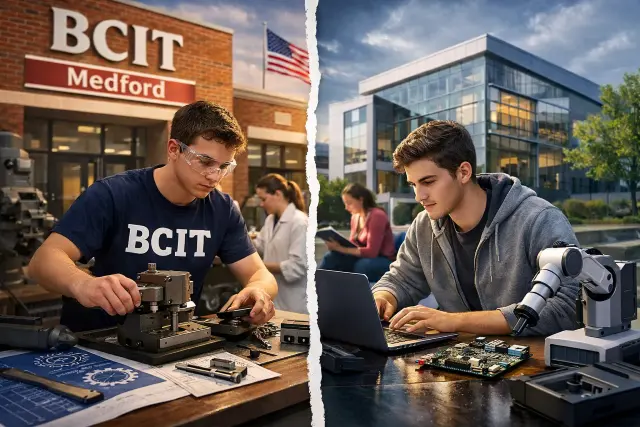
If you’re comparing BCIT Medford Tech with other tech institutes, you’re probably trying to answer one simple question: Where will I get the best mix of real skills, strong academics, and a clear path to what comes next? That’s the right question, because “tech school” can mean very different things depending on the place.
BCIT Medford Tech is not a generic training center or a short course provider. It’s a countywide vocational-technical public high school campus in Medford, New Jersey, serving grades 9 to 12, with a hands-on Career and Technical Education model built into a full high school experience.
In this guide, you’ll see how BCIT Medford Tech stacks up against other tech institutes (vo-tech schools, magnet schools, community college pathways, private trade schools, and bootcamps). We’ll cover what really matters: programs, learning style, credentials, costs, student support, outcomes, and which option fits different goals.
Quick definition: What is BCIT Medford Tech?
BCIT Medford Tech (BCIT Medford Campus) is a vocational school (public) that combines standard high school academics with career majors and technical training.
A useful way to think about BCIT Medford Tech is “high school plus a career major.” Students still graduate with a high school diploma, but they also build industry-aligned skills through lab work, equipment-based training, projects, and career-focused coursework.
A few baseline facts that matter when comparing schools
- It’s listed as a vocational school and is an open public school serving grades 9 to 12.
- The NCES listing shows 896 students and a 13.78 student-teacher ratio (2024–2025).
- The district publishes a broad set of career and technical programs, including Information Technology, Computer Engineering, and Video Game Design among many others.
Those details matter because they change what “value” looks like compared to other tech institutes.
Why comparisons get messy
People lump together:
- Vocational-technical high schools
- STEM magnets
- Community colleges and dual enrollment programs
- Private trade schools
- Coding bootcamps
But these options differ in who they serve, what credential you earn, how long it takes, and how much it costs. So the fair comparison is not “which is best,” but “best for what outcome.”
BCIT Medford Tech vs other tech institutes at a glance
Here’s a high-level snapshot. We’ll unpack every row after this.
| Factor | BCIT Medford Tech | STEM/Tech Magnet HS | Community College Path | Private Trade School | Bootcamp |
|---|---|---|---|---|---|
| Who it’s for | Grades 9–12 | Grades 9–12 | Usually post-HS | Usually post-HS | Usually post-HS |
| Credential | HS diploma + CTE training | HS diploma | Associate/certs | Diploma/cert | Certificate |
| Learning style | Labs + projects + academics | Academics + selective STEM | Mix of lecture/labs | Skills-heavy | Intensive projects |
| Cost | Public (low direct tuition) | Public | Tuition-based | Often high | Often high |
| Time | 4 years | 4 years | 2 years typical | Months to 2 years | 8–24 weeks typical |
| Best for | Skills + diploma + exploration | Academic STEM track | Degrees + transfer | Fast entry | Career switch |
Key difference 1: Program breadth and “career major” variety
This is one of the biggest reasons BCIT Medford Tech stands out in a typical comparison.
The district’s career and technical program list spans multiple clusters (health, skilled trades, creative media, engineering, IT). That variety is a real advantage if a student is curious but not 100 percent sure yet.
How BCIT Medford Tech compares
- BCIT Medford Tech: Strong breadth. Students can explore pathways that range from Information Technology and Computer Engineering to hands-on trades and applied health programs.
- Other tech institutes (especially bootcamps): Often narrow by design (for example “only web development”). That’s fine for focused adults, but it’s not always ideal for teenagers still discovering strengths.
If you’re choosing for a high-school student, BCIT Medford Tech often wins on breadth because it keeps doors open.
Key difference 2: Full high school experience plus technical training
Some people worry that a tech-focused school sacrifices the “regular” high school experience. With BCIT Medford Tech, the model is still a comprehensive high school, but with career majors integrated.
Why that matters in real life
A teenager’s life is not just skills. It’s also:
- Graduation requirements
- College readiness
- Clubs, athletics, and student life
- Guidance support
A bootcamp can’t offer that because it isn’t built for grades 9–12. A private trade school won’t offer it either because it is usually postsecondary. BCIT Medford Tech is structured specifically around the high school timeline.
Key difference 3: Student-teacher ratio and learning environment
Numbers do not tell the whole story, but they do help you understand the environment.
NCES lists BCIT Medford Tech with a 13.78 student-teacher ratio (2024–2025).
In many technical programs, smaller ratios are not just a comfort thing. They can be a safety and quality issue, because labs and equipment-based learning work better when teachers can actually see what each student is doing.
This is a quiet advantage for BCIT Medford Tech compared to large, lecture-heavy settings.
Key difference 4: Outcomes and what CTE research suggests
A common myth is that CTE equals “not college.” Reality is more nuanced.
NCES data on CTE shows differences in educational outcomes for CTE concentrators versus non-concentrators. For example, among 2013 public high school graduates who enrolled in postsecondary education by June 2021, a higher percentage of CTE concentrators had an associate’s degree as their highest credential (14 percent vs 9 percent), while a lower percentage had a bachelor’s or higher as their highest credential (48 percent vs 54 percent).
That doesn’t mean “CTE is worse.” It often means students are choosing different routes: earlier employment, targeted credentials, or technical degrees that match their goals.
Separately, ACTE’s CTE research summaries commonly report higher graduation rates for CTE concentrators compared with national averages.
So when you compare BCIT Medford Tech to other tech institutes, it helps to ask:
- Do you want a straight-to-work path?
- A technical degree path?
- A four-year university path with strong applied skills?
BCIT Medford Tech can fit more than one of these, but it tends to be strongest when the student values applied learning and wants options.
Key difference 5: Cost and value for families
This is where comparing BCIT Medford Tech to bootcamps or private trade schools becomes almost unfair.
- BCIT Medford Tech is a public vocational high school.
- Many private trade schools and bootcamps come with significant tuition and financing structures.
For families, public CTE can be a high-value model: structured training and equipment access without the price tag of a private program.
Key difference 6: Equipment, labs, and “learning by doing”
Technical education is not just theory. If the learning experience is mostly slides and worksheets, it will not feel like tech training.
BCIT Medford Tech emphasizes career majors and technical training where labs, tools, and projects are central. The district promotes a large set of CTE programs across multiple career areas.
This is one of the biggest differences versus:
- Some “tech magnets” that are academically rigorous but lab-light
- Some community college courses that may be more lecture-based in the early semesters
- Some bootcamps that are project-heavy but limited to what you can do on a laptop
For hands-on learners, BCIT Medford Tech can feel more engaging because the work looks like “real work” earlier.
Key difference 7: Industry alignment and local workforce connections
Many tech institutes claim “industry ready,” but the best programs do two things:
- Teach in-demand skills
- Connect students to work-based learning, employers, or apprenticeship-style pathways
BCIT is presented as competency-based with advanced career placement opportunities at higher pay rates in some descriptions of the district’s approach.
Even without making promises about any single student’s outcome, the structure of CTE is designed to build job-ready capability. And in today’s hiring market, proof of skill matters.
Key difference 8: Who “other tech institutes” are, and the fairest comparisons
Let’s compare BCIT Medford Tech to the main alternatives people usually mean.
BCIT Medford Tech vs a STEM/tech magnet high school
A STEM magnet can be amazing for:
- Competitive academics
- Advanced math/science sequences
- Research projects, competitions, and selective programs
But magnets may be less focused on job-ready technical training across multiple career clusters. BCIT Medford Tech tends to shine when the student wants applied skill-building in a defined career pathway while still getting a full high school experience.
Best fit:
- Choose BCIT Medford Tech if the student wants a clear hands-on pathway and might pursue tech, trades, health, or applied business.
- Choose a STEM magnet if the student is strongly aimed at a research-heavy or advanced academic STEM track.
BCIT Medford Tech vs community college programs
Community college is a great option after high school for:
- Associate degrees
- Transfer pathways
- Adult learners re-skilling
But it is not a replacement for a high school campus model. The advantage of BCIT Medford Tech is timing: skill-building can start earlier, and students graduate with both academic completion and technical exposure.
Best fit:
- Choose BCIT Medford Tech to start earlier and build confidence and direction.
- Choose community college after graduation to deepen credentials (associate, certificates) in a chosen field.
BCIT Medford Tech vs private trade schools
Private trade schools can be effective, especially for adults who want speed. But they often carry higher costs, and quality varies widely by provider.
A public vocational high school like BCIT Medford Tech is designed around student support systems, counseling, and academic requirements while integrating technical skills.
Best fit:
- Choose BCIT Medford Tech if the student is in grades 9–12 and wants training without sacrificing a standard diploma track.
- Consider a trade school later if an adult wants quick entry and has verified the school’s outcomes and accreditation.
BCIT Medford Tech vs coding bootcamps
Bootcamps are usually built for adults and career changers. They can be intense, narrow, and fast.
A student at BCIT Medford Tech is typically developing foundational skills over several years, along with academic development, guidance support, and broader career exploration.
Best fit:
- Choose BCIT Medford Tech if you want a structured, long-run development path and room to grow.
- Choose a bootcamp if you are an adult with time to dedicate full-time and a clear target role.
Real-world scenarios: which choice makes sense?
Scenario A: The student loves computers but isn’t sure which tech field
This is where BCIT Medford Tech can be a strong fit, because exposure to multiple pathways (IT, computer engineering, design, and more) helps the student discover what “tech” actually means for them.
Scenario B: The student wants college but also wants job-ready skills
This is the sweet spot for many CTE programs. Research suggests CTE concentrators do pursue postsecondary education and often complete technical degrees at meaningful rates.
In practice, BCIT Medford Tech can help a student build a portfolio of skills while keeping the academic foundation for college.
Scenario C: The student wants to work as soon as possible after high school
Programs that emphasize real skills, credentials, and work-based learning alignment tend to be the best match. This is often a strength of the BCIT Medford Tech model compared to purely academic pathways.
How to evaluate BCIT Medford Tech the smart way
If you’re seriously comparing BCIT Medford Tech with other institutes, don’t stop at program names. Ask questions that reveal the day-to-day reality.
Questions to ask any tech institute
- How many hours per week are hands-on labs vs classroom instruction?
- What tools, software, or equipment do students actually use?
- Are there capstone projects or portfolios by graduation?
- How do you support students who struggle early?
- What are typical next steps for graduates (work, apprenticeship, college)?
Questions that matter specifically for BCIT Medford Tech
- Which career major best matches the student’s strengths right now?
- What does a typical week look like for that major?
- What student support and guidance systems are available on campus?
Even basic contact details and campus info are published by the campus, which makes it easier to verify and reach the right office for accurate answers.
FAQ
Is BCIT Medford Tech a college?
No. BCIT Medford Tech is a public vocational high school campus serving grades 9–12.
Does BCIT Medford Tech replace traditional high school classes?
BCIT Medford Tech still operates as a high school with academic requirements, while integrating career majors and technical education.
Is BCIT Medford Tech only for students who do not want college?
Not necessarily. CTE pathways often support multiple outcomes, including technical credentials and college. National CTE reporting shows different postsecondary patterns for CTE concentrators, not “no college.”
What makes BCIT Medford Tech different from a bootcamp?
A bootcamp is typically short, intense, and narrow, usually for adults. BCIT Medford Tech is a four-year high school experience that blends academics with technical pathways.
Conclusion: So which one is “better”?
The honest answer is that “better” depends on the goal, but here’s the practical takeaway.
If you want a high school environment where technical training is not an afterthought, where career majors are built into the weekly rhythm, and where students can graduate with both academics and real-world skills, BCIT Medford Tech is often a stronger match than most alternatives in the same age range.
If you are comparing BCIT Medford Tech to other tech institutes that are designed for adults, the comparison shifts. Bootcamps and private trade schools can move fast, but they are usually narrower, costlier, and not built around the long-term development teens need.
The best way to decide is to align the choice with the student’s timeline, learning style, and next-step plan, then verify the program details and support systems. Once that alignment is clear, BCIT Medford Tech becomes easier to judge on its real strengths: structure, breadth, hands-on learning, and a pathway that keeps options open.
In the last step of your research, it helps to understand how the broader system of vocational education is designed to blend career preparation with academic learning.