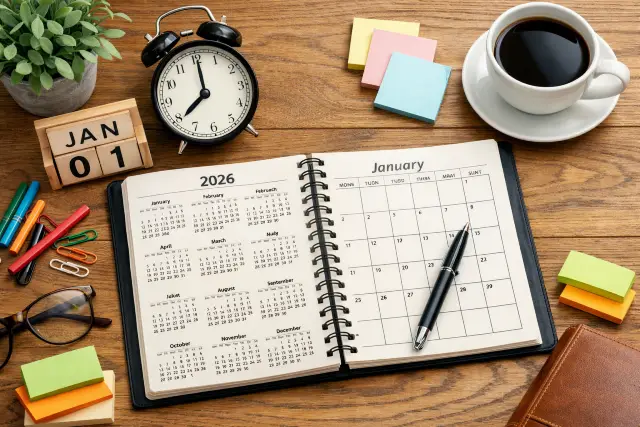
If you’ve ever hit mid-year and thought, “Wait, where did the last few months go?” you’re not alone. The easiest way to stop living in reaction mode is to plan your year in a way that feels simple, realistic, and easy to maintain. That’s exactly what a 2026 Calendar can do for you when you use it as a month-by-month planner instead of a pretty grid you glance at once in a while.
In this guide, you’ll learn how to use a 2026 Calendar to organize your work, home life, goals, and even your downtime without turning your schedule into a stressful puzzle. You’ll also get a practical monthly planning system, a usable planning table, and answers to the questions people ask most when they’re trying to finally stay consistent.
What a 2026 Calendar really is (and why it works)
A 2026 Calendar is more than dates on a page. It’s a decision-making tool. It helps you:
- See your time clearly (weeks, months, seasons)
- Commit to priorities early instead of squeezing them in later
- Spot conflicts before they become emergencies
- Build routines that actually stick
When your plans live only in your head, everything feels urgent. When your plans live in a 2026 Calendar, you can separate what’s important from what’s just loud.
This matters because stress is not just an emotional feeling, it affects the body and behavior. The American Psychological Association has documented how widespread stress is and how strongly it connects to daily functioning, relationships, and health. A calendar does not remove problems, but it can reduce the chaos around them.
Pick the right 2026 Calendar format for your life
Before you start filling in anything, decide what your 2026 Calendar will look like in real life. The “best” format is the one you will keep using in April, not the one that looks perfect in January.
Option 1: Digital calendar (best for reminders and sharing)
Digital calendars shine when you need alerts, device sync, and quick editing. Google Calendar is a common choice because it works across phone and desktop, and it integrates with tasks and reminders. Google has also been expanding the ability to block time for tasks directly on your calendar, which makes planning feel more like real time management instead of a never-ending checklist.
Option 2: Paper planner (best for focus and reflection)
Paper calendars are still powerful because writing slows you down just enough to think. The downside is it won’t nudge you with reminders, so it works best when paired with a consistent daily check-in.
Option 3: Hybrid system (best for most people)
A hybrid 2026 Calendar setup is straightforward:
- Digital calendar for appointments, deadlines, reminders, travel, events
- Paper planner for daily priorities, reflection, habit tracking, weekly review
This keeps the “hard schedule” and the “human side” of planning in the same system.
How to set up your 2026 Calendar in under an hour
This setup is designed to be done once, then maintained in small moments. No complicated system. No planner perfection.
Step 1: Put in the non-negotiables first
Start with the events that are already decided:
- Work or school schedule
- Public holidays
- Family events, weddings, planned travel
- Bill due dates
- Exams, launches, fiscal dates
If you’re using a digital 2026 Calendar, create separate calendars (or color tags) for work, personal, health, and family. That makes conflicts obvious at a glance.
Step 2: Add recurring routines next
Routines are what make the year feel stable. Add things that happen regularly, like:
- Gym or walking days
- Weekly planning session
- Monthly finance check
- House maintenance tasks
- Content schedule (if you publish)
A calendar gets easier to use when it contains both events and rhythms.
Step 3: Create three “anchors” for every week
Anchors are simple blocks that keep you from drifting:
- A weekly planning block
- A deep-work block (or study block)
- A rest block (real rest, not scrolling)
This is where modern digital calendars help, because time-blocking is easy, and task blocks can now be treated like real calendar time in some tools.
2026 Calendar month-by-month planning system
Here’s the heart of the article: a month-by-month system that stays realistic. Each month has one theme, one planning reset, and a few consistent actions.
Month-by-month planner table for 2026
Use this table as your planning template inside your 2026 Calendar. Add your real dates and adapt the focus areas to your season and workload.
| Month | Planning Theme | What to Schedule in Your 2026 Calendar | Monthly Reset Checklist |
|---|---|---|---|
| January | Fresh start | Annual goals, first 90-day plan, key deadlines | Clear clutter, set routines, choose top 3 goals |
| February | Consistency | Weekly reviews, habit blocks, learning blocks | Check progress, simplify commitments |
| March | Momentum | Project milestones, health checkups, travel ideas | Review goals, adjust time blocks |
| April | Focus | Fewer priorities, deeper work sessions | Drop one non-essential task, refine routines |
| May | Energy | Social events, outdoor time, fitness rhythm | Audit sleep, plan recovery days |
| June | Mid-year check | Mid-year review, budget check, course corrections | Reset goals, plan Q3 priorities |
| July | Balance | Family time, vacations, creative days | Protect rest, reduce overbooking |
| August | Preparation | Back-to-school/work planning, skill building | Refresh schedules, prep busy season |
| September | Execution | Major deliverables, exams, launches | Tighten routines, set boundaries |
| October | Maintenance | Health screenings, admin, home tasks | Declutter calendar, cleanup finances |
| November | Wrap-up | Year-end deadlines, gifting budget, planning | Review wins, simplify holiday schedule |
| December | Reflection | Next-year draft, downtime, family plans | Close loops, plan January calmly |
This table works because it avoids pretending every month should be a high-achievement sprint. You get cycles: push, maintain, reset.
How to plan each month inside your 2026 Calendar
At the beginning of every month, do a “10-minute calendar reset.” This is short enough that you’ll actually do it.
The 10-minute monthly reset
- Scan the month view in your 2026 Calendar
- List the top outcomes for the month (3 is enough)
- Add deadlines and prep dates (not just the final due date)
- Block weekly planning time
- Block two rest windows
That’s it. The power comes from doing it every month, not making it complex once.
Weekly planning that doesn’t fall apart by Thursday
A 2026 Calendar becomes useful when weeks are planned in a way that survives real life.
Use the “Three Lists” method
Every week, maintain three lists:
- Must do (critical, deadline-driven)
- Should do (important, flexible)
- Nice to do (optional)
Then turn only the “Must do” items into calendar blocks. This prevents your calendar from becoming an overpromising fantasy.
Build buffer time on purpose
Most calendars fail because they have no breathing room. Put buffer blocks directly into the 2026 Calendar:
- 15 minutes between meetings
- A weekly catch-up block
- One low-commitment evening
This is a quiet way to protect your schedule without constantly saying no.
Daily planning with a 2026 Calendar (without micromanaging yourself)
Daily planning is where many people overdo it. The goal is clarity, not control.
The “One Page Day” approach
Whether you use paper or digital, your day only needs:
- One main priority (the one thing you will not skip)
- Two supporting tasks
- One self-care block (walk, workout, meal, early sleep)
- One stop time (when work ends)
If you want to use a digital 2026 Calendar for this, time-blocking makes it easier to defend focus time from interruptions.
Staying organized all year: what makes people quit (and how to avoid it)
People don’t stop using a 2026 Calendar because they’re lazy. They stop because the system is fragile.
Problem 1: You only schedule deadlines, not prep time
Fix it by adding “prep” blocks:
- Draft day
- Research day
- Review day
- Finalize day
Deadlines rarely fail because the due date is unclear. They fail because the runway is missing.
Problem 2: Your calendar is packed with tasks that belong on a checklist
A calendar is for time-based commitments. A list is for everything else. When you put too many tiny tasks into your 2026 Calendar, it becomes noisy and stressful.
Problem 3: Your calendar is all work, no life
That’s not a calendar, it’s a pressure cooker. Block rest the same way you block meetings. The APA’s research-based resources on stress highlight how persistent stress affects wellbeing and performance, so planning recovery time is part of staying effective, not an extra.
Real-life scenarios: how different people use a 2026 Calendar
Scenario A: Student planning exams and deadlines
A student’s 2026 Calendar works best when it includes:
- Exam dates plus weekly revision blocks
- Assignment prep dates
- Group study times
- Sleep and recovery windows
Academic stress can have real long-term mental health impact, which is why a structured plan is more than productivity, it’s protection.
Scenario B: Working professional juggling meetings and deep work
A professional calendar needs two clear layers:
- Meetings and fixed appointments
- Focus blocks for actual output
Blocking time for tasks directly on the calendar makes workload visible to others and reduces the chance of double-booking yourself.
Scenario C: Family schedule with kids and home responsibilities
A household 2026 Calendar becomes easier when it includes:
- A shared family calendar for school events and appointments
- A rotating “admin” block for bills, errands, groceries
- A weekly check-in to coordinate the week ahead
When everyone can see the plan, mental load drops.
Frequently asked questions about using a 2026 Calendar
How many times should I check my 2026 Calendar per day?
Two checks are enough for most people:
- One in the morning to confirm the plan
- One in the evening to prepare tomorrow
Is paper or digital better for a 2026 Calendar?
Paper is stronger for reflection and memory. Digital is stronger for reminders and sharing. A hybrid 2026 Calendar system often holds up best for long-term consistency.
What’s the simplest way to stay consistent all year?
A monthly reset plus a weekly planning block. Consistency comes from small repeats, not big motivation.
How do I keep my 2026 Calendar from becoming overwhelming?
Use your calendar for time-based commitments and time blocks. Keep the rest in a task list. If everything is on the calendar, nothing stands out.
What should I do when I fall behind?
Update the next two days, not the whole week. A calendar is a living tool, not a record of perfection.
Conclusion: make the 2026 Calendar work like a calm control center
A 2026 Calendar is not about filling every hour. It’s about choosing what matters, giving it real space, and building a year that feels manageable. When you plan month by month, you stop trying to “fix your whole life” on a random Monday. You build structure in layers: monthly themes, weekly anchors, and daily priorities.
Keep it simple: non-negotiables first, routines second, and a monthly reset that takes ten minutes. Over time, your 2026 Calendar becomes a steady guide that reduces last-minute scrambling and makes progress feel normal.
In the last step, remember that most schedules are built on the Gregorian calendar, so your planning works best when you align your goals with real seasons, real energy, and real time.