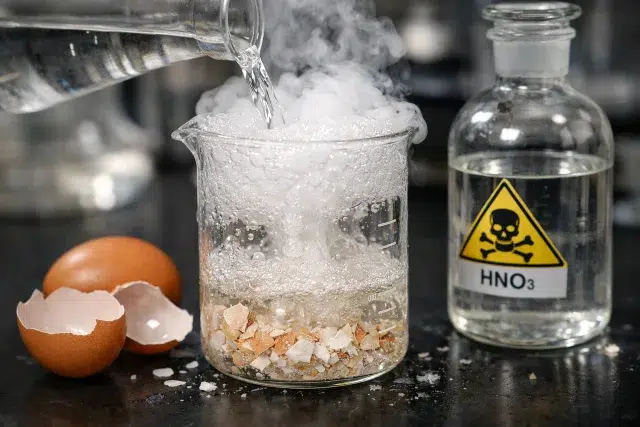
If you’ve ever dropped an eggshell into a strong acid (or watched a lab demo), you know it doesn’t just “sit there.” It fizzes, bubbles, and slowly disappears. So, what happens when egg shell is added to nitric acid in real chemical terms?
The short version is this: eggshell is mostly calcium carbonate, and nitric acid is a strong acid. When they meet, the acid attacks the carbonate, releasing carbon dioxide gas (that fizzy bubbling you see), forming water, and leaving behind a dissolved salt called calcium nitrate. That’s the core story, but the interesting part is why it happens, what you’ll observe step by step, what changes the reaction speed, and what safety issues matter if you’re doing this outside a controlled lab.
Let’s break it down in a way that actually feels clear, practical, and publish-ready.
Why eggshell reacts so strongly with nitric acid
Before we talk about what happens when egg shell is added to nitric acid, it helps to know what an eggshell really is.
Eggshell isn’t “just a shell.” It’s a mineral structure made mainly of calcium carbonate (CaCO₃). Depending on the reference and the type of egg, it’s typically around the mid-90% range by dry weight, with small amounts of other minerals and organic material mixed in. Government and academic sources consistently point to calcium carbonate as the dominant component.
Nitric acid (HNO₃), on the other hand, is a strong, highly corrosive acid and also an oxidizer in concentrated forms, which is why labs treat it with respect.
When a carbonate (like CaCO₃) meets a strong acid (like HNO₃), the carbonate portion gets converted into carbon dioxide gas (CO₂) and water (H₂O). That gas escaping is exactly what makes the reaction look dramatic.
What happens when Egg Shell is Added to Nitric Acid: the chemical reaction
Here’s the balanced chemical equation for what happens when egg shell is added to nitric acid, assuming the eggshell behaves like calcium carbonate:
CaCO₃ + 2HNO₃ → Ca(NO₃)₂ + CO₂ + H₂O
What each part means in plain English
- CaCO₃ (eggshell mineral) reacts with
- HNO₃ (nitric acid) to produce
- Ca(NO₃)₂ (calcium nitrate) which stays dissolved in the liquid, plus
- CO₂ (carbon dioxide gas) which bubbles out, and
- H₂O (water) as part of the acid-carbonate reaction.
So if you’re asking what happens when egg shell is added to nitric acid, the visible answer is “bubbling and dissolving,” and the chemical answer is “a carbonate-acid reaction that produces calcium nitrate, CO₂, and water.”
What you will actually observe in a container
If you put a piece of eggshell into nitric acid (even moderately diluted), these are the common real-world observations:
1) Immediate bubbling (effervescence)
This is CO₂ gas being produced at the shell’s surface. It often starts within seconds.
2) The shell looks like it’s “melting”
It’s not melting from heat like wax. The calcium carbonate is dissolving because it’s being converted into a soluble calcium nitrate salt.
3) The solution may warm slightly
Acid reactions can release heat (exothermic behavior). The warming is usually mild in small amounts but can be noticeable depending on concentration and volume.
4) Leftover thin, flexible material may remain
Eggshell has an inner membrane made of protein-rich material. That membrane does not dissolve as easily as calcium carbonate and can remain as a soft, translucent “skin.” Research reviews describe eggshell membrane as a fibrous, protein-based network.
Quick “observation vs cause” table
| What you see | What it means | What’s causing it |
|---|---|---|
| Fast fizzing bubbles | Gas is being released | CO₂ forming from carbonate + acid |
| Shell shrinking/disappearing | Mineral is dissolving | CaCO₃ converting to soluble Ca(NO₃)₂ |
| Solution clears or stays clear | Product is dissolved | Calcium nitrate remains in solution |
| Rubbery film remains | Non-mineral part persists | Eggshell membrane (protein-rich) |
What changes the speed of the reaction?
People often repeat the question what happens when egg shell is added to nitric acid because they try it once and it fizzes like crazy, then another time it seems slower. That’s normal. The reaction rate changes a lot depending on conditions.
Factors that make it faster
- Higher acid concentration: more H⁺ ions available to react
- Warmer temperature: molecules collide more often
- Crushed eggshell instead of a large piece: more surface area
- Stirring: removes CO₂ bubbles from the surface so acid can keep contacting the shell
Factors that slow it down
- Diluted acid (less reactive per second)
- Large intact shell pieces (low surface area)
- A “bubble blanket”: CO₂ bubbles can stick to the shell and temporarily shield it until they pop or float away
Why carbon dioxide is produced (and why it’s a big deal visually)
The bubbling isn’t random. Carbonates are basically “CO₂ stored in a solid form.” When acid hits a carbonate, it drives the carbonate to become CO₂ gas.
A helpful way to picture it:
- The acid “pulls” the carbonate apart
- CO₂ escapes as gas
- Calcium pairs with nitrate to make a new dissolved salt
That escaping gas is why what happens when egg shell is added to nitric acid looks so active compared to many other reactions.
Is calcium nitrate dangerous?
Calcium nitrate is widely used in industry and agriculture (for example, as a fertilizer component), but “dangerous” depends on context. In a lab beaker, it mainly means you’ve produced a nitrate salt in an acidic solution. The bigger risk in this setup is usually not calcium nitrate itself, but the nitric acid remaining in the mixture.
Also, any nitrate salt should be treated responsibly and not poured somewhere inappropriate. This is general chemical hygiene: handle, store, and dispose properly.
Safety: the part you should not skip
Because the question what happens when egg shell is added to nitric acid sounds like a simple “kitchen chemistry” experiment, people sometimes underestimate the hazard. Nitric acid is not a mild acid like vinegar.
Safety data sheets for nitric acid commonly classify it as:
- Corrosive (can cause severe skin burns and eye damage)
- Toxic if inhaled (especially fumes/vapors)
- Oxidizer (can intensify fire under certain conditions)
Practical safety takeaways
- Use eye protection and protective gloves
- Work in a well-ventilated area
- Avoid breathing any fumes
- Use small quantities and appropriate containers
- Never cap a sealed container during active fizzing (gas pressure risk)
This isn’t “extra caution.” These points match the hazard language found in standard SDS documentation.
Real-life scenario: why this reaction is used in demonstrations
Teachers like this reaction because it shows several concepts at once:
- Acid-carbonate reactions
- Gas formation (CO₂)
- Conservation of mass in balanced equations
- Surface area effects on reaction rate
- Separation of mineral and membrane layers (when a membrane remains)
And the visual effect is immediate, which makes it memorable.
The eggshell composition matters more than you think
To really understand what happens when egg shell is added to nitric acid, it helps to realize the eggshell is mostly mineral, but not only mineral.
Authoritative references describe eggshell as predominantly calcium carbonate, often around the mid-90% range, along with small amounts of magnesium, phosphorus, and organic matrix materials.
This explains two common surprises:
- Why the reaction is so strong: CaCO₃ is plentiful.
- Why something may remain: the protein-rich membrane and organic matrix are not the same as CaCO₃ and don’t behave the same way in acid.
What happens if you use powdered eggshell instead of a piece?
If you grind eggshell into a fine powder, what happens when egg shell is added to nitric acid becomes dramatically faster.
Why?
- Powder has far more surface area
- More contact points means faster CO₂ release
- The reaction can foam more strongly, sometimes looking like “boiling” even when it’s not actually boiling
This is one reason labs often add solids slowly to acids, especially when gas is produced.
Does the reaction produce a smell?
Carbon dioxide is odorless, and calcium nitrate solution has no strong smell by itself. However, nitric acid can have a sharp, irritating odor, and depending on concentration and conditions, fumes can be hazardous. That’s another reason ventilation matters.
What happens to the pH as the reaction continues?
At the start, nitric acid dominates, so the pH is very low (strongly acidic). As calcium carbonate reacts, it consumes acid. If enough eggshell is added, acidity can decrease, but the final pH depends on:
- how much acid you started with
- how much eggshell was added
- whether any acid remains unreacted
In many practical cases, the solution remains acidic because nitric acid is often present in excess.
Common questions people ask (FAQ)
Why does it fizz so much?
Because CO₂ gas is produced when nitric acid reacts with calcium carbonate in the eggshell.
What gas is released when egg shell is added to nitric acid?
The gas is carbon dioxide (CO₂).
What salt is formed?
Calcium nitrate, Ca(NO₃)₂, forms and stays dissolved in the solution.
Will the eggshell completely disappear?
The mineral part can dissolve completely, but the inner eggshell membrane may remain as a thin film because it’s protein-rich and behaves differently.
Is this reaction the same as using vinegar?
It’s the same type of reaction (acid + carbonate produces CO₂), but nitric acid is far stronger and more hazardous than vinegar, so the reaction can be faster and the safety risk is much higher.
Step-by-step summary of the process
If you want a clean mental timeline for what happens when egg shell is added to nitric acid, this is it:
- Nitric acid contacts the eggshell surface
- The acid reacts with calcium carbonate
- CO₂ bubbles form and escape
- Calcium nitrate forms and dissolves into the liquid
- The solid mineral structure shrinks and breaks down
- The membrane may remain as a soft residue after most mineral is gone
Conclusion: What Happens When Egg Shell is Added to Nitric Acid
So, what happens when egg shell is added to nitric acid is a classic acid-carbonate reaction with a very visible result. The eggshell (mostly calcium carbonate) reacts with nitric acid to produce calcium nitrate, carbon dioxide gas, and water. The fizzing is CO₂ escaping, and the “disappearing shell” is the mineral converting into a dissolved salt.
In many cases, a thin membrane can remain after the mineral dissolves, which is a neat reminder that eggshell isn’t purely mineral. And while the chemistry is straightforward, it’s worth emphasizing the safety angle: nitric acid is corrosive and hazardous, which is clearly stated across standard SDS references.
If you’re writing or learning about this reaction, the key takeaway is simple: strong acids plus carbonates equal bubbles, salt formation, and a fast, noticeable transformation. For a deeper definition of the two-word phrase nitric acid, it’s helpful to see how it’s classified and described in general chemistry references.