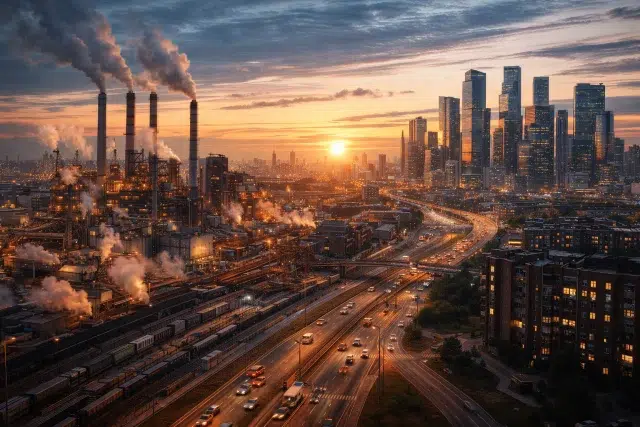
If you’ve ever looked at a skyline and thought, “How did this city get so big?”—chances are, the answer starts with factories, jobs, and the ripple effects of economic change. That’s exactly why Industrialisation and Urbanisation Go Hand in Hand Justify the Statement is more than a textbook line. It’s a real-world pattern we’ve watched play out for over 200 years: as industries grow, cities expand; and as cities expand, industries often grow even faster.
In this article, we’ll unpack why these two processes are so tightly linked, what it looks like in real places (from Industrial Britain to modern China), and the benefits and problems that come along with it.
What do industrialisation and urbanisation mean?
Let’s keep it simple:
- Industrialisation = the shift from an agriculture-based economy to one driven by manufacturing, factories, and large-scale production.
- Urbanisation = the growing share of people living in towns and cities, plus the physical expansion of urban areas.
Here’s the key idea: industrialisation creates jobs and infrastructure in concentrated areas, and people move toward those opportunities. That movement fuels urban growth.
Globally, urban living has become the norm—about 57.7% of the world’s population lived in urban areas in 2024, based on World Bank data. That isn’t happening in isolation; it’s strongly connected to how economies industrialise and modernise.
Why industrialisation and urbanisation go together
Industrialisation rarely spreads evenly across a country at first. Industries cluster where they can operate efficiently. Once that happens, cities form and grow around those clusters.
1) Factories create jobs, and jobs pull people in
When industries expand, they create:
- direct jobs (factory workers, technicians, engineers)
- indirect jobs (transport, retail, food services, housing construction)
This pulls people from rural areas because city wages are often higher and more regular than farm income.
2) Industries need infrastructure—and cities provide it
Factories depend on:
- roads, railways, ports
- electricity and water supply
- banks and business services
- communication networks
Governments and private investors tend to build these systems where industry is concentrated, which usually becomes urban territory.
3) Cities create markets for industrial goods
Urban residents buy more manufactured products:
- clothing, appliances, construction materials
- processed foods
- transportation and services
So industry feeds the city, and the city feeds industry. It becomes a cycle.
Industrialisation and Urbanisation Go Hand in Hand: Justify the Statement (Core Explanation)
A practical way to justify the statement is to view it as a chain reaction:
- Industries expand →
- Jobs rise in industrial locations →
- Migration increases (rural-to-urban) →
- Cities grow (housing, transport, services) →
- Urban markets expand →
- More industries develop (and diversify)
That’s why industrial hubs often become mega-cities or dense metropolitan areas over time.
A quick comparison table: how each one supports the other
| Industrialisation triggers | Urbanisation triggers | How they reinforce each other |
|---|---|---|
| Factory and service jobs | Rural-to-urban migration | Migration supplies workers to industries |
| Investment in transport & power | Expansion of housing & city services | Infrastructure supports both people and production |
| Higher productivity & incomes | Larger consumer markets | Cities buy more industrial output |
| Business clustering | Innovation and skill development | Cities become hubs for talent and technology |
Real-world examples that clearly show the link
Example 1: Industrial Britain (18th–19th century)
Britain’s Industrial Revolution is the classic case. Textile mills, coal mining, and manufacturing concentrated around certain towns—and those towns exploded into cities.
Manchester is often used as the symbol of this shift. Historical research highlights how it more than tripled in population from 1800 to 1850, largely because it became a heartland of textile industry.
But the growth wasn’t pretty:
- overcrowded housing
- poor sanitation
- polluted air and water
- long working hours
Still, it demonstrates the “hand in hand” relationship perfectly: industrial growth created an urban boom.
Example 2: China (late 20th century to today)
Modern China is one of the strongest contemporary examples of industry-driven urban growth. As manufacturing expanded (especially export-oriented production), cities grew rapidly—particularly in coastal regions.
Data attributed to China’s National Bureau of Statistics shows the urbanisation rate rose to 66.16% by the end of 2023, reflecting decades of economic and industrial transformation.
Places like Shenzhen (once a small fishing area) became major urban and industrial centers because:
- special economic policies attracted factories and foreign investment
- jobs attracted mass internal migration
- housing, ports, and transit expanded to match growth
This is industrialisation → jobs → migration → urbanisation in real time.
Example 3: The Ruhr Region (Germany)
The Ruhr area grew around coal and steel. As mining and heavy industry expanded, towns merged into a dense urban-industrial belt.
Even after heavy industry declined, the urban footprint remained—showing another important point:
- urbanisation can outlast industrialisation
- cities often evolve into service, tech, and logistics economies afterward
Example 4: Detroit (United States) — and what happens when industry declines
Detroit boomed with automobile manufacturing. It shows the positive linkage first:
- industrial growth → high wages → rapid city expansion
But Detroit also shows the risk:
- when industries shrink or relocate, cities can face unemployment, population loss, and infrastructure strain.
So yes, industrialisation and urbanisation go together—but the relationship can also create long-term vulnerabilities if a city depends too heavily on one sector.
Benefits of industrialisation-led urbanisation
When managed well, the combination can raise living standards quickly.
Major advantages
- More jobs and higher incomes
- Better access to education and healthcare
- Improved infrastructure (roads, electricity, internet)
- Innovation and entrepreneurship due to business clustering
- Higher productivity and economic growth
Urbanisation is now a defining global trend. The UN’s World Urbanization Prospects (latest revision platform) tracks how urban shares have risen since 1950 and are projected to continue increasing through mid-century.
Challenges (and why people complain about “rapid urbanisation”)
This is where the conversation gets real. Fast industrial growth can overwhelm cities if planning doesn’t keep up.
Common problems
- Housing shortages → informal settlements / slums
- Traffic congestion and long commuting times
- Air and water pollution
- Pressure on water, sanitation, hospitals, and schools
- Inequality (high-income districts vs underserved areas)
In other words: industrialisation may bring opportunity, but it also brings crowding unless governments plan ahead.
How governments can manage this cycle better
If a country wants the benefits without the chaos, planning matters just as much as production.
Practical steps that work
- Build affordable housing near job centers
Reduces slums and commuting pressure. - Invest early in public transport
Metro systems, BRT, commuter rail—these scale better than roads alone. - Zone for mixed-use development
When homes, shops, and workplaces are closer, cities become more livable. - Enforce pollution controls
Clean air rules, wastewater treatment, and industrial monitoring can reduce health impacts. - Diversify the city economy
Encourage services, tech, and SMEs so the city isn’t crushed if one industry declines.
FAQs
1) Why do industries develop more in cities than villages?
Because cities offer infrastructure, skilled labor, transport links, suppliers, finance, and large consumer markets—all of which reduce costs and increase efficiency.
2) Can urbanisation happen without industrialisation?
Yes. Some cities grow due to services, government administration, tourism, or resource booms. But historically, the largest and fastest urban expansions often followed industrial growth or industrial-era economic transformation.
3) Is industrialisation always good for cities?
It can be—if managed well. Without planning, it can cause pollution, overcrowding, and inequality. Cities benefit most when growth includes infrastructure, housing, and environmental regulation.
4) What is one modern example of industrialisation causing urbanisation?
China is a major example: industrial expansion and economic reforms were closely tied to a long rise in urbanisation, reaching 66.16% urbanisation by end-2023 (as cited from NBS reporting).
Conclusion
So, how do we justify the idea that Industrialisation and Urbanisation Go Hand in Hand Justify the Statement? By looking at the pattern that repeats across history and across continents: industry concentrates jobs and investment, people follow those opportunities, cities expand, and that urban growth creates even larger markets and support systems for more industrial development.
From Manchester’s mill-driven boom in the 1800s to China’s modern industrial-urban rise , the connection is clear. The real challenge isn’t whether the two go together—they do. The challenge is making sure cities grow in a way that stays livable, inclusive, and sustainable.