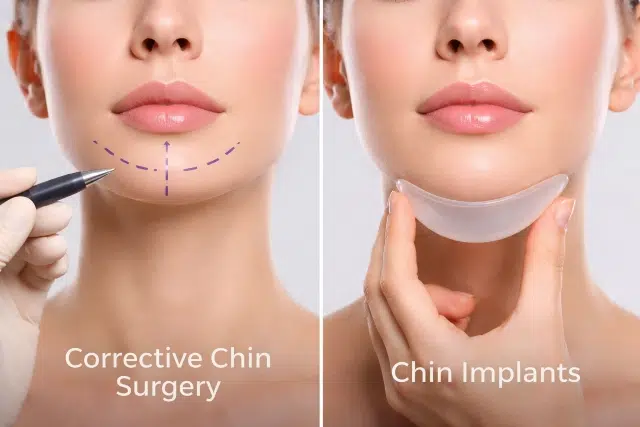
If you have ever looked at photos of yourself and thought, “My chin feels a little off,” you are not alone. A small change in chin projection or shape can make the whole face look more balanced or slightly “unfinished,” especially in side profile. The good news is that modern facial contouring offers two main paths: Corrective Chin Surgery that reshapes your own bone (often called sliding genioplasty) and chin implants that add structure with a preformed implant.
This article breaks down what each option really does, who tends to benefit most, what recovery feels like in real life, and how to choose based on your goals, anatomy, and long term expectations. By the end, you should have a clear sense of whether Corrective Chin Surgery or an implant is the better fit for you.
What “Corrective Chin Surgery” Usually Means in Practice
In everyday clinic conversations, Corrective Chin Surgery often refers to bony chin reshaping, especially sliding genioplasty. Instead of adding an implant, the surgeon makes a controlled cut in the chin portion of the lower jaw and repositions the bone segment. It can be moved forward, down, up, narrowed, or made more symmetric depending on the plan. The segment is then stabilized with plates and screws.
Because it uses your own bone, Corrective Chin Surgery is often chosen when the goal is a structural change rather than simply adding volume.
Common goals people bring to a consultation
People usually do not walk in saying “genioplasty.” They say things like:
- “My chin disappears in profile.”
- “My chin looks crooked or shifted.”
- “My lower face looks too long or too short.”
- “My jawline does not match my nose.”
- “I want a sharper chin but still natural.”
Those goals can sometimes be addressed with an implant, but they are classic reasons surgeons discuss Corrective Chin Surgery first, especially when symmetry or vertical height is part of the problem.
What a Chin Implant Does (and What It Cannot Do)
A chin implant is an alloplastic (synthetic) device placed over the front of the chin bone to increase projection or change contour. The implant can be inserted through a small incision under the chin or inside the mouth. The shape and size are selected based on facial proportions, and many surgeons now use imaging or sizing tools to plan this carefully.
Chin implants are popular because they are straightforward, often take less time in the operating room, and can offer a noticeable profile improvement in a single step. Professional safety resources describe chin surgery as reshaping the chin either with an implant or by altering the bone.
Where implants can be limiting is when the issue is not just “more chin,” but the direction, height, or asymmetry of the chin itself. That is where Corrective Chin Surgery can be more precise.
Corrective Chin Surgery vs Chin Implants: The Core Difference
Here is the simplest way to think about it:
- Corrective Chin Surgery changes the position and shape of your own chin bone.
- Chin implants add an external structure on top of the bone.
That one difference affects everything else: what problems can be fixed, how stable the result is over time, what risks matter most, and how “custom” your outcome can be.
Quick Comparison Table
| Feature | Corrective Chin Surgery (Sliding Genioplasty) | Chin Implant |
|---|---|---|
| Best for | Projection + asymmetry + vertical changes | Projection and contour enhancement |
| “Custom” shaping | High (bone can be moved in multiple directions) | Moderate (depends on implant shape/size) |
| Foreign material | No | Yes (implant material) |
| Reversibility | Possible but involves another bony procedure | Often removable or replaceable |
| Typical recovery feel | More swelling and soreness | Often milder recovery |
| Long term considerations | Bone healing and stability | Implant positioning, infection, revision |
A systematic review of osseous genioplasty outcomes highlights how widely it has been studied across many countries and decades of published literature.
Who Is a Better Candidate for Corrective Chin Surgery?
Many surgeons lean toward Corrective Chin Surgery when your goal involves more than just a stronger profile. You may be a strong candidate if you recognize yourself in any of these:
1) You need symmetry correction
If your chin is shifted to one side, rotated, or uneven, moving the bone segment can correct that in a more controlled way than choosing a slightly different implant shape.
2) You want vertical changes (longer or shorter lower face)
A chin implant mostly adds forward projection. It can do some contour changes, but it usually cannot reliably shorten a long lower face or add meaningful vertical height. Corrective Chin Surgery can move the chin segment up or down when the plan calls for it.
3) You have a bite or jaw relationship issue
If your chin concern is tied to jaw position or orthodontics, the “right” solution may involve a coordinated plan. In those cases, Corrective Chin Surgery is often part of a bigger facial balance strategy.
4) You want a “your bone” solution
Some people simply prefer not to have an implant. For them, Corrective Chin Surgery feels like a cleaner long term choice.
A realistic scenario
Imagine someone with a recessed chin and mild facial asymmetry. An implant can push the chin forward, but if the chin is also slightly off center, it might still look subtly “not quite right” in certain lighting. A bony move through Corrective Chin Surgery can bring the chin forward and center it at the same time.
Who Is a Better Candidate for Chin Implants?
Chin implants can be a great match if your goal is mainly added projection or a sharper contour and your chin bone is otherwise symmetric and proportionate.
Chin implants often shine when:
- Your chin is symmetric but just a bit recessed.
- You want a noticeable profile improvement with a simpler procedure.
- You want a change that can be modified more easily later (size swap, removal, revision).
- You are combining it with rhinoplasty and want quick, predictable profile balancing.
In many practices, chin implants are commonly discussed alongside other cosmetic procedures. ASPS publishes annual procedural statistics and patient safety guidance that cover chin surgery as a recognized cosmetic option.
A Deeper Look at Results: Naturalness, Definition, and Stability
Natural look
Both approaches can look natural when properly planned. The “too pointy” or “overdone” chin typically comes from poor sizing, poor positioning, or mismatched goals, not the category of procedure.
That said, Corrective Chin Surgery can be especially helpful when the plan requires subtle directional changes rather than “more volume.”
Definition and jawline effect
- Implants can create a crisp front chin contour quickly.
- Corrective Chin Surgery can enhance the chin and also change how the lower face transitions into the jawline, depending on how the bone is moved.
Long term stability
Bony movements are designed to heal in place, and literature reviews look closely at long term stability after advancement genioplasty with follow up beyond one year.
Implants can also be stable long term, but they carry implant specific considerations like malposition or the need for revision.
Risks and Complications: What People Actually Worry About
Every surgery has risks. The key is understanding which risks are more associated with each option.
Risks that come up with chin implants
Commonly cited implant complications include malposition, infection, extrusion, nerve changes, asymmetry, and revision needs.
A systematic review focused on alloplastic chin augmentation tracks complications such as malposition, infection, extrusion, revision, removal, numbness, and asymmetry across studies.
Also worth knowing: published reviews note that complication rates vary across studies and approaches, with reported ranges that can extend into the mid teens in some series depending on technique and definitions.
Risks that come up with Corrective Chin Surgery
With Corrective Chin Surgery, people often ask about:
- Temporary numbness in the lower lip or chin area
- Swelling and tightness
- Bone healing and hardware stability
- Infection (less common, but still a concern with any oral region surgery)
Clinical reviews describe genioplasty as having a generally low complication rate in experienced hands, while still detailing the types of complications that can occur and how they are managed.
Recovery: What It Feels Like Week by Week
Recovery experiences vary, but here is a practical, “real life” overview.
Chin implant recovery (typical pattern)
- Days 1 to 3: swelling, tenderness, “tight” feeling, mild bruising
- Week 1: most people look presentable with some swelling remaining
- Weeks 2 to 4: swelling gradually settles, shape looks more refined
Corrective Chin Surgery recovery (typical pattern)
- Days 1 to 5: more swelling, more pressure, often a stronger “jaw tightness” feeling
- Week 1: swelling is still noticeable; diet modifications may matter more
- Weeks 2 to 6: steady improvement; the chin begins to look “like you” again
- Months 2 to 4: final refinement becomes clearer as residual swelling fades
If your work involves speaking a lot on camera or in meetings, the first week matters for both procedures, but Corrective Chin Surgery often requires a bit more downtime for comfort and swelling.
Scars and Incisions: Under the Chin vs Inside the Mouth
Both procedures can be done with incisions either inside the mouth or under the chin, depending on surgeon preference, anatomy, and planning.
A visible scar under the chin is usually small and placed in a natural crease. Inside the mouth avoids an external scar but introduces oral hygiene considerations early in recovery.
Cost, Value, and Revision Planning
Costs vary by country, surgeon expertise, facility fees, anesthesia, and whether the surgery is combined with other procedures. What matters for decision making is value, not just the initial number.
In general:
- Chin implants may be less expensive upfront.
- Corrective Chin Surgery can cost more due to operative complexity and fixation hardware.
But revisions can change the value equation. If an implant is too large, shifts, or does not address vertical or asymmetry issues, revision may be needed. If Corrective Chin Surgery is planned correctly for the structural issue, it may reduce the chance of needing a second “fix” later for the same concern.
How to Decide: A Goal First Checklist
Instead of starting with “implant or not,” start with what you want to change.
Choose Corrective Chin Surgery if your main goals include:
- Correcting asymmetry
- Changing chin height (shorter or taller lower face)
- Adjusting chin position in multiple directions
- Building a long term structural fix without an implant
Choose a chin implant if your main goals include:
- Adding projection to a symmetric chin
- Getting a simpler procedure and recovery
- Wanting an option that is easier to swap or remove
- Combining with another cosmetic procedure for profile harmony
A good consultation should include profile analysis, front view symmetry assessment, and discussion of how the chin relates to lips, nose, and jawline. Corrective Chin Surgery should not be “sold” as automatically better. It is better when it matches the problem.
Questions People Ask Before Booking
Does Corrective Chin Surgery look more natural than an implant?
Not automatically. Both can look natural. Corrective Chin Surgery can be more precise when the chin needs directional changes, while implants can look extremely natural when properly sized and positioned.
Can I do Corrective Chin Surgery and still use an implant later?
Sometimes, yes. But most people try to pick the best single solution first. If the structural change is done well, many do not need an implant.
What about numbness?
Temporary numbness can occur with both, but nerve related symptoms are frequently discussed in implant complication lists, and also in bony surgery counseling. A qualified surgeon will explain your personal risk based on imaging and anatomy.
Is one safer than the other?
Both are common procedures with established safety guidance. ASPS outlines chin surgery risks and emphasizes that patient selection, surgeon qualification, and proper follow up are critical. “Safer” depends on matching the procedure to the anatomy and using good technique.
Actionable Tips for Getting the Best Outcome
These are practical steps that help, regardless of whether you choose Corrective Chin Surgery or an implant:
- Bring photos you like and explain why. “I like this because the profile is softer” is more useful than “make me look like this person.”
- Ask about movement options, not just size. If your issue includes asymmetry or height, make sure Corrective Chin Surgery is discussed.
- Confirm the incision plan and aftercare. Inside mouth approaches require meticulous oral hygiene early on.
- Ask how revisions are handled. This is especially relevant for implants, where repositioning or replacement may be part of the long term conversation.
- Plan your calendar realistically. Even if you feel fine, swelling can linger. If you have a wedding, filming, or interviews, build in buffer time.
Final Take: Which Option Fits Your Goals?
If your chin is symmetric and you mainly want stronger projection, a chin implant can be a clean, efficient solution with a relatively simple recovery. If your goals include symmetry correction, vertical adjustments, or a more customized structural change, Corrective Chin Surgery often provides the most precise control because it reshapes and repositions your own bone.
The best choice is the one that matches your anatomy, not the one that sounds more “advanced.” When you align the problem with the right tool, Corrective Chin Surgery and chin implants can both deliver natural, balanced results that still look like you, just sharper and more proportionate.
For a quick anatomy refresher that helps you understand why movement direction matters, read about bone anatomy in the context of chin position and lower face structure.