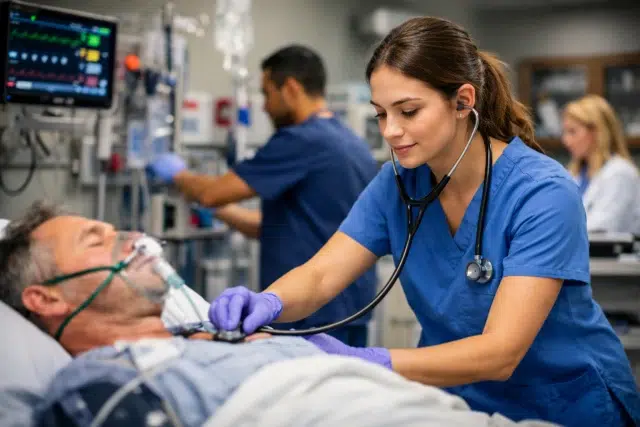
If you have ever walked past an emergency room and thought, “How does anyone keep up with that pace?” you are not alone. The truth is, an ER only runs smoothly because a whole team is moving in sync, and one of the most practical, hands-on roles in that team is the nurse tech emergency department position.
Whether your hospital calls it an ED Tech, ER Tech, Patient Care Tech (PCT), or Nurse Technician, the core idea is the same: you support nurses and providers by handling essential patient-care tasks, keeping the workflow moving, and helping the department stay safe and organized in a high-pressure environment. And with emergency departments seeing huge patient volume in the U.S. (for example, the CDC reports 155 million ED visits in 2022), the need for well-trained support staff is not a small thing.
Below is a full, real-world breakdown of what the job actually looks like, the skills that matter most, what a typical shift includes, and how to succeed without burning out.
What Is a Nurse Tech in the Emergency Department?
A nurse tech emergency department professional is a clinical support team member who works under the supervision of registered nurses (and within the rules of the facility and local regulations). Your job is not to diagnose or prescribe. Your job is to help patients receive timely care by completing practical tasks that free the RN and provider team to focus on advanced assessment, medication administration, and critical decision-making.
Think of the ED like a busy airport. Nurses and doctors are managing “flight control.” The nurse tech is the person making sure the right bags get loaded, the right passengers get to the right gate, and the runway stays clear. It is hands-on, fast, and incredibly team-based.
Why This Role Matters More Than People Realize
The emergency department is a place where minutes matter. When patient volume is heavy, even small delays can snowball. Nurse techs help reduce bottlenecks by:
- Getting vitals quickly and accurately
- Assisting with patient movement and room turnover
- Supporting procedures (within scope)
- Keeping supplies ready and equipment functioning
- Observing and reporting changes that nurses may not see immediately
That last point is bigger than it sounds. You are often the one in the room more frequently than anyone else, especially when nurses are juggling multiple patients.
Nurse Tech Emergency Department vs CNA vs EMT: Quick Comparison
Titles vary by hospital, but here is a practical way to understand common differences:
| Role | Typical Focus | Common Strengths | Where They Work |
|---|---|---|---|
| Nurse Tech / ED Tech | Support ED nursing workflow, patient care tasks, basic clinical procedures (facility dependent) | Speed, multitasking, patient handling, basic clinical skills | Emergency department |
| CNA / Nursing Assistant | Daily patient care, hygiene, comfort care, vitals | Long-term care routines, bedside care consistency | Hospitals, nursing homes, rehab |
| EMT | Pre-hospital emergency response, stabilization and transport | Scene safety, rapid assessment, transport protocols | Ambulance, EMS, some EDs |
Some ED techs have an EMT background. Some come from CNA programs. Some are nursing students. The key is always scope and training expectations inside that specific emergency department.
Core Roles and Responsibilities in an Emergency Department Shift
A nurse tech’s day is rarely “routine,” but most tasks fall into a few main categories.
1) Patient Intake Support and Early Data Collection
In many emergency departments, nurse techs help gather the first set of measurable information that helps the clinical team move faster. This can include:
- Taking and documenting vital signs
- Measuring height and weight when needed
- Obtaining blood glucose checks (if trained/authorized)
- Helping patients change into gowns and securing belongings
- Assisting with EKG placement (if trained/authorized)
Even when you are not the person doing triage, you often support the triage flow by prepping equipment, escorting patients, and keeping the process moving.
2) Ongoing Patient Care and Safety Checks
This is where the job becomes very “real.” You are supporting comfort, safety, and basic monitoring, often for many different patient types in the same shift:
- Elderly fall patients who need safe transfers
- Dehydrated patients who need frequent re-checks
- Behavioral health patients who need observation and calm communication
- Kids with fever who need reassurance and gentle care
- Trauma patients who require rapid team coordination
Common responsibilities include:
- Assisting with toileting, hygiene, and repositioning
- Applying oxygen equipment under direction
- Transporting patients to imaging or inpatient units
- Setting up and cleaning rooms between patients
- Maintaining fall precautions and safety measures
3) Procedure Assistance (Within Scope)
Depending on facility policy and your credentialing, ED techs may assist with procedures by preparing supplies and supporting the RN/provider team. Examples include:
- Setting up suture trays or wound care supplies
- Helping position a patient for a procedure
- Holding limbs steady during splinting or dressing changes
- Assisting with specimen handling (labeling/transport per policy)
The important part is that you are not “freelancing.” You are operating within scope, under supervision, and according to department policy.
4) Documentation and Communication
A strong nurse tech is not just fast with their hands, they are reliable with information.
You will likely document things like:
- Vitals and re-check times
- Patient transport times
- Intake/output (when assigned)
- Blood glucose readings (if applicable)
- EKG completion time (if applicable)
Communication includes:
- Reporting abnormal vitals immediately
- Updating the RN when a patient’s condition changes
- Giving clear hand-offs to other techs during breaks or shift change
A simple habit that saves lives is this: say it out loud, then chart it. If it matters, do not assume the chart will “speak” for you.
5) Stocking, Equipment Readiness, and Room Turnover
Some shifts are heavy on patient care. Others feel like a never-ending loop of restocking and cleanup because the department is bursting.
You may be responsible for:
- Restocking rooms with linens, PPE, basic supplies
- Checking oxygen tanks and monitoring equipment
- Cleaning stretchers, side rails, and high-touch areas per protocol
- Ensuring suction and monitors are ready for the next patient
When the ED gets slammed, good room turnover can be the difference between patients waiting in hallways versus getting placed quickly.
A Realistic “Day-in-the-Life” Scenario
Let’s paint a realistic shift snapshot.
You clock in and within 10 minutes, triage has a backlog. You grab a vitals machine, take two sets of vitals, and notice one patient looks sweaty and unusually pale. You do not panic. You do what strong ED techs do: you communicate clearly and fast.
You report: “Room 12, chest discomfort, BP 90 over 60, HR 118, looks diaphoretic.” The nurse moves immediately, and the workflow changes. That is not “just vitals.” That is early recognition plus clear communication.
Later, you transport a patient to CT, help clean a trauma room, set up supplies for wound irrigation, and assist an anxious parent while the nurse handles meds.
That mix is the job. The best nurse techs get comfortable with controlled chaos.
Skills That Make a Nurse Tech Truly Excellent
Some skills come from training. Others are learned on the floor.
Clinical and Technical Skills
- Accurate vital signs, including manual blood pressure when automatic cuffs fail
- Proper infection prevention habits (hand hygiene, PPE, isolation awareness)
- Safe patient transfers, including using gait belts and slide boards when available
- Basic rhythm awareness for alarms (you do not interpret like a nurse, but you recognize when something is clearly wrong)
- Basic life support readiness
Most emergency departments expect CPR competence. The American Heart Association describes BLS training as teaching CPR and other basic cardiovascular life support skills for healthcare environments.
Human Skills (These Matter Just as Much)
- Calm voice under pressure
- Clear, short communication when things get intense
- Emotional control when families are stressed
- Situational awareness (who looks worse than their chart suggests)
- Respectful teamwork, even when people are tired
A nurse tech who is trustworthy becomes the person nurses want beside them during the hard moments.
Common Challenges in the ED and How to Handle Them
Challenge 1: Constant Interruptions
Your workflow will get interrupted all day. The trick is learning to reset quickly.
Practical tips:
- Keep a “mental checklist” for each patient task
- If interrupted, restart your checklist from the top
- Chart immediately when possible so you do not rely on memory
Challenge 2: Difficult Conversations
People in the ED are scared, in pain, or frustrated. Sometimes all three.
What helps:
- Use simple language
- Avoid arguing about wait times
- Acknowledge feelings without making promises
- Offer one practical next step (blanket, water if allowed, update request to nurse)
Challenge 3: Physical Strain
The job is physical. Protect your body early.
- Use proper lifting mechanics every time
- Ask for help with transfers, no hero behavior
- Wear supportive shoes
- Stretch before and after long shifts
Education, Training, and Requirements (What Employers Often Expect)
Requirements vary by country, state, and hospital policy, but many facilities look for some mix of:
- CNA training, EMT training, or nursing program enrollment
- BLS certification (commonly required)
- Basic competency validation for vitals and patient handling
- Familiarity with EHR charting basics (you will learn on-site if you are new)
For broader workforce context, the U.S. Bureau of Labor Statistics reports median pay and employment projections for nursing assistants and orderlies, a category that overlaps with many patient-care support pathways and gives a useful benchmark for entry-level clinical support roles.
Nurse Tech Emergency Department Responsibilities Checklist
Here is a quick practical list many nurse techs recognize as “the real shift menu”:
- Vitals and re-checks
- Blood glucose checks (if applicable)
- Patient transport to CT, X-ray, ultrasound
- EKG assistance (if applicable)
- Assisting with ADLs: toileting, hygiene, repositioning
- Fall risk precautions and observation support
- Room turnover and restocking
- Communication of abnormal findings to the RN
- Comfort measures within scope
- Supporting procedures through prep and positioning
Best Practices That Make Nurses Trust You Fast
If you are new and want to build credibility quickly, focus on these behaviors.
Be reliable with time
If you say you will re-check vitals in 15 minutes, do it in 15 minutes.
Report abnormal vitals immediately
Do not wait until you “finish a few things.” In the ED, abnormal vitals are a priority message, not a note for later.
Know your scope and follow policy
Being safe beats being impressive. Every time.
Be the person who prepares the room before being asked
When you anticipate needs, you reduce stress for everyone.
Keep your communication short and clear
Example: “Room 8 oxygen saturation dropped to 88% on room air, rechecked twice, patient looks more short of breath.”
Frequently Asked Questions
What does a nurse tech do in an emergency department?
A nurse tech supports the ED team by performing delegated patient-care tasks like vital signs, transport, basic monitoring, room turnover, and reporting changes to nurses, all within facility policy and scope.
Is an ED tech the same as a nurse?
No. A nurse tech works under nurse supervision and does not have the same licensure, scope, or clinical responsibility as an RN or LPN.
Is the job stressful?
It can be, mainly because of pace, unpredictability, and emotional situations. The stress becomes manageable when you build solid routines, communicate well, and use your team.
What skills should I learn first?
Start with accurate vitals, safe transfers, infection prevention, and strong communication. These four skills will carry you through almost any shift.
Conclusion
The nurse tech emergency department role is one of the most hands-on ways to contribute to urgent patient care without being the person making final clinical decisions. You are the support that keeps the system moving. You gather the early data, help patients stay safe, assist the clinical team, and make the ED more functional during high volume, high pressure moments. With emergency departments handling massive demand each year, this work is not “extra help” at all, it is part of how modern emergency care stays afloat.
If you are stepping into this job or considering it, treat your fundamentals like gold: accurate vitals, safe movement, clear communication, and calm professionalism. Those basics, done consistently, are what turn a busy shift into a controlled one. And when you understand the purpose behind the flow, even the chaos starts to make sense, especially during patient triage in peak hours.