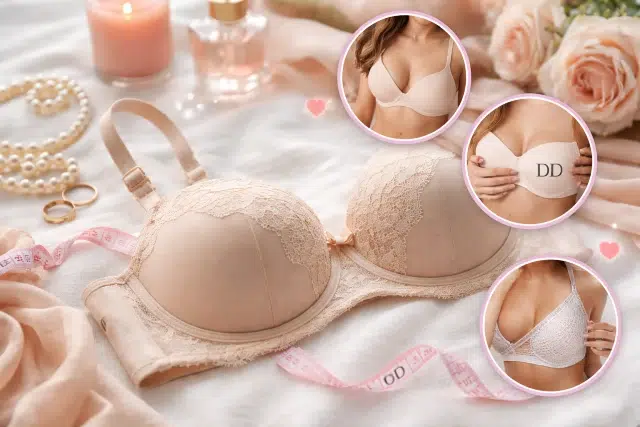
If you have ever tried to decode bra labels and felt like they were written in a secret language, you are not alone. And if your question is specifically about double d bra size, you are in good company, too. DD is one of the most searched cup sizes because it is common, confusing, and often misunderstood.
Here is the simple truth: a DD is not a “huge” size by default. It is just a cup volume that depends heavily on the band number. A 30DD and a 40DD are not even close in actual breast volume. Once you understand that one idea, the rest becomes much easier.
What does double d bra size actually mean?
A bra size is made of two parts:
- Band size (the number): this is the measurement around your ribcage where the bra band sits.
- Cup size (the letter): this is the difference between your bust measurement and your band measurement.
Many fitting guides explain cup size as a measurement difference system. For example, Marks and Spencer describes finding cup size by subtracting band size from overbust measurement, where each inch difference equals one cup step. (1 inch A, 2 inches B, and so on.)
So in many common sizing systems, Double D Bra Size means the bust is about 5 inches larger than the band measurement (often labeled DD in US sizing and sometimes equivalent to E in UK labeling, depending on the brand and system).
That is the “math” behind the label, but real bodies are not math problems, so fit also depends on breast shape, tissue firmness, and bra construction.
Double D is not one fixed size (why band size changes everything)
This is where people get tripped up. Cup letters are not absolute volumes across all bands. They scale up as the band size increases.
A quick way to picture it:
- 32DD is a smaller cup volume than 36DD
- 36DD is smaller than 40DD
Same letters, different actual capacity because the whole bra is built on a different band frame.
This is also why someone can “look like a C” and still measure as a DD. The band number is doing a lot of the work.
Double d bra size vs D vs DDD vs E (the common confusion)
If you are shopping online, you will see DD next to DDD, E, or even F depending on the brand and region.
Here is the practical breakdown:
- D is typically one cup step smaller than DD.
- DD is one cup step above D.
- DDD (sometimes called F in US progression) is one cup step above DD.
- E is often used in UK or EU labeling differently, and many brand charts treat DD and E as equivalents, but not always.
Global sizing differences are real and can be messy. Wikipedia’s overview notes that bra labeling systems vary and can be confusing across countries and manufacturers.
So the best habit is to treat size charts as a starting point, not the final truth.
How to measure for a double d bra size at home (without overthinking it)
You do not need fancy tools. A soft measuring tape is enough, and if you do not have one, many fit experts suggest using a non-stretch ribbon or string and measuring it with a ruler.
Step 1: Measure your band
Wrap the tape around your ribcage where your bra band sits. Keep it level and snug, not painfully tight.
Step 2: Measure your bust
Measure around the fullest part of your bust, again keeping the tape level.
Step 3: Subtract bust minus band
That difference helps estimate your cup size.
Marks and Spencer describes the core idea clearly: subtract band size from overbust, and each inch difference corresponds to a cup step.
Important reality check: brands do not build bras identically, so measurement is a starting point. The fitting test is what confirms the size.
Double d bra size fit checklist (how it should feel on your body)
A “correct” bra fit is not about suffering through the day. It should feel secure and supportive, with no constant adjusting.
Here is a practical fit checklist you can use the moment you put a bra on.
Band fit (the foundation)
- The band feels snug and level around your body
- It does not ride up your back
- You can fit about two fingers under it comfortably
If the band is riding up, it usually means the band is too large or the straps are doing the work the band should be doing.
Cup fit (no spilling, no gaping)
- Breast tissue is fully contained
- No “quad-boob” spilling at the top
- No big empty space or wrinkling in the cups
Center gore (the middle panel)
- For most wired bras, the center panel should sit relatively flat against your chest
- If it floats away dramatically, cups may be too small or the shape may not match you
Straps (supportive but not painful)
- Straps stay on without digging
- Shoulder grooves usually mean the band is too loose, forcing straps to carry too much load
A bra-fit guide from the National Breast Cancer Foundation highlights that poor fit can cause issues like spilling, riding up, and discomfort, emphasizing why correct sizing matters.
Common double d fit problems and easy fixes
Most “I hate bras” complaints are really “I hate this fit.”
Problem 1: Cups spill over the top
What it usually means:
- Cups too small
- Wrong cup shape for your breast shape (for example, too shallow)
What typically helps:
- Go up one cup size, or change style (balconette vs full coverage)
- Check that the band is snug enough first
Problem 2: Gaping cups
What it usually means:
- Cups too big, or
- Cup shape mismatch (common in molded cups)
What typically helps:
- Try a different bra style
- Try a sister size
Problem 3: Band rides up your back
What it usually means:
- Band too large
- Straps tightened too much to compensate
What typically helps:
- Go down a band size and adjust cup accordingly
Problem 4: Underwire pokes or feels sharp
What it usually means:
- Wrong wire width for your root shape
- Cup too small
- Worn-out bra
Try a different style, and if it is an older bra, it might simply be past its best days.
Sister sizes for double d bra size (so you can shop smarter)
Sister sizing is the trick that saves time when the cups are close but the band feels off.
The rule is simple:
- Go up a band size, go down a cup size (to keep similar cup volume)
- Go down a band size, go up a cup size
So if you are around 34DD, sister sizes often include:
- 32DDD (tighter band, larger cup letter)
- 36D (looser band, smaller cup letter)
This concept is widely taught in modern fitting advice because it reflects how cup volume scales with band size.
Real-life examples (what DD can look like in everyday terms)
Instead of vague “big” or “small,” here are grounded examples people relate to.
Example 1: “I was wearing 36C, but it never felt secure”
This happens a lot. A looser band can feel comfortable at first, but it rides up and forces straps to do the work. The person tightens straps, shoulders hurt, and the cups still do not contain everything. After measuring, they might land on something like 34DD or 34D, where the band anchors and the cups actually hold the tissue.
Example 2: “My cups gape, but I spill when I go smaller”
This is often a shape issue. Molded cups can gape if you are more bottom-full, while still cutting in at the top due to shape mismatch. A different style, like a balconette or a stretch-lace top cup, often solves it.
Example 3: “I wear DD in one brand and DDD in another”
Totally normal. Even Wikipedia notes variability and confusion across manufacturers and sizing systems.
That is why experienced bra shoppers keep a small range of sister sizes in mind, especially when buying new brands online.
Best bra styles for double d bra size (comfort and support first)
Different styles work better depending on breast shape and daily use.
T-shirt bras (smooth under clothes)
- Great for a seamless look
- Not always ideal for shape mismatches because molded cups can be less forgiving
Balconette bras
- Often great for lift and rounded shape
- Works well for many DD wearers who want structure
Full coverage bras
- Good for containment and support
- Helpful if you dislike any spillage at the top
Plunge bras
- Useful with lower necklines
- Can work well if your breasts are closer set
Wireless bras
- Comfort focused
- Look for wider bands and supportive internal structure for DD, so the support does not rely only on straps
Sports bras (high support)
For DD, support matters more during movement. Look for:
- Firm band
- Encapsulation (separate support for each breast) if you want less bounce
- Wide straps that do not dig
Fabric and construction details that matter more than the label
When you are shopping, do not stop at the size tag. Construction is the real difference between “fine” and “wow.”
Key details to check:
- Wider underband elastic for better anchoring
- Side support panels for a centered shape
- Strong hook-and-eye closure (more rows often helps)
- Quality straps that do not stretch out too quickly
This is why two bras in the same size can feel completely different.
Care tips to make DD bras last longer (and keep their fit)
A bra that has stretched out will feel like the wrong size even if it was perfect at first.
Easy habits that help:
- Rotate bras instead of wearing the same one daily
- Use gentle washing methods and avoid high heat
- Replace when the band is permanently stretched or cups lose structure
It is not about being precious. It is about keeping the support you paid for.
FAQs people ask about double d bra size
Is a double d bra size considered large?
It depends on the band size and body frame. DD is a cup step, not a fixed volume across all bands. That is why a smaller band DD can look moderate, while a larger band DD is a different volume.
Why do I measure DD but look smaller than friends who wear D?
Because the band number and breast shape matter. A smaller band with a larger cup letter can still look proportionate.
Is DD the same as E?
Sometimes. Many systems treat DD and E as equivalent depending on region and brand, but labeling is not universal.
Can weight changes affect DD sizing?
Yes. Even small changes can affect band fit and cup volume, which is why periodic re-measuring helps.
Conclusion
Now you know what a double d bra size really means: it is a cup volume based on the difference between your bust and band measurements, and it is not a one-size-fits-all label. Once you focus on band fit, cup containment, and comfort, DD becomes just another size on the rack, not a mystery.
If your current bras pinch, gape, or ride up, it is rarely “your body.” It is usually a mismatch between measurements, shape, and bra design. Understanding cup sizes makes shopping feel less like guesswork and more like a quick, confident checklist.