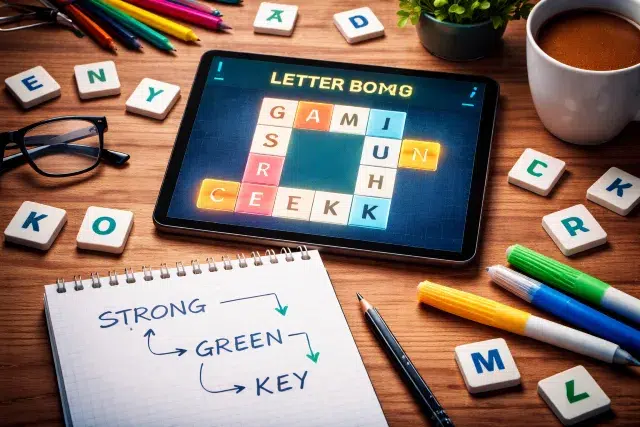
If you search Letter Boxed Answers every day, you are not alone. The puzzle looks simple at first glance, but once you start chaining words, you realize it is a game of planning, not just vocabulary. You are working with 12 letters around a square, you must avoid taking consecutive letters from the same side, and every new word has to begin with the last letter of the previous word.
This article is not a list of daily solutions. Instead, it gives you the best repeatable strategy so you can solve the daily challenge yourself faster, in fewer words, and with way less frustration.
What Letter Boxed actually wants you to do
Before strategy, lock in the rules. The core rules are consistent across guides and summaries:
- You get 12 letters, placed on the four sides of a box (3 letters per side).
- Words must be at least 3 letters.
- You cannot use consecutive letters from the same side of the box.
- The last letter of your current word becomes the first letter of the next word.
- The goal is to use all 12 letters at least once, ideally in as few words as possible.
Once you accept that it is a chaining puzzle, you stop hunting random words and start building a path.
The mindset shift that unlocks better Letter Boxed Answers
Most people play it like this:
- Find a long word
- Try to bolt another word onto the last letter
- Repeat until something works
That approach can solve the puzzle, but it is slow.
A better mindset is:
- You are designing a route that “touches” every letter.
- Words are the vehicle, not the destination.
- Your real target is to cover awkward letters early (the ones that are hard to place later).
This is why many strategy guides emphasize planning your connections rather than just forming any words.
The best strategy: build from anchors, not from “cool words”
Here is the strategy that consistently produces strong Letter Boxed Answers without needing a solver.
Step 1: Identify “anchor letters”
Anchor letters are letters that are easy to start or end words with. In English, these are often:
- S, T, R, N, E, A, I, O
- Sometimes L, D, M, P
You do not need a perfect list. You just need to spot letters that feel flexible.
Why anchors matter: chaining depends on the last letter. If you end on a flexible letter, you keep your options open.
Step 2: Find the “problem letters”
Problem letters are the ones that tend to trap you:
- J, Q, X, Z (when they appear)
- V, K, Y (sometimes)
- Any letter sitting next to two letters you keep needing from the same side
Your job is to get those problem letters used early, inside a word that still ends on a useful last letter.
Step 3: Create a two-word “dream path” first
Even if you do not achieve it, aiming for a two-word solution improves your overall plan.
A two-word plan looks like:
- Word 1 uses 6 to 9 letters and ends on a flexible letter
- Word 2 uses the remaining letters and loops back to cover anything missing
Some strategy resources even talk about the “two-word solve” as the highest-efficiency goal.
Step 4: Only then start writing the actual chain
Once you have a rough plan, build the real chain:
- Keep words natural and common
- Avoid obscure words that may be rejected (many guides mention acceptance can be picky)
- Watch the “same side twice” rule like a hawk
A simple planning method that works on mobile
If you play on your phone, you do not want to take notes forever. Use this quick method:
- Pick two letters that feel like a good bridge (example: T to S, or N to E).
- Make a word ending with one of those letters.
- Immediately try 2 to 3 follow-up words that start with that ending letter.
- Choose the follow-up that uses the most unused letters.
This is basically “branch testing.” It is faster than staring at the box hoping inspiration shows up.
The “coverage first” rule (the one most people skip)
Here is the truth: the puzzle is rarely lost because you cannot find words.
It is lost because you leave one annoying letter for the end, and then the last letter of your chain will not connect to anything that can include it without breaking the side rule.
So play with this priority:
- Cover rare or awkward letters early
- Keep a flexible ending letter
- Then clean up the leftovers
This approach is repeatedly recommended in Letter Boxed strategy write-ups that focus on solving quickly.
The best word types for reliable Letter Boxed Answers
When you want consistent wins, certain word types are your best friends.
Strong “utility” words
These are common, easy, and flexible:
- words ending in S
- words ending in E
- words ending in N
- words ending in T
Those endings start many other words, giving you more chaining freedom.
“Connector” endings that keep you safe
- -ER, -ED, -ING style endings can work, but only if the letters exist and the side rule allows it.
- Short connectors like -EN, -ES, -ON, -IN, -AT can help you pivot.
Plurals are not cheating, they are tools
If the puzzle accepts your word list, adding an S can:
- help you use S
- change your ending letter to S, which is incredibly chain-friendly
Just do not build your entire solve on weird pluralizations.
Common traps and how to avoid them
Trap 1: Building a beautiful long word that ends badly
A long word feels like progress, but if it ends on a letter that starts few common words, you can choke the chain.
Fix: if your long word ends badly, try to find a different long word that ends on:
- S, E, N, T, R, L
Trap 2: Forgetting the side rule while brainstorming
You think of a word, get excited, and then realize it uses two letters from the same side back to back, which is not allowed.
Fix: say the sides in your head as you spell:
Top, Right, Bottom, Left.
If you repeat a side, the word is invalid.
Trap 3: Saving one letter for last
This is the classic heartbreak moment.
Fix: after every word, pause and ask:
- Which letters have I not used at all yet?
- Can my next word include at least one of them?
A practical checklist you can use every day
When you are stuck, run this checklist in order:
- Can I form a word that uses two unused letters at once?
- Can I change my current word to end on S or E instead?
- Can I swap in a synonym that uses different letters?
- Can I shorten a word to change its ending letter?
- Can I pivot using a small bridging word that follows the side rule?
Most days, one of these fixes breaks the deadlock.
Mini table: what to do based on your problem
| Your situation | What it usually means | Best move |
|---|---|---|
| You have 1 letter left unused | You did not plan coverage | Rebuild last two words to include it |
| You keep breaking the side rule | Your word shape conflicts with the box | Choose a different word pattern, not a different word |
| You are stuck on a bad ending letter | Chain is locked | Replace the previous word with one ending in S, E, N, or T |
| You have too many words (6+) | You are playing reactionary | Pause and redesign a 2 to 3 word path first |
Should you use a solver for Letter Boxed Answers?
If your goal is to improve, use a solver like training wheels:
- Try for 10 minutes first
- If you are truly stuck, peek
- Then reverse-engineer why that solution worked
Many strategy posts treat solvers as helpful in moderation, especially for learning patterns.
A good middle-ground is: do not copy the whole solution immediately. Copy the first word, then solve the rest yourself.
How to get better fast (without spending hours)
Here are habits that actually build skill:
Play “unlimited” practice versions for pattern recognition
Practicing multiple puzzles back to back helps you spot:
- common ending letters
- common chain pivots
- side-rule friendly letter paths
Many sites offer unlimited practice versions inspired by the game format.
Build your personal “connector list”
Keep 20 to 30 simple connector words in your head. Nothing fancy, just words that:
- follow the side rule easily
- end on a flexible letter
- show up in normal vocabulary
Track your mistakes, not just your wins
After you solve, ask:
- Where did I waste time?
- Which letter trapped me?
- What should I have used earlier?
That is how your solving speed improves week by week.
And remember, this is a daily word puzzle designed to reward smart routes, not lucky guesses.
Conclusion
The fastest path to better Letter Boxed Answers is not having a bigger vocabulary. It is learning to think like a planner. Spot the anchor letters, eliminate problem letters early, aim for a two-word route even if you miss it, and keep your chain endings flexible. Once you start playing for coverage instead of chasing random long words, the daily challenge stops feeling brutal and starts feeling fun.