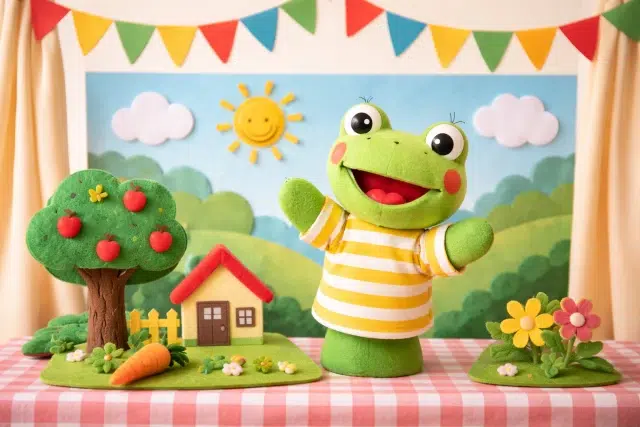
Hand Puppet Puppets have a special kind of magic. The moment a puppet “wakes up,” kids lean in, listen closer, and suddenly the room feels playful instead of noisy. If you have ever tried reading a story to a distracted child, you know how hard it can be to compete with big energy, short attention spans, and screens. But Hand Puppet Puppets work because they turn storytelling into a two-way experience. Kids are not just hearing a story, they are watching it, responding to it, and often helping shape it.
This article shares practical, real-world storytelling tricks using Hand Puppet Puppets that make children want to stay involved, laugh, and talk back. You will learn how to create characters fast, keep the pace moving, handle interruptions without losing the moment, and build mini stories that kids actually remember.
If you enjoy screen-free entertainment ideas, you can explore more fun family content in our Entertainment section.
Why Hand Puppet Puppets keep kids engaged better than “just talking”
A puppet feels like a character, not an adult giving instructions. That difference matters. Children often respond more openly to playful, imaginative interaction, especially when it feels like a conversation rather than a lesson.
There is also a wider evidence base showing that play supports children’s development, including language and social skills. The American Academy of Pediatrics highlights the importance of play in early development and learning.
Puppets fit naturally into that world because they:
- Invite pretend play and roleplay
- Encourage turn-taking and listening
- Create a safe “distance” where shy kids may speak more freely
- Make repetition feel fun instead of boring
Research and reviews on puppetry in early childhood education also describe benefits for engagement, communication, and language development when hand puppet puppets are used thoughtfully.
The biggest mistake people make with puppet storytelling
The most common mistake is trying to perform like a professional puppet show on day one.
Here is the truth: kids do not need perfect voices or fancy scripts. They want connection, surprise, and participation. If you try to memorize a long story or force a “perfect” performance, you will feel stiff, and kids will sense it.
Instead, use simple structures and repeatable tricks. You can reuse the same puppet characters for months. The goal is not to impress. The goal is to keep kids engaged.
Start strong: the first 30 seconds decide everything
If you want kids to stick with the story, your opening matters.
A simple “puppet entrance” that works almost every time
Use this 3-step entrance:
- Puppet hides behind your back or inside a bag.
- Puppet peeks out slowly, looking around like it is checking if it is safe.
- Puppet whispers to you, and you whisper back.
Then the puppet says something like:
- “Is this the kid club? I heard there are snacks.”
- “I’m looking for a brave helper.”
- “I forgot how to tell a story. Can you help me?”
This instantly turns the child into a participant. Now they are needed.
Quick tip: give the puppet a problem
Kids engage faster when they are trying to help.
Good starter problems:
- The puppet lost something silly (a sock, a spoon, a superhero cape)
- The puppet is scared of something harmless (bubbles, a teddy bear, a cucumber)
- The puppet has a mystery (who took the cookie, where did the rainbow go)
Choose a storytelling style that matches your child
Hand Puppet Puppets can tell stories in different ways. Pick a style that fits the child’s age and attention span.
For toddlers: tiny stories with big reactions
Toddlers love short scenes, repetition, and exaggerated emotion.
Aim for:
- 1 to 3 minutes per “scene”
- Repeated phrases (“Oh no!” “Again!” “Where is it?”)
- Simple choices (“red hat or blue hat?”)
For preschoolers: problem-solving stories
Preschoolers enjoy helping the character solve something.
Use:
- Simple puzzles (find a shape, match a color, count 3 items)
- Funny misunderstandings (puppet thinks socks go on hands)
- Emotion moments (puppet feels jealous, nervous, excited)
For ages 6 to 10: adventures and character growth
Older kids can handle longer stories and more plot.
Add:
- A mission (rescue, treasure hunt, secret code)
- A villain that is more silly than scary
- A twist (the “monster” is actually a friendly cat)
Build a puppet character kids recognize in under 60 seconds
You do not need a backstory novel. You need 4 simple character ingredients.
The 4-part character formula
- Name: short and easy to say (Milo, Coco, Zippy, Nunu)
- One strong trait: curious, dramatic, sleepy, bossy, brave, clumsy
- One “thing”: loves bananas, hates socks, collects shiny rocks, fears loud sneezes
- One catchphrase: a repeated line kids can shout with you
Example:
- “This is Captain Waffle. He is brave but always hungry. He loves waffles. His catchphrase is ‘Waffle power!’”
Now you have a character kids can predict and enjoy.
Keep kids involved: 9 storytelling tricks that actually work
These are the engagement tools you can rotate through any story.
1) The “ask the audience” trick
Puppet asks the child for advice:
- “Should I open the door?”
- “Do you think it’s safe?”
- “What should I do next?”
Kids love being the decision-maker.
2) The “repeat after me” magic phrase
Pick a phrase that unlocks the next part of the story.
Examples:
- “Brave and kind!”
- “Zoom, zoom, zap!”
- “Story time, let’s go!”
The child repeats it, and the puppet reacts like it worked. This makes the child feel powerful.
3) The “wrong answer” comedy moment
The puppet gives a silly wrong answer on purpose, and the child corrects it.
Puppet: “A triangle has… seven corners!”
Child: “No, it has three!”
Puppet: “Ohhhh. I was close-ish.”
This builds attention and confidence.
4) The “secret whisper” technique
Puppet whispers a secret to the child, and the child whispers back.
This lowers the noise level naturally and creates closeness.
5) The “countdown” for focus
Use a countdown to reset attention:
- “In 3… 2… 1… freeze like a statue!”
Then the puppet continues the story once kids are “frozen.”
6) The “prop surprise”
Add one small prop:
- A spoon becomes a microphone
- A sock becomes a hat
- A paper cup becomes binoculars
Props make stories feel real without requiring a full setup.
7) The “sound effect team”
Assign the child a sound:
- Wind: “whoooosh”
- Door: “creeeak”
- Dinosaur: “rawr”
Now they are part of the performance.
8) The “emotion mirror”
Puppet makes a face and the child copies it:
- surprised
- worried
- proud
- silly
This works well for emotional learning and keeps bodies engaged, not just ears.
9) The “cliffhanger stop”
End a scene right before the next part:
- “And then we heard a sound behind the door… but we will check after one big stretch!”
Cliffhangers keep attention, even through transitions.
A simple puppet story structure you can reuse forever
You do not need a new plot every time. Use a repeatable template.
The 5-step mini story
- Character wants something
“Puppet wants to bake a cupcake.” - A problem appears
“But the eggs are missing.” - Child helps search
“Where could they be?” - Funny obstacle
“The puppet finds a shoe and thinks it’s an egg.” - Happy ending and celebration
“Cupcakes for everyone, dance party!”
This structure works for almost any theme.
Table: quick engagement fixes for common problems
| Problem during story | What it usually means | Quick fix with Hand Puppet Puppets |
|---|---|---|
| Child keeps interrupting | They want control | Let puppet ask questions and give choices |
| Child looks bored | Story is too long | Switch to 1-minute scenes and add a prop |
| Child gets too hyper | Energy needs direction | Use countdown and “freeze statue” moments |
| Child feels shy | Pressure feels too direct | Puppet talks gently and asks yes/no questions |
| Child wants the puppet | They want to play too | Make them the “sound effects boss” or give a second puppet |
Puppet voice tips that sound fun without hurting your throat
You do not need 10 voices. You need 2 or 3 that you can do comfortably.
Easy voice styles
- Slow and sleepy: lower volume, slower pace
- Excited chipper: faster pace, brighter tone
- Serious superhero: calm, confident, slightly deeper
The real secret: change rhythm, not pitch
If changing pitch is hard, change:
- speed (fast vs slow)
- volume (whisper vs normal)
- personality (confident vs nervous)
Kids hear it as a different character.
How to handle “screen kids” who quit quickly
If a child is used to fast digital stimulation, long stories can feel “slow.” That does not mean puppets will not work. It just means you start differently.
Try:
- Short bursts (30 to 90 seconds)
- More interaction than narration
- Quick humor and movement
- A mission with steps (“First we find the key. Then we open the box.”)
Play-based learning resources often highlight that playful interaction is a powerful context for learning and attention building.
Story ideas that keep kids engaged (and are easy for adults)
Here are themes that work well because they naturally invite participation.
1) The lost-and-found adventure
The puppet loses a silly object and needs the child’s help to find it.
You can hide:
- a spoon
- a toy car
- a small ball
- a paper “map”
2) The brave helper mission
The puppet needs a helper to do a “brave” task:
- knock on an imaginary door
- rescue a teddy bear
- cross the “lava” (a pillow line)
3) The emotion day story
The puppet feels:
- nervous
- jealous
- frustrated
- proud
Kids help the puppet name the feeling and solve it. This is great for emotional language.
4) The silly classroom (great for groups)
The puppet tries to follow “class rules” but gets them wrong:
- “We listen with our elbows!”
- “We sit on the ceiling!”
Kids correct the puppet and feel smart.
Using Hand Puppet Puppets for learning without making it feel like school
A big win with puppets is sneaking learning into fun.
Easy learning moments:
- Counting objects the puppet finds
- Naming colors and shapes
- Practicing polite phrases (“please,” “thank you,” “excuse me”)
- Story sequencing (“first,” “next,” “last”)
Studies and reviews discussing puppets in early learning settings often point to increased participation and language opportunities, especially when puppets make speaking feel safer and more playful.
Puppets are a classic part of children’s creative play, and they still work today because imagination never goes out of style.
FAQs
How long should a puppet story be?
For toddlers, aim for 2 to 5 minutes total, broken into tiny scenes. For preschoolers, 5 to 10 minutes can work if the story stays interactive. For older kids, 10 to 15 minutes is realistic when there is a clear mission and humor.
What if my child keeps grabbing the puppet?
That is normal. Give them a role: sound effects, holding a prop, choosing the next step, or using a second puppet. When kids feel included, they grab less.
Do I need a puppet theater?
No. A couch, a table, or even your hand behind a book works. The character matters more than the stage.
What kind of puppets are easiest for beginners?
Soft hand puppets with big mouths are easy because they “talk” clearly. But even a simple sock puppet can work if the character is fun.
Conclusion: Hand Puppet Puppets turn storytelling into a shared game
When kids lose interest in stories, it is rarely because they hate stories. It is usually because the story feels one-way. Hand Puppet Puppets fix that by making storytelling feel like play. The puppet can ask questions, make mistakes, react dramatically, and invite kids into the action. With a few simple tricks, you can turn reading time, after-school time, or party time into something children look forward to.
And here is the best part: once you build one or two puppet characters, you can reuse them for months. Your child will start asking, “Where is the puppet?” instead of “Can I have the phone?”