Buying a magic booster box online can be exciting, but it can also be stressful. You’re paying for something you can’t physically inspect first, and sealed product is exactly what scammers love to target. One listing looks perfect, another is suspiciously cheap, and suddenly you’re zooming in on photos like a detective.
The good news is you don’t need to be an expert collector to protect yourself. You just need a simple buying routine, a few visual checks, and the confidence to walk away when something feels off. This guide will help you spot common warning signs, shop smarter, and verify a magic booster box when it arrives so you don’t end up with a fake, a reseal, or a misrepresented product.
What “fake” really means when buying a magic booster box
When people say “fake,” they often mean one of these situations:
- Counterfeit product
Packaging and contents are made to imitate the real thing. - Resealed product
A real box was opened, packs were searched or swapped, and then the box was resealed to look new. - Tampered packaging
The product may be real, but someone has cut, loosened, or rewrapped the box in a way that compromises it. - Misrepresented listing
The box is legitimate but not what you ordered (wrong set, wrong language, damaged, missing items, or not truly sealed).
If you care about value, collectability, or a clean opening experience, all four are problems.
Why scammers target booster boxes online
A magic booster box is a perfect scam target because:
- Buyers can’t inspect it before purchase
- “Sealed” is a powerful word that sells fast
- Demand spikes create urgency and impulsive purchases
- Many buyers don’t know what factory shrink wrap should look like
- A reseal can look convincing in photos if you don’t know what to check
Scammers aren’t always amateurs. Some run the same playbook again and again because it works.
Buy safely online: the best checks before you pay
Most bad purchases can be avoided before you click “buy.” Use this checklist every time.
1) Price-check like a realist, not a dreamer
A deal is great. A deal that makes no sense is a warning.
Use a simple rule:
- Slightly lower than average can be a legit sale.
- Way lower than average is where the risk starts.
If the price is dramatically cheaper than other sellers, assume there is a reason and make the seller prove otherwise.
2) Don’t rush because the listing says “only 2 left”
Scarcity tactics are common. Sellers know people panic-buy sealed product. If you feel pushed, slow down. Good listings still exist tomorrow. Bad listings disappear for a reason.
3) Check the seller’s track record, not just the rating
A high rating doesn’t automatically mean safe. Look deeper:
Good signs:
- Long selling history
- Consistent feedback over time
- Reviews that mention packaging and sealed condition
- Clear return policy and clear product description
Red flags:
- Brand-new seller account with premium boxes
- Seller refuses to show real photos
- Lots of unrelated inventory that looks random
- Reviews that seem generic or repeated
4) Ask for photos that scammers hate providing
Send a quick message like this:
“Can you share clear photos of all sides of the box, including corners and the shrink wrap seams, and confirm it’s factory sealed and untampered?”
A legit seller usually responds normally. A suspicious seller may dodge, delay, or act irritated.
5) Watch out for wording that quietly removes responsibility
Be cautious with phrases like:
- “As-is”
- “No returns”
- “Not sure if factory sealed”
- “I don’t know much about it”
- “From storage or liquidation”
Sometimes that language is honest. Other times it’s a shield.
Which products carry higher risk?
Not every box has the same scam risk. In general, the more hype and money involved, the more attention scammers pay.
Higher-risk situations:
- Hot new releases with heavy demand
- Premium collector-style boxes
- Older sets with strong resale value
- Anything sold “way under market”
Lower-risk situations:
- Widely available boxes from current print runs
- Purchases from established hobby sellers
- Listings with many clear, original photos and a return option
How to spot a fake or resealed magic booster box from listing photos
Photos won’t catch every scam, but they can catch a lot.
Shrink wrap clues that often reveal reseals
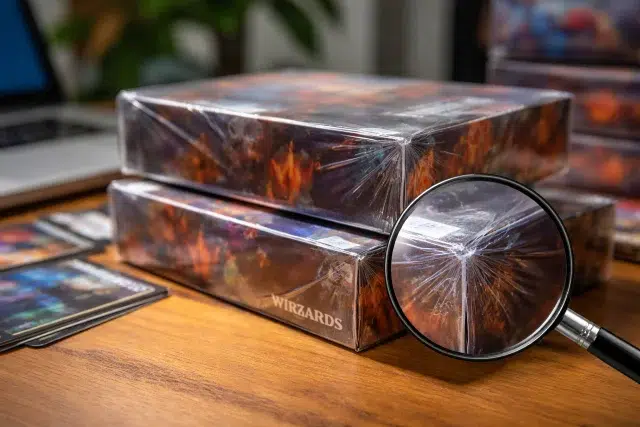
Factory shrink wrap typically looks consistent and professionally applied. Reseals often look “close” but not clean.
Red flags in photos:
- Excessive wrinkling around corners
- Loose shrink wrap that shifts easily
- Uneven tightness (tight on one side, loose on another)
- Strange seams that look too thick or oddly placed
- Plastic that looks overly glossy or cloudy in an unnatural way
- Corners that look “worked on” or pressed down
Packaging print quality and alignment
Counterfeit packaging often slips on details. Look for:
- Blurry printing
- Slightly off colors
- Misaligned text
- Uneven edges, folds, or cuts
- Icons or symbols that look different from common retail images
You don’t need to be perfect here. You’re looking for multiple small inconsistencies, not just one.
Stock photos only? Treat it as a caution sign
Stock images aren’t automatically a scam, but they remove your ability to inspect condition. If a seller uses only stock images and refuses real photos, that’s a strong reason to pass.
When your magic booster box arrives: inspect it the safe way
Before you rip anything open, inspect and document. This protects you if you need a return and it helps you stay calm and objective.
Step 1: Record a quick unboxing video
This is one of the simplest protections you can give yourself.
Record:
- The shipping label
- The unopened shipping box
- The moment you remove the product
- All sides of the sealed box, close-up
If there’s a dispute later, your evidence is clear.
Step 2: Inspect shrink wrap in bright light
Rotate the box and look for:
- Straight “knife-like” cuts
- Overlapping plastic that looks reheated
- Glue residue or sticky spots
- Seam lines that look unusually thick
- Small tears that look “fixed” or pressed
Step 3: Check corners and edges closely
Corners are where reseals often reveal themselves. Look for:
- Crushed or softened corners under tight wrap
- Tiny separations where wrap has been lifted
- Scuff marks that don’t match “new sealed” condition
Step 4: Consider weight as an extra clue
A scale won’t prove authenticity on its own, but a big difference from what you’d expect can hint at missing packs or unusual contents. Use weight as a supporting signal, not a final verdict.
If you open packs: signs the packs were tampered with
Sometimes the box looks okay, but the packs tell a different story.
Watch for:
- Packs that look re-glued
- Uneven top seals or crimping
- Packs that open too easily or feel “reheated”
- A strange chemical smell near seals
- Multiple packs with oddly similar damage patterns
If you suspect tampering mid-opening, stop and document before you continue.
Simple authenticity checks for suspicious cards
If you pull a high-value card and something feels off, check it before celebrating too hard.
Buyer-friendly checks (non-destructive):
- Magnification: look at the print dots and sharpness of fine details. Fakes often look muddy or inconsistent.
- Compare to a known real card: same era, similar printing. Differences are easier to spot side-by-side.
- Light-through comparison: shine a bright light through the card and compare it to a known authentic card from a similar time period.
Avoid “bend tests.” They can damage real cards and reduce value.
Common scams and what to do immediately
Here’s a practical response guide:
- If the shrink wrap looks cut, reheated, or glued: stop, document, request return.
- If the set or language is wrong: document and request return.
- If the box is damaged but listing didn’t mention it: document and request return.
- If packs look resealed: stop opening immediately and document everything.
The most important move is speed. If something is wrong, handle it right away while your evidence is fresh.
How to reduce risk with smarter buying habits
These habits dramatically lower the chances of getting burned:
- Don’t chase extreme discounts
- Avoid sellers who won’t show real photos
- Prefer sellers with repeated sealed-product feedback
- Read the listing carefully for “escape hatch” language
- Document the arrival and inspection
- Keep packaging until you’re satisfied
Also, trust your instincts. If something feels weird, you don’t need a courtroom level of proof to decide not to buy.
Real-world scenario: the deal that pushes you off-platform
This is a common one.
You find a cheap magic booster box. The seller says they can give you an even better price if you pay directly. They claim it avoids fees and helps them ship faster.
What usually happens next:
- You pay outside the platform
- The item never arrives, or arrives resealed
- You have fewer options to recover your money
- The seller disappears or blocks you
A safe purchase is often boring. Boring is good.
Conclusion: buy your magic booster box with confidence, not luck
A magic booster box should feel like fun, not like a financial risk. The best protection is a simple system: verify the seller, demand real photos, avoid prices that don’t make sense, inspect carefully when it arrives, and document the unboxing. Once you’ve done this a few times, it becomes second nature.
If you’re new to the hobby or buying a gift, remember this: you don’t have to win every deal. You only have to avoid the bad ones. And avoiding the bad ones is mostly about patience and process, not expert-level knowledge.
For anyone exploring the bigger world of trading cards, these habits make online buying safer and a lot more enjoyable.