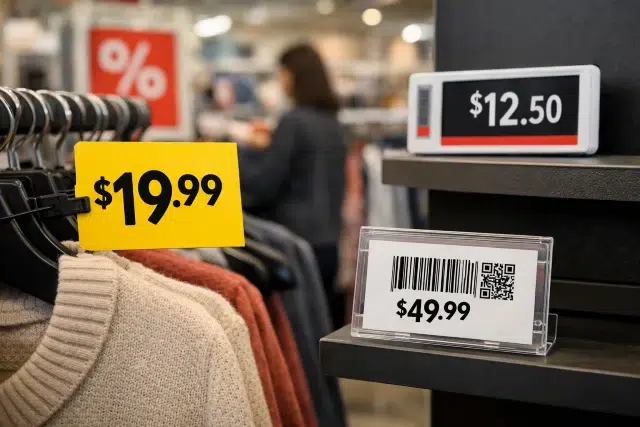
If you run a retail shop, you already know Price tags are not “just labels.” They are tiny salespeople that work all day. They answer the first question every shopper has, “How much is this?” and they quietly influence trust, speed, and buying decisions. Done right, price tags reduce friction and make your store feel organized. Done poorly, they create confusion, complaints, and in some places, compliance headaches when shelf prices and checkout prices do not match.
This article walks you through practical, real-world tips for design, placement, and compliance so your pricing looks clean, reads fast, and stays accurate.
Why Price tags Matter More Than Most Retailers Think
In-store pricing is one of the quickest ways customers judge whether a store is honest and professional. When pricing is easy to find and consistent at checkout, shoppers relax. When it is missing, unclear, or inconsistent, shoppers get suspicious and spend less time browsing.
There is also a legal and regulatory side. In the United States, retail pricing rules vary by state, and there are well-known standards for price verification programs and unit pricing guidance. NIST provides an overview of retail pricing laws and regulations and even maintains a state-by-state reference.
What Counts as “Price tags” in Retail?
When people say “price tags,” they usually mean the little sticker on a product. But in retail operations, the term covers multiple formats:
- Shelf-edge labels (on the shelf rail under the product)
- Hang tags (attached to the item, common in apparel)
- Stickers (on packaging or the product itself)
- Signage (endcap signs, aisle signs, promo posters)
- Digital labels (electronic shelf labels, ESL)
- Barcode labels (for scanning and inventory, sometimes separate from consumer-facing pricing)
A store can use one or a mix. What matters is that customers can clearly identify the price, and your systems keep the displayed price aligned with the price that rings up.
Design: How to Make Price tags Easy to Read and Hard to Misunderstand
Your goal is simple: a customer should be able to spot the price in under two seconds, even in a busy aisle.
The “Two-Second Rule” Layout
A clean tag usually follows this hierarchy:
- Price (largest element)
- Product name or short descriptor
- Unit price (when required or helpful)
- SKU or barcode (for staff and systems)
- Promo details (only if it is truly needed)
If everything is the same size, nothing stands out. If the price is buried, customers hesitate and walk away.
Typography That Works on a Real Shelf
For readability, focus on:
- Simple fonts (avoid overly decorative styles)
- Strong contrast (dark text on light background is easiest)
- Large price numerals compared to product text
- Consistent formatting across aisles
A surprisingly common mistake is squeezing too much info onto a small tag. If your tag looks “busy” from arm’s length, simplify it.
Color: Use It for Meaning, Not Decoration
Color helps shoppers understand pricing at a glance, but only if it is consistent. A smart approach is to assign meaning, such as:
- One color for regular pricing
- One color for promotions
- One color for clearance
Keep it consistent storewide, otherwise color becomes noise.
Price Formatting That Builds Trust
Small formatting choices can change how “clear” your store feels:
- Always show currency the same way
- Keep decimals consistent (especially in grocery and pharmacy)
- Avoid tiny fine print that changes the meaning of an offer
- Make “per unit” pricing visible when applicable
On unit pricing specifically, NIST references uniform laws and regulations that include requirements for unit pricing and rules related to misrepresentation of pricing.
Placement: Where Price tags Should Go So Customers Actually See Them
Even perfectly designed tags fail if customers can’t find them. Placement is about sightlines, consistency, and reducing “search time.”
Shelf-Edge Label Placement
Best practice is straightforward:
- Place the tag directly below the item
- Align tags so customers can scan along the shelf
- Avoid gaps between product and its label
- Keep the tag flush and unwrinkled
When labels slip or curl, shoppers misread. That leads to price disputes and checkout delays.
Hang Tags for Apparel and Accessories
For clothing, customers often hold the item while shopping. That means:
- Keep hang tags attached securely
- Put the price where it is easy to find without unfolding the tag
- Avoid placing pricing where it gets covered by branded inserts
If your hang tag has a barcode, make sure the barcode is not blocked by folds or glossy reflections that interfere with scanners.
Endcaps and Promotions: Match Signs to Shelf Prices
Promotional signage is powerful, but it is also where mistakes happen most. If a sign says “Sale,” customers assume the shelf label and checkout price will match.
To keep it clean:
- Ensure promo signs include enough detail (size, variant, dates, limits)
- Place the sign at the correct product group
- Remove expired signs immediately
Deceptive or misleading pricing claims can create real risk. The FTC publishes guidance and rules related to deceptive pricing in advertising and pricing representations.
Checkout and Service Counter Visibility
For certain product types, customers ask staff more questions at the counter. If you sell items that require staff help (electronics accessories, cosmetics behind glass, services), consider:
- A small, clear price list at the counter
- Pricing visible before a customer commits to the transaction
That reduces awkward disputes and improves customer experience.
Compliance: What Retailers Need to Get Right
Compliance depends on your country and region, but there are common themes everywhere: transparency, accuracy, and not misleading the customer.
Price Accuracy: Shelf Price Must Match Checkout Price
Even when a jurisdiction does not require each item to be individually tagged, regulators and consumer protection standards focus heavily on price accuracy and avoiding misrepresentation.
In the U.S., NIST discusses the Examination Procedure for Price Verification (EPPV), developed with the National Conference on Weights and Measures (NCWM) in response to public concern about price accuracy in retail stores.
Why this matters in daily retail life:
- If your shelf label says one price and the register rings up another, customers feel tricked even if it was an honest mistake.
- Repeated inaccuracies can lead to penalties in places with price verification laws.
NIST also maintains a state-by-state overview of retail pricing laws and regulations, showing how rules differ across jurisdictions.
Unit Pricing: When “Per oz” or “Per 100g” Is Required
Unit pricing rules vary, but the general intent is simple: help shoppers compare value fairly. NIST’s retail pricing laws and regulations reference requirements for unit pricing as part of uniform laws and regulations.
If you sell groceries, health and beauty, or household essentials, unit price labels can reduce confusion and complaints, especially when products come in different sizes.
Promotional Pricing and “Was/Now” Claims
If you advertise a discount, make sure it is truthful and defensible. FTC guidance on deceptive pricing addresses how reference prices and comparative price claims can become misleading when they are not based on real prevailing prices.
Practical compliance-minded habits:
- Keep records of promo start and end dates
- Ensure “regular price” was actually used for a reasonable time
- Avoid vague claims that can’t be verified
Electronic Shelf Labels and “Electronic Pricing” Rules
ESL systems can be excellent for accuracy, but they still fall under pricing disclosure rules. Some jurisdictions explicitly address electronic shelf labeling and electronic pricing requirements. For example, Connecticut’s consumer commodity pricing statute discusses universal product coding, electronic shelf labeling systems, and pricing display requirements.
Bottom line: digital does not remove responsibility. It just changes how you manage it.
Barcodes, GTINs, and Why They Matter for Price tags
Barcodes are not just for speed at checkout. They are part of price accuracy and inventory integrity.
GS1 explains that common linear barcodes like UPC encode product identification data such as a GTIN. GS1 also notes that GS1 standards help retailers and brands uniquely identify products and share accurate data across supply chains.
What this means in practice:
- When barcode data is correct, your POS can reliably match product to price.
- When barcode data is wrong, you get misrings, disputes, and messy audits.
Quick Barcode Checklist for Retailers
- One product variant = one correct barcode identity
- POS database matches shelf label price
- Promo pricing updates are reflected in scanning systems
- Staff knows how to handle “barcode won’t scan” situations without guessing
A Simple Store System to Prevent Pricing Errors
Pricing issues usually come from process gaps, not bad intentions. Here is a simple approach that works for many retailers.
1) One Source of Truth for Pricing
Decide what system is authoritative, typically your POS or pricing database. Shelf labels should come from it, not from manual typing.
2) Scheduled Price Label Audits
Many stores do short audits:
- High-volume aisles weekly
- Promo endcaps daily during campaigns
- Clearance sections every few days (they change fast)
NIST’s price verification materials highlight the importance of structured approaches to evaluating retail price accuracy, which is the same logic behind internal audits.
3) A Clear “Mismatch Policy” Staff Can Follow
When a customer says, “This rang up wrong,” your staff should not improvise. Have a short policy that covers:
- How to verify the shelf label
- How to correct the POS price if needed
- How to document the incident so it doesn’t repeat
Best Practice Templates for Common Retail Scenarios
Grocery and Convenience Stores
What matters most:
- Unit pricing consistency
- Frequent promo changes
- Clear shelf-edge alignment
Common pitfalls:
- Promo signs left up after expiration
- Similar items swapped in the wrong shelf spot
Fashion and Apparel
What matters most:
- Hang tag durability
- Fast re-tagging for markdowns
- Clear size and variant mapping
Common pitfalls:
- Wrong price tag attached after returns
- Multiple stickers layered, confusing the real price
Home Improvement and Hardware
What matters most:
- Large shelves and deep bays make placement harder
- Items often moved, labels stay behind
- Bulk packaging needs clear unit comparisons
Common pitfalls:
- Labels not updated after supplier price changes
- Products stocked in the wrong bay location
FAQ: Design, Placement, and Compliance
What should be the biggest element on a price tag?
The price itself. Customers are scanning shelves quickly. Make the price the easiest thing to spot.
Do I need a price on every single item?
This depends on local laws and the store category. Some places require item pricing, others allow shelf pricing, and rules can vary by state or jurisdiction. NIST provides a state-by-state overview of U.S. retail pricing laws and regulations.
What causes the most customer complaints about pricing?
In most stores, it’s price mismatches between shelf and checkout, unclear promo conditions, and missing unit pricing where shoppers expect it.
Are electronic shelf labels safer for compliance?
They can improve consistency because updates are centralized, but you still need the right processes and legal awareness. Some jurisdictions explicitly address electronic shelf labeling and related pricing display requirements.
Conclusion: Price tags Should Make Buying Feel Easy
When your Price tags are clean, consistent, and accurate, customers feel comfortable. They browse longer, compare faster, and trust your promotions. When tags are confusing or inconsistent, shoppers slow down, ask more questions, and sometimes walk away, even if your products are great.
Think of it like this: the tag is the handshake between your store and your customer. Design it so it reads instantly, place it where it is naturally seen, and run a simple system that keeps shelf prices aligned with checkout prices. That is how you protect trust and reduce daily friction. And if you ever wonder why shoppers react so strongly to a wrong price, it comes down to perceived fairness, the same basic logic that sits behind the idea of a price itself.