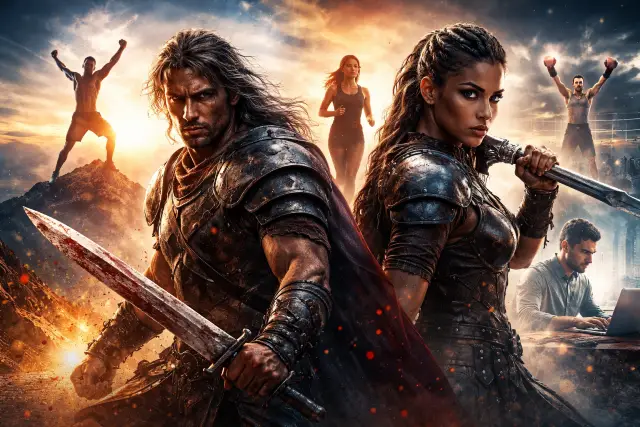
There’s a reason you can watch a movie, finish a season finale, or close a game after an intense storyline and feel like you could take on your real life challenges with fresh energy. The best entertainment does not just distract us. It reminds us what grit looks like, what courage costs, and how comeback stories are built one small choice at a time. In that sense, warrior and warrior is not only a phrase. It is a mirror. It reflects the two battles happening at once: the one on the outside and the one inside your mind.
Entertainment stories often give us a “safe arena” to feel fear, hope, loss, and victory in a short time. And when the writing is good, those emotions do not stay on the screen. They follow us into our daily habits, our workouts, our studies, our relationships, and even the way we speak to ourselves.
Streaming has become a major part of modern life, with streaming’s share of total TV usage reaching over 40% in the US in June 2024 according to Nielsen’s Gauge report. That matters because the more time we spend with stories, the more influence those stories can have on how we think about identity, resilience, and what “greatness” even means.
What “Warrior and Warrior” Means in Entertainment
In entertainment, a “warrior” is not only someone who fights with a sword or throws punches. A warrior can be a student who refuses to quit, a parent rebuilding after loss, an athlete rehabbing in silence, or a rookie who gets humbled and comes back smarter.
So why warrior and warrior?
Because the strongest stories usually show two warriors:
- The visible warrior: the character in action, facing rivals, danger, deadlines, betrayal, pressure.
- The invisible warrior: the same character battling fear, doubt, ego, shame, trauma, or the temptation to give up.
When entertainment hits you hard, it is typically because you recognize the invisible warrior. You have been there, just in a different costume.
Why Entertainment Can Genuinely Inspire Greatness
People sometimes dismiss entertainment as “just fun,” but research on positive and prosocial media effects suggests the opposite can happen: watching prosocial models in media can increase prosocial behavior and shift what people see as normal or admirable.
Another big concept is “narrative transportation,” the idea that when you get absorbed into a story, it can influence your beliefs and evaluations in story-consistent ways. Experimental work in psychology has found that higher transportation tends to produce stronger story-consistent beliefs and evaluations. Recent academic overviews also discuss how transportation relates to attitude and belief change, and even effects on the self.
That is the practical reason entertainment can push you toward greatness: it can temporarily “borrow” your attention so completely that your brain rehearses new perspectives. Not magic. Not a guarantee. But a real mechanism that helps explain why a single scene can change how you think about your own life.
The 7 Story Patterns That Create “Warrior” Energy
Entertainment repeats certain story patterns because they work. If you want to understand why a show or film motivates you, look for these.
1) The Comeback Arc
This is the classic: fall, rebuild, return.
A comeback arc inspires because it validates the ugly middle, that period where you are not winning yet. In real life, most goals are an ugly middle. Fitness. Learning. Business. Healing. The comeback arc tells you: “Being behind is not being finished.”
Actionable takeaway: when you feel stuck, ask, “What would the comeback version of me do today?” Then do one small thing that version would do.
2) The Code of Honor
Many “warrior” characters follow a personal code, even when it costs them. Sometimes the code is justice. Sometimes it is loyalty. Sometimes it is protecting the weak.
A code is powerful because it reduces decision fatigue. When life gets chaotic, a clear code becomes your GPS.
Try building a simple personal code like:
- I do not lie to myself.
- I finish what I start.
- I train even on low-motivation days.
- I treat people with respect, especially under stress.
3) The Rival Who Forces Growth
Rivals are not just enemies. They are pressure. A strong rival forces the hero to level up, get disciplined, and think differently.
In real life, your “rival” might be your past habits. Or a deadline. Or the version of you that keeps procrastinating.
Tip: identify a growth rival. Something that exposes your weakness. Then train directly against it.
4) The Mentor Who Gives Truth, Not Comfort
The best mentors in entertainment do not just hype the hero. They confront them.
Why it inspires: we all want guidance that is honest. Even if it stings.
Real-world move: pick one “mentor voice” you respect (a coach, a teacher, a leader, or even a well-known expert) and ask, “What would they call out in my excuses today?”
5) The Quiet Discipline Montage
Montages look cool, but the real message is discipline.
They compress weeks of repetition into seconds, but you still feel the grind. That grind is the difference between “wish” and “result.”
Build your own montage routine:
- 25 minutes focus work (study or skill)
- 30 to 45 minutes training
- 10 minutes reflection (notes or journaling)
- 7 hours sleep target
6) The Identity Shift
Greatness often starts when the character stops saying “I can’t” and starts saying “I’m the kind of person who…”
That identity shift matters because identity drives behavior. You protect who you believe you are.
Example shifts:
- “I’m trying to get fit” becomes “I’m a person who trains.”
- “I want to write” becomes “I’m a writer who ships.”
- “I should study” becomes “I’m a student who prepares early.”
7) The Sacrifice Scene
At some point, the warrior gives up something: comfort, ego, status, the easy path.
Sacrifice scenes hit because they reveal a truth: greatness costs something, but regret costs more.
A Quick Table: Warrior Archetypes You See Everywhere
| Warrior archetype | What they teach | Why it sticks |
|---|---|---|
| The Reluctant Hero | Courage is a decision, not a personality | You relate to doubt |
| The Underdog | Consistency beats talent when talent relaxes | You love proving odds wrong |
| The Strategist | Thinking is a weapon | You start planning better |
| The Protector | Strength is responsibility | You feel purpose, not ego |
| The Redeemed Fighter | Past mistakes are not a life sentence | You believe change is possible |
These archetypes show up in movies, series, anime, dramas, sports docs, and even comedy. Different genre, same emotional engine.
Real-Life Greatness Lessons You Can Borrow From Stories
Entertainment is only helpful if it changes what you do next. Here are practical lessons you can translate into real routines.
Build “Warrior” Consistency, Not Random Motivation
Motivation comes and goes. Consistency is what survives a bad mood.
A simple consistency formula:
- Make it small enough you can do it on hard days.
- Make it scheduled, not negotiable.
- Make it visible (track it).
If your goal is fitness, do not start with perfection. Start with attendance. A 20-minute walk done 5 days a week beats the “perfect plan” you do for 8 days and abandon.
This matters globally because inactivity is a real modern problem. The World Health Organization reports that 31% of adults were insufficiently active in 2022. Entertainment can’t fix that alone, but it can spark the emotional “why” that gets someone moving.
Train Your Mind Like a Character Arc
Characters grow because they face stress, learn, and adapt. You can do the same by using a simple weekly review:
- What was my biggest challenge this week?
- How did I respond?
- What skill would make that easier next time?
- What is one small practice for that skill?
Examples:
- If you panic under pressure: practice breathing + timed problem sets.
- If you procrastinate: practice starting with a 5-minute rule.
- If you get distracted: practice phone-free deep work blocks.
Use Entertainment as Fuel, Not Escape
The line between inspiration and escapism is thin. Here’s how to keep it healthy:
- Watch intentionally: pick stories that match the traits you want to build.
- Pause and extract one lesson.
- Apply within 24 hours.
If you watch a “warrior” story and then do nothing different, it stays entertainment only. If you watch it and then do one small brave thing, it becomes a tool.
Warrior and Warrior in Different Entertainment Genres
A lot of people think “warrior stories” are only action and combat. Not true.
Sports Documentaries and Biopics
These hit hard because the opponent is often time, injury, criticism, or self-doubt. You get to watch discipline in real form.
What you can copy:
- process focus
- training structure
- recovery and patience
- mental routines before performance
Sci-Fi and Fantasy
These genres externalize internal battles. Power becomes responsibility. Monsters become fear. Quests become growth.
What you can copy:
- vision (where you’re going)
- “party building” (your circle and support)
- strategic thinking (plan, adapt, repeat)
Drama and Character-Driven Stories
These are often the most realistic “warrior” tales. The fights are emotional: grief, betrayal, addiction, family pressure, identity conflict.
What you can copy:
- emotional intelligence
- boundaries
- communication skills
- rebuilding after setbacks
Comedy With Heart
Even comedy can carry warrior energy. Some of the strongest resilience lessons come from characters who keep showing up despite embarrassment, rejection, or failure.
What you can copy:
- humility
- the ability to reset after a bad day
- confidence without arrogance
Common Questions People Have
Can entertainment really change behavior?
It can, but not automatically. Research on prosocial modeling and entertainment education suggests media can shape perceptions of norms and sometimes influence attitudes and behaviors, though effects vary by person and context. The biggest difference comes when a viewer actively reflects and applies what they felt.
Why do “warrior” stories feel so personal?
Because they map onto universal human challenges: fear of failure, desire for respect, need for meaning, and the struggle to become better than yesterday. Narrative transportation research helps explain why stories can feel like lived experiences and shape evaluations.
How do I pick entertainment that inspires instead of drains me?
Look at how you feel after: clearer or foggier, energized or numb, hopeful or empty. Choose stories that leave you with a lesson you want to practice, not just a cliffhanger.
A Simple “Warrior Watch” Method You Can Use Tonight
If you want entertainment to inspire greatness, try this method:
- Pick one story intentionally (movie, episode, documentary).
- Notice the core trait the hero develops (discipline, courage, patience, honesty).
- Write one line: “My version of this trait looks like…”
- Take one action within 24 hours that proves it.
Examples:
- Trait: discipline. Action: 30 minutes of study before scrolling.
- Trait: courage. Action: send the email you’ve been delaying.
- Trait: patience. Action: stick to your plan even if results are slow.
This turns inspiration into identity.
Conclusion: Make Greatness a Habit, Not a Moment
The reason warrior and warrior works as an idea is simple: the outer fight is loud, but the inner fight decides everything. Entertainment stories that inspire greatness do more than hype you up. They show you the cost of growth, the loneliness of rebuilding, and the strength of showing up again.
If you want to use entertainment wisely, do not chase endless motivation. Chase small proof. Let a character’s courage remind you of your own, then practice it in a real situation, even a small one. Greatness is rarely a single dramatic scene. It is repetition, done with intention.
And when you need a final reminder, remember the oldest lesson hidden inside almost every hero story: the real arena is the self, a truth echoed across myth, drama, and even the idea of a hero itself.