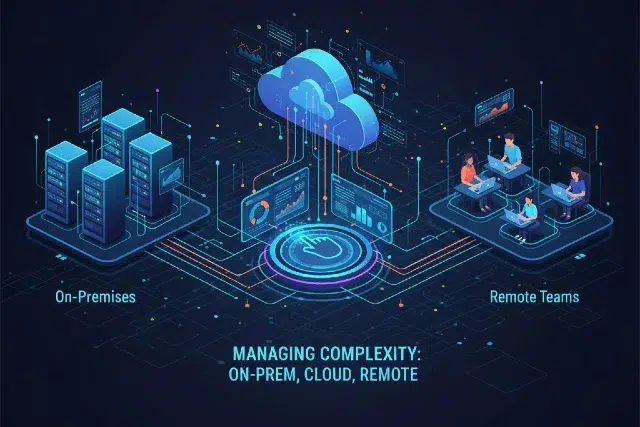
Modern enterprises no longer live in one environment. Systems stretch across on-premise data centers, cloud platforms, and the home offices of globally distributed teams. This hybrid reality promises flexibility and scale — but it also multiplies the complexity of managing communication, performance, and security. When technology is spread across multiple layers and locations, even small disruptions can ripple through an organization.
The New Normal of Hybrid Infrastructure
Many organizations have evolved organically into hybrid models. Legacy on-prem systems still handle critical workloads, while new projects often rely on cloud infrastructure. Add to that the growing number of employees working remotely, and you have a highly dynamic ecosystem that rarely sits still.
The challenge isn’t just about connecting these layers — it’s about maintaining consistent visibility and performance across them. Traditional monitoring tools built for single environments struggle to provide a complete picture. IT teams need a unified way to see how data moves, where delays occur, and how users experience communication tools in real time.
The Visibility Gap
When networks span multiple environments, blind spots appear. On-prem systems can be tightly monitored, but once data leaves for the cloud or travels to a remote user’s laptop, visibility often fades. This lack of insight can make troubleshooting painfully slow.
A common symptom is the “finger-pointing effect.” A remote employee reports poor call quality, but the issue could stem from their home Wi-Fi, a cloud service delay, or the internal network. Without end-to-end monitoring, IT teams can only guess. Resolving performance issues turns into detective work instead of a quick fix.
Bridging Environments with Unified Monitoring
To manage this complexity, organizations are adopting monitoring platforms that bring all environments under one pane of glass. Unified systems track performance metrics, application uptime, and user experience across on-prem, cloud, and remote connections simultaneously.
This unified approach doesn’t just simplify troubleshooting — it helps IT teams move from reactive to proactive management. Instead of responding to alerts after an outage, they can identify early warning signs like rising latency or jitter and address them before they impact users.
One valuable component in this ecosystem is voice monitoring software, which provides deep insight into communication quality. By analyzing call data across networks, it detects subtle issues like packet loss or poor routing that can degrade audio quality. For businesses that rely on voice collaboration tools — contact centers, financial services, healthcare providers — this visibility ensures that users and customers experience clear, reliable communication no matter where they’re located.
Performance Consistency Across Teams
Hybrid environments introduce a new kind of performance challenge: inconsistency. On-prem teams might enjoy stable internal networks, while remote employees depend on variable internet connections. Cloud applications, meanwhile, depend on external service providers who operate beyond the company’s direct control.
To maintain fairness and productivity, organizations need to monitor user experience equally across all locations. A modern monitoring system doesn’t just measure uptime — it evaluates how every environment affects the end user. Are remote workers experiencing higher latency during peak hours? Is the cloud-hosted collaboration tool performing slower than its on-prem counterpart? These questions require continuous data, not periodic reports.
Security and Compliance in a Distributed Environment
Managing multiple environments isn’t only a technical challenge — it’s a governance one. Security protocols, access controls, and compliance standards must remain consistent across systems that are often owned or managed by different providers.
Hybrid visibility tools can play a critical role here, tracking activity across networks and ensuring that sensitive data isn’t exposed or mishandled. Real-time alerts for suspicious activity or policy violations help IT leaders maintain compliance without micromanaging every platform.
Balancing Cost and Control
Another layer of complexity lies in budgeting. Cloud services offer flexibility but can become costly if not monitored carefully. On-prem infrastructure provides control but often requires higher maintenance and capital investment. The right monitoring framework can reveal how resources are being used and where efficiencies can be gained.
For example, tracking network traffic patterns might show that certain workloads perform better — and more cost-effectively — on specific platforms. By aligning cost data with performance insights, companies can make informed decisions about where to host workloads and how to allocate IT spend.
Building a Culture of Shared Accountability
Technology can bridge systems, but people must bridge processes. As teams become more distributed, communication and accountability need to evolve too. Monitoring tools shouldn’t just serve IT — they should empower business units, customer support, and management with actionable insights.
When teams can see the same performance data, silos begin to break down. Instead of blaming departments or vendors, everyone works toward shared goals: uptime, clarity, and seamless communication. This shift from “technical ownership” to “shared responsibility” is essential in today’s hybrid organizations.
The Road Ahead
Managing complexity across on-prem, cloud, and remote environments will only become more crucial as businesses scale. The future isn’t about choosing one environment over another — it’s about orchestrating them together.
With the right mix of monitoring, analytics, and cultural alignment, organizations can turn a tangled web of systems into a transparent, predictable, and high-performing ecosystem. By embracing smarter tools like voice monitoring software and unified visibility platforms, teams can transform complexity from a challenge into a competitive advantage.
Ultimately, it’s not just about managing technology — it’s about enabling connection. Because when communication flows effortlessly, every environment feels like one unified workspace.